Composing a band like composing music
If we composed bands like we compose music, would there be an aesthetic surplus?
Publish at September 19 2016 Updated October 30 2025


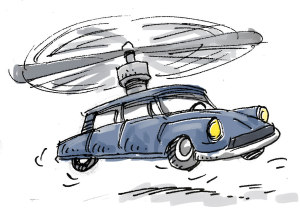
Airships capable of carrying heavy loads, a plane that circumnavigates the globe without refueling, a drone designed for the consumer market, or a segway that allows you to move vertically on two wheels? These products illustrate the C-K method, designed to encourage the emergence of breakthrough innovations.
In a speech filmed in 2013, Armand Hatchuel outlines three common mistakes about innovation, as well as the C-K method he developed with Benoît Weil.
Armand Hatchuel makes three criticisms of current representations of innovation. Firstly, they imagine innovation as a reasoned, planned process. On the contrary, at the origin of innovation, we're looking for a chimera, a composite object, which we don't know if it's achievable, a "desirable unknown", to use Armand Hatchuel's terms. In the course of this innovation process, the nature of the object changes. When we set out to make an airplane capable of flying non-stop around the world, the result no longer resembles an "airplane", as we originally imagined it. A car that consumes 2 liters per hundred kilometers will no longer be a car as we think of it today.
Secondly, they separate design from knowledge. Creative people or designers would come up with ideas, which would then be proposed to engineers for implementation, if they thought they were feasible. Innovations are rarely born this way. The segway could not have emerged from brainstorming. It could, however, have emerged from knowledge of gyroscopic techniques. More often than not, design and knowledge feed off each other.
Optimizing means negotiating, balancing and compromising. It means choosing between known solutions, based on a reduced number of criteria. If a company wants to increase a vehicle's range, it can increase the size of its fuel tanks, reduce its weight, improve its aerodynamics... and therefore push existing solutions a little further. Disruptive innovation, on the other hand, means looking for solutions that are far removed, in new fields of knowledge.

The C-K approach often starts with an ideal product, a chimera, a combination of characteristics that we don't really know if it can be achieved. To move forward, the company's own knowledge is not enough. In the course of their collective work, groups of experts are therefore fed with new skills and knowledge, leading them to explore new areas. In Innovation intelligence, Albert Meige and Jacques Schmitt show how the designers of Swatch watches had to explore the field of polymers to innovate, or how manufacturers of syringe needles became interested in certain mosquitoes.
The C-K model thus proposes a constant to-and-fro between concepts (C) and knowledge (knowledge), necessary for objects to come to life. Knowledge and concepts feed into each other in a process that enables both the creation of original concepts and the renewal of knowledge.
He encourages companies to cultivate their "crazy ideas", which lead to the exploration of new areas of knowledge that will prove highly useful for the company's traditional products.

Corsi and Michel explain that, at the outset, knowledge of aviation engineering and traditional materials was not enough, and as the C-K model envisages, the designers had to explore other areas of knowledge from composite materials, the automotive industry, assembly techniques and plastics.
The concept was refined in return, and seemed to get even crazier: a plastic airplane... "an airplane that is no longer an airplane. This back-and-forth between design and knowledge is only possible with the help of a wide range of players from a variety of disciplines. The authors mention design, manufacturing techniques, medicine, pilots, structures, meteorology...
Solar Impulse illustrates the need for a flexible definition of the object. For it is a plane that is no longer a plane. It retains an approximate shape, but weighs no more than a mid-range car, and has the power of a moped... One by one, preconceived ideas fall by the wayside. An airplane isn't necessarily heavy, it can capture energy instead of transporting it, it can generate energy while flying, and so on.
And, as we have just seen, the solutions sometimes come from very different fields. Patrick Corsi and Claude Michel cite the example of a boat manufacturer who came to contribute his expertise.
The C-K model presented very briefly already has many illustrations. It breaks with a linear, reasoned approach to innovation. It emphasizes the constant link between design and knowledge. Above all, it shows that we can't be satisfied with "business" knowledge alone, and that we need to reach out to other knowledge and expertise to move away from immediate solutions and those that merely optimize what already exists.
This model demonstrates the value of companies capable of bringing together the experts we talked about in a previous article.
Illustrations: Frédéric Duriez
Resources :
M. PEYRI Breaking mental patterns to innovate June 20, 2013 http://www.prospectivedesign-leblog.com/methode-dkcp-casser-les-schemas-mentaux-pour-innover/
Cayak-innov "our offers" consulted September 17, 2016
http://www.cayak-innov.com/nos-offres/dkcp/
Methodology of a consulting firm specializing in the C-K approach
Armand Hatchuel: la théorie C-K 2013 video of one hour and twenty-five minutes. The sound isn't very good for the first few minutes, but this is soon rectified.
https://vimeo.com/80540286
Segway - How it works accessed September 17, 2016 http://www.segway.ch/fr/infos/funktionsweise.php
Patrick CORSI and Claude MICHEL Way of the Solar Impulse
Project - Revisiting an Inspiring Design Thinking Process at the Light of a DKCP Process in the C-K Framework January 26 and 27, 2015
http://cgs-mines-paristech.fr/tmci/wp-content/uploads/2015/02/Way-of-the-Solar-Impulse-Project-Revisiting-an-Inspiring-Design-Thinking-Process-at-the-Light-of-a-DKCP-Process-in-the-C-K-Framework.pdf
You might also like:
Composing a band like composing music
If we composed bands like we compose music, would there be an aesthetic surplus?
Crawford invites us all to reflect on the meaning of our work. No doubt we won't all make decisions as radical as his. But in these times of crisis, it can be salutary to remember that repair jobs provide satisfaction and a decent income, whereas many so-called intellectual tasks are in fact nothing more than mechanical operations paid by the slingshot.
Asian influences on collective intelligence facilitation
This article endeavors to bring together and articulate the main sources that feed the Asian roots of collective intelligence facilitation, from the 3 great Chinese philosophies to their most contemporary disseminators.
Relations between think tanks and universities
Many think tanks call on university researchers to study and put forward ideas. These may even influence politicians' decisions. However, while some laboratories are objective, many are partisan and act more or less ethically depending on the case. A situation that raises many questions.
This article examines a variety of community songs and their effect on our ability to do and learn together, to strengthen our communities and to vibrate with the same impetus rather than become disunited.