Publish at December 19 2016Updated January 19 2022
What will Homo numericus pass on to his descendants?
No objects, no memories?
Our departed ancestors left us photo albums, boxes of trinkets, schoolbooks filled with recipes... Our memories of these deceased are inextricably linked to these objects, images and handwritten pages.
But digital has taken precedence over objects. Photos, music, and writings no longer have substance... So what are we going to leave to our descendants?
Objects have a soul
Francis Ponge, and closer to us François Bon, the author of Autobiography of Objects, have convinced us that objects have a soul. They carry in them a part of our memories, and crystallize emotional bonds. They evoke atmospheres, colors, tones, eras.
Some objects thus enriched the memory of our lives as they patinated. Orhan PAMUK, a Nobel Prize winner in literature, wrote the Museum of Innocence and designed an actual museum, where the objects mentioned in the book can be found. This museum collects the often insignificant objects that crystallize the memory of a love relationship, and that cause memories and emotions to resurface. The Madeleine Project is also a testament to the evocative power of objects.
...And especially the books
The records and books that come down to us from previous generations bear the marks of time. They are corroded, yellowed. The annotations in the margins are the memory of successive readings. These alterations create an additional history and draw us into the mini-community of those who handled and passed on the volume.
The objects? Not all of them. François Bon tells us about durable objects, those that accompany our lives or that we regularly find when we go to visit relatives. The durable objects have unfortunately disappeared. Disposable, consumable, or "programmed obsolescence" products carry with them neither memory nor emotion. "The time of objects has ended" François Bon tells us.
What emotion will our descendants feel when browsing the files of our e-readers? What will these files say about our reading, about our attention? Nothing. Read once or fifty times, the file remains the same.
Certainly, but do digital objects also have a soul?
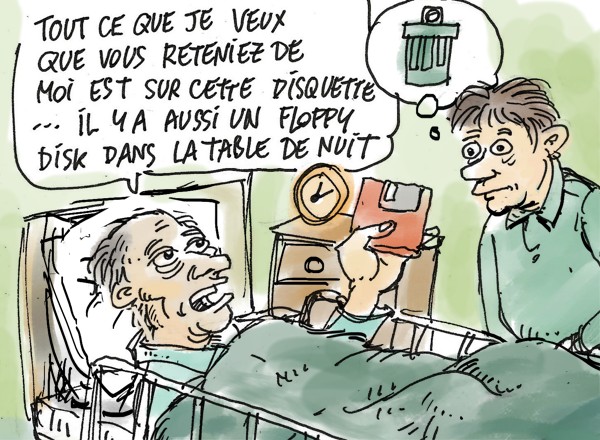
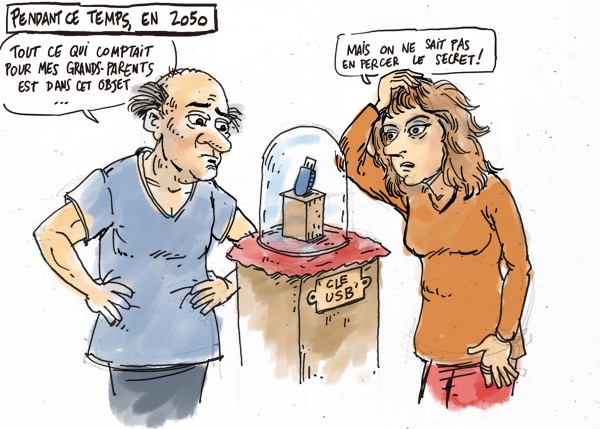
As much as ancient objects seemed to carry a history, electronic objects seem cheesy and worthy of the scrap heap when they take a few years. They clutter us up even more because they are no longer compatible with anything. We also have tapes, mini-DVDs, or SD cards and CD-ROMs. These media sometimes contain more photos than a lifetime of albums, but they seem to have no consistency. We can't imagine passing them on with any solemnity. At most, one would make a copy.
.
The obsolescence of technology also limits the possibilities of transmission. Homo numericus produces megabytes of data every day. But since no one will have the equipment to read the media, he may not have the equivalent of a shoebox of photos and letters to pass on to his descendants!
Even after death, there is no such thing as a digital void
Our ambition is no longer limited to existing through a tin of cookies and a few shoeboxes full of memories. In a digital world, we seek to survive online. Many companies and start-ups are convinced of this, and offer to manage our posthumous image...
Writers propose their service to collect testimonies from people who want to pass on their story. These are often family initiatives. The stories have a territorial anchor and a resonance with the chronology of the country. The collections are then distributed in several copies within the family. There is less risk of the scattering that threatens a photo album or a collection of trinkets!
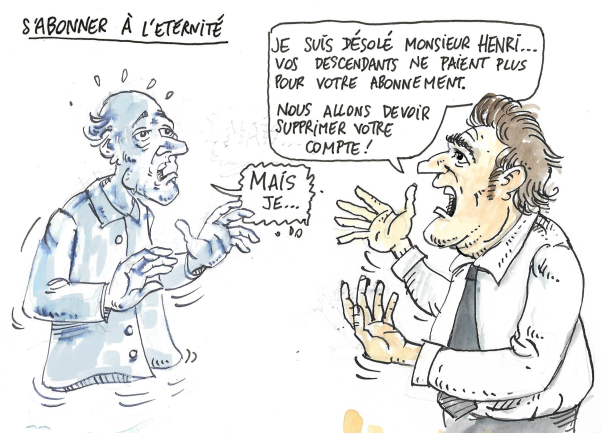
But the startup eterni.me promises you more. It offers you eternity on subscription. You entrust your memories, your ideas, your creations, your stories, your beliefs... and a lot of information about yourself to the company. It will be able to feed a chatbot. Your descendants will ask questions, and the robot will answer for you, but with the raw material you entrusted to it...
As of December 17, 2016, more than 34,000 people have taken a subscription. How long will their eternity last?
The blockchain has led to various creations, including one of the most popular in 2021: the NFT or non-fungible token. This certification allows for the sale of unique certified items. Consequently, many believe in the implementation of NFT degrees. But should we trust a polluting technology that shows many limitations in 2022?
Learners' failure is often blamed on the school. There may be other reasons for students' lack of guidance and empowerment. In this respect, the imposition of a set path by the parent is often a source of internal conflict and demotivation for the learner. Hence the need to build a framework conducive to student empowerment, through listening and dialogue.
The scars of an old building tell the story of its history and the legacy left by its successive inhabitants. It preserves the memory of owners and tenants and reflects the history of the country. Ruth Zylberman sensitively tells the story of a Paris building from 1840 to 2017, searching for the many traces left by the generations who have lived there.