We always learn alone, but never without others, as Philippe Carré puts it. Some training or self-training situations involve more group work and confrontation with other ideas. Meetups and hangouts help create learning situations based on the group, and on the pleasure of learning together, with and through others. I tested a LegoSeriousPlay© meetup.
I tested a meetup with the LegoseriousPlay© group.
What motivates people to meet up with strangers in the evenings after work, for training or to work on projects? Many of these encounters take place via a platform called"meetup". It allows you to form interest groups and organize face-to-face meetings at a specific location. Only invited group members are informed of the venue. This digital space is somewhere between a social network and a shared agenda. It enables organizers to validate registrations and create links between participants.
Our meeting took place on February 1st, at theUX Republic offices. The general objective of this meetup was to discover and experiment with a method called LegoSeriousPlay. We've already mentioned this technique in a previous article. Here, it's more a question of focusing on what constitutes the pleasure of learning together, in a very short meeting.

Action, object manipulation
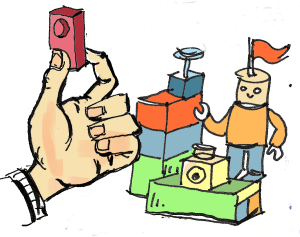
In tables of 5 to 8, participants are immediately encouraged to build with their Lego pieces. Elements of theory are introduced progressively, as the different groups produce, while graphic facilitation enables a gradual synthesis of these contributions.
These colorful little objects invite you to rummage around, manipulate and make inventories... A large part of the pleasure of learning comes from the object itself, from the relationship with childhood and the play it carries with it...

Another pleasure comes from experiencing a different way of thinking. Participants soon realize that they're not just translating ideas with the bricks, but that ideas come to them by manipulating the bricks. "If you don't have an idea, manipulate the pieces", the facilitators tell us. We also learn that 70% of our brain is connected to our hands...

The group
Many of the activities are carried out in groups. Progress is made together. We encourage and inspire each other. Communication is facilitated by the use of objects. We don't expose our ideas; we explain a construction by showing it. There's undoubtedly a pleasure in concentrating together on the same question. Everyone listens to the other members of their group, there's little cutting off, and the exchanges are positive and friendly.
And as you quickly get to know the other participants, you make new contacts, exchange business cards and aliases. Meeting others is part of the pleasure of learning.
The role of the moderator, trainer or facilitator - whichever you prefer to call it - must also be emphasized. Encouragement, content that arrives just when it's needed, and the pace andenthusiasm they instill are all essential to the pleasure of learning.
Dice challenges
The pleasure of learning is closely linked to the feeling of progress. Graduated challenges are a good way of achieving this. Challenges, first individual then collective, are time-limited and tend towards a fairly high level of abstraction. The fun also comes from competition without stakes, or rather from emulation. Everyone tries to come up with clever, creative solutions.
A sense of competence
The concepts and themes to be illustrated with Legos are complex and often abstract. The initial reaction is that perhaps the challenge is too ambitious... Then, as they manipulate and build, ideas emerge. Individually, but also within each group, everyone feels they are making progress and can dare.
That's why some people don't hesitate to train after a day's work. The pace is fast, there's little downtime, but many elements contribute to the "pleasure of learning".
See more articles by this author