Adaptation is a key to survival. In nature, species evolve to survive in their changing environment. Human organizations must also adapt to their social environment.
With the advent of the Internet, which has democratized many means of expression and made communications more direct, pyramid-shaped companies seem to be on the way out...
Democracy in the workplace
Indeed, there is growing talk of liberated or "liberating" companies, which are moving away from the idea of Taylorism and assembly-line work. With an almost sociocratic structure, they take the place of hierarchy to give way to collective intelligence. For Thierry Raynard, who is trying to transform working methods at the SNCF, among others, collective intelligence is essential to an organization that needs to explore the unknown. Indeed, training and communication are excellent tools for well-trodden paths, but when it comes to adapting to a new reality, it's essential to go beyond conventional means. The learning organization must therefore experiment in order to achieve transformation. This is a major challenge that can lead to extraordinary results, such as Semco, a liberated and democratic Brazilian company that has seen its growth improve dramatically over the last quarter-century.
But democratizing the workplace requires a great deal of effort. This is no easy task, since for decades, managers have been taught to look for the best strategy rather than to be agile. This is "easier" in a liberated, democratic company, but there are obstacles. This is especially true of managers, who need to review their place in the company, since they are no longer the sole decision-makers. Mechanisms must also be put in place to manage conflicts, which are more frequent in this context.
The appropriate implementation of collaborative tools in the workplace is also important. It must be said that there are many such as Slack, Trello, Jira and many others that can have a beneficial effect on work when used properly. In fact, a 2016 report showed that many companies were welcoming the use of these collaborative technologies. It also claimed that this collaboration at work had a positive impact on production, processes, decision-making and so on.
Once again, it's all a question of agility. Standardizing communication methods when some employees are more comfortable with others will only do harm. The liberated and collaborative method also needs to adapt to employees' needs. Especially as it requires employees to be more involved in the entrepreneurial approach, which is not everyone's cup of tea.
More democratic schools? They do exist!
Now, could the educational world also draw inspiration from this model? At first glance, it's hard to say. Schools, whether primary or higher education, require a more formal framework... Or maybe not...
At Inseec, a graduate school of commerce, management and communication, the administration, the school and the students are experimenting with ways to increase collaboration. Rigid furniture has given way to more mobile ones, easily adaptable to single or group work.
And then there's the democratic school movement, which is gaining ground in France, like the very recent Ecole de Paris. In this school, no classes or activities are imposed. Students are entirely in charge of their own timetable. They can take modules, do workshops and do whatever they really want. Learners discuss with each other and develop not only social skills, but often unwittingly teach each other approaches, knowledge, vocabulary and so on.
But these are alternative schools. What about the traditional one? Can it become more collaborative, encouraging students to help each other, whether in class or online through technological means? Can we give more space to the learner without going as far as fully democratic schools?
The constraints of today's school system make this challenge more difficult. But who knows? These liberated enterprises and democratic schools could have a long-term impact on the way we teach, and a collaborative, agile education could emerge from their influence. It remains to be seen...
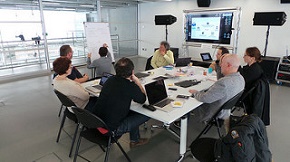
Illustration: The Paper Dome 2.0: Collaborate #1 via photopin (license)
References
Feugey, David. "La Collaboration En Entreprise, L'occasion D'un Nouveau "Business Model"?" Orange Business Services Worldwide. Last updated: September 22, 2016. http://www.orange-business.com/fr/blogs/usages-dentreprise/entreprise-20/la-collaboration-en-entreprise-l-occasion-d-un-nouveau-business-model-.
Guillaud, Hubert. "Vers Des Organisations Du Travail Humaines (1/3): Do You Believe In Collective Intelligence?" InternetActu.net. Last updated: March1, 2017. http://www.internetactu.net/2017/03/01/vers-des-organisations-du-travail-humaines-13-croyez-vous-dans-lintelligence-collective/.
Guillaud, Hubert. "Vers Des Organisations Du Travail Humaines (3/3): Peut-on Appliquer Le Modèle Au-delà De L'entreprise?" InternetActu.net. Last updated March 3, 2017. http://www.internetactu.net/2017/03/03/vers-des-organisations-du-travail-humaines-33-peut-on-appliquer-le-modele-au-dela-de-lentreprise/.
Guillaud, Hubert. "Travailler De Manière Collaborative, Oui! Mais Comment S'organiser?" InternetActu.net. Last updated May 31, 2016. http://www.internetactu.net/2016/05/31/travailler-de-maniere-collaborative-oui-mais-comment-sorganiser/.
Jourdan, Camille. "Ni Cours, Ni Programme: Bienvenue Dans Les écoles Démocratiques." Slate.fr. Last updated May1, 2016. http://www.slate.fr/story/116317/ecoles-democratiques-cours-programmes.
See more articles by this author