
Animals have over 400 million years of history and learning that can teach us about ourselves
Publish at April 30 2018 Updated April 10 2024


An Italian proverb says
Fortune has skill in its right hand and thrift in its left",
to which we could add
"and a mouth that speaks many languages".
Admittedly, it's less poetic to hear, but oh so rich and meaningful!
In today's globalized world, where the economy plays a predominant role, we can no longer exist on an individualistic basis. If we are to move forward and continue to grow in this world, we all have to make our own contribution.
But how can we combine language and business in the age of globalization? How can speaking several languages be an important economic driver in our 21st century society? Are you ready to discover these answers with us? Then let's get started!
The past often sheds light on the future, which is why it's a good idea to take a look at the historical aspect of the economy, and more precisely at the first real merchants who developed the world economy, namely those of the great Chinese, Egyptian, Greek and Roman civilizations, not forgetting the inescapable Silk Road, which for a long time remained the link between Eastern and Western societies.
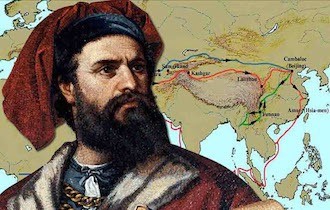
These early merchants understood the importance of being able to communicate with their customers in order to make their business prosper, hence the importance of mastering languages other than one's own. Let's take the case of a great merchant-traveller, the Italian Marco Polo (1254-1324), who traded from the Mediterranean to China, and who was a precursor of multilingualism, having learned "not only the language of the 'Tatars', i.e. the Mongols, but also other languages that the text doesn't detail - Chinese, Arabic, Persian".
This linguistic skill also won him the favor of the great Kubilai Khan (emperor of China in the late 13th century), who made him his emissary throughout his empire as translator and interpreter. At the time, learning and speaking 4 languages (and forms of writing!) fluently, from linguistic systems totally different from one's native Italian, was no mean feat... It's worth pointing out, however, that in the Middle Ages, most people spoke several languages. How is this possible? Quite simply: written and spoken languages rarely coincided, hence the widespread use of one - or even two - vernacular languages, not to mention Latin, which was widely used in the Middle Ages.
Another interesting example is that of the Emperor of the Holy Roman Empire, who was supposed to be able to speak four languages to be crowned (and communicate with all his subjects of different languages)...
What about today? Nothing has really changed. Take Facebook founder Mark Zuckerberg, for example.
Although the hegemony of the English language is well established, this American businessman is actively learning Mandarin. His wife is Chinese, so what could be more normal? But what if it's just a clever business maneuver to get back to China? Remember, even if some manage to get around this ban, Facebook is officially and legally blocked in China. But what could be more profitable than entering the Chinese market?
Another example is that of Willy Brandt, the former German Chancellor, who once said: "If I sell you something, I speak your language. But if I buy something from you, dann müssen Sie Deutsch sprechen" (then you must speak German). So much for "the customer is king". If you want to charm your customer, then speak the same language as they do, making contacts and exchanges easier, and developing your business.
Then, off to the land of the Helvetians, Switzerland, well known for its neutrality, its chocolate, its banks, but also for its multilingualism, with four official languages: German, French, Italian and Romansh. Yet the value of this same multilingualism alone is estimated at 10% of the country's GDP (gross domestic product). Why? In many companies and organizations, transactions are easily carried out in different languages...
Conversely, it's estimated that England loses around 3.5% of that same GDP annually due to its population's poor language skills, and unfortunately, it's not getting any better since the Brexit (the UK's withdrawal from the European Union, which began on March 29, 2017), where the economy is in decline.
Finally, let's return to American soil, in the state of Florida, where we find that workers who speak Spanish and English earn around $7,000 more per year than those who speak only English. A Canadian study even states that bilinguals earn an average of 3.6% (for men) and 6.6% (for women) more than monolinguals.

In conclusion, speaking several languages is good for the economy and business. Those who invest more in their professional language education will have better business and economic skills.
While the United States remains the world's leading economic power in 2018 (over $19 trillion), China is close behind (over $12 trillion), with Japan ($5 trillion), Germany ($3.6 trillion), the UK ($2.6 trillion) and France ($2.5 trillion) well behind. But does this mean that English remains THE language of the global economy? Today, yes. But what about tomorrow?
If the figures and statistical forecasts are anything to go by, Mandarin could well take first place, not to mention the fact that, even if they are relegated to lower ranks, many of the countries in the top 10 are in Europe, well known for its linguistic wealth. Whatever the case, it would seem that, in any case, the use of one or more languages can only be beneficial to the economic development of a country, a company or an individual, so what are you waiting for, too, to propel your career forward? Here's another great reason to learn a language!
Illustrations: Marco Polo et ses voyages,
Bilinguisme.
The Global Job market
Sources
- Why multilingualism is good for economic growth, Gabrielle Hogan-Brun, The Conversation, 03/20/2017, https://theconversation.com/why-multilingualism-is-good-for-economic-growth-71851
- Language, economy and globalization, RTS Suisse, 15/04/2014, https://www.rts.ch/decouverte/monde-et-societe/culture-et-sport/les-langues/5776193-langue-economie-et-mondialisation.html
- Messire Marco Polo, Florian Besson, Actuel Moyen-Âge, 16/02/2017, https://actuelmoyenage.wordpress.com/2017/02/16/messire-marco-polo/
- Speaking more languages boost economic growth, Sophie Hardach, World Economic Forum, 06/02/2018, https://www.weforum.org/agenda/2018/02/speaking-more-languages-boost-economic-growth/
- Classement PIB 2018 : les pays les plus riches du monde, Journal du Net, 09/03/2018, https://www.journaldunet.com/patrimoine/finances-personnelles/1171985-classement-pib/
You might also like:
Animals have over 400 million years of history and learning that can teach us about ourselves
Innovation training between tradition and rupture. Thesis by Tiphaine Liu.
This thesis examines the conditions for innovation in incremental or breakthrough training through the analysis of school practices. It concludes by proposing the conditions for emancipating systems.
Massively multiplayer online role-playing games in education and training
Massively multiplayer online role-playing games (MMORGPs) are now one of the most dynamic segments in the video game industry. But what about education? What experiments or educational uses can and have been carried out using MMORPGs?
Natural resource: the collective intelligence of the masses
When we think of natural resources, we think of oil, water, coal, but we forget to include the collective intelligence and in particular that of the masses, the crowd. The sharing of this wealth is also to be considered.
Which academic discipline seems the most difficult to teach? If the media reports of recent years are anything to go by, sociology comes out on top. Professors have to juggle greater student sensitivities to minorities with intersectionality. They are also under pressure from the media and politicians not to give any credibility to these subjects, and not to give in to "radical" ideas.


