The place of the collective in motivation to learn. Important, but informal [Thesis].
We do better with others than alone. Research supported by 7 studies conducted with over 700 students.
Publish at May 28 2018 Updated December 04 2025


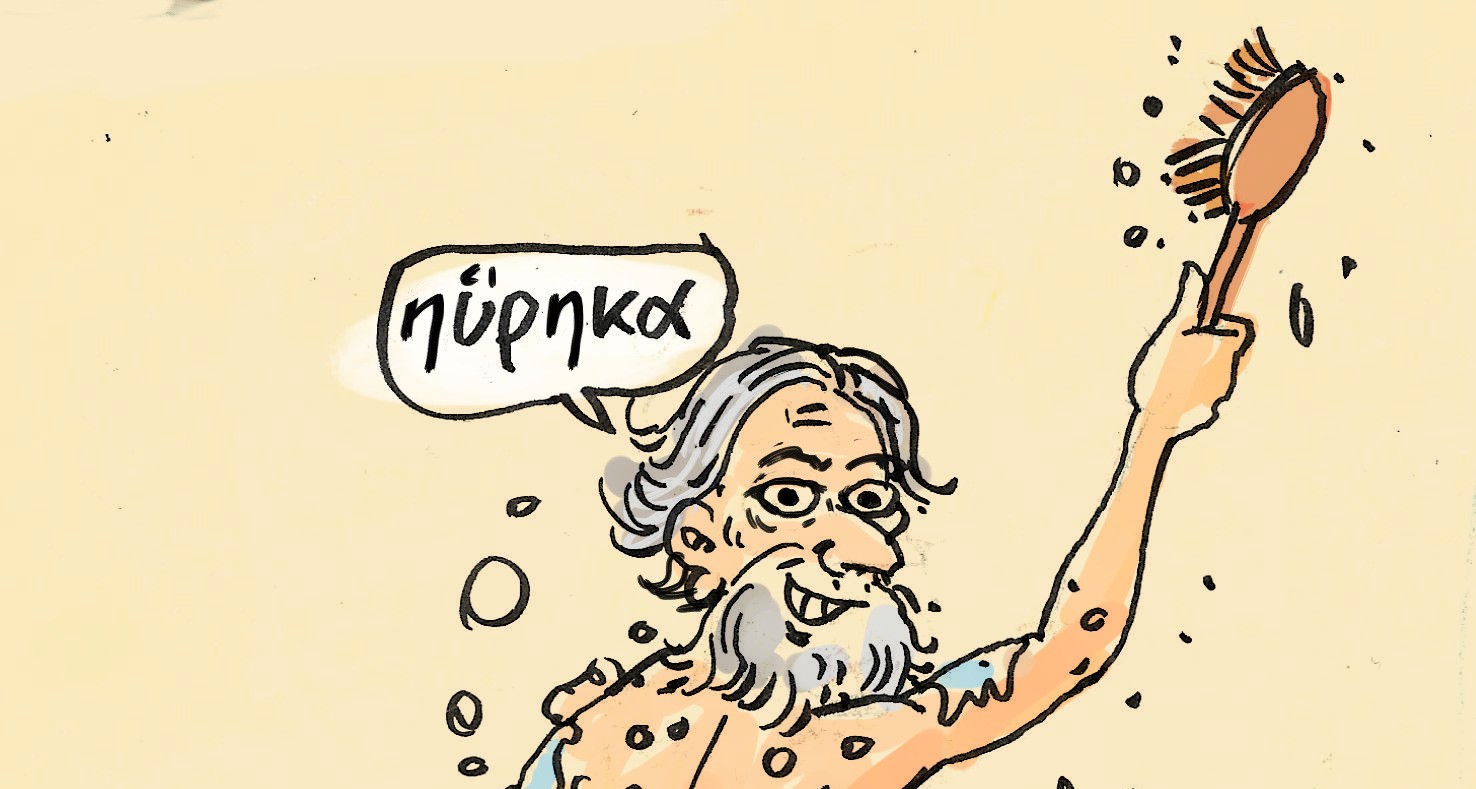
The eureka moment is that euphoria we feel when we make a discovery, when suddenly, without knowing why, very complicated problems seem to find a crystal-clear solution. The intuition behind scientific discovery is often associated with Archimedes, who had the revelation of the thrust of the same name in his bathtub. With his mind at peace, seemingly untouched by research and concentration, our pioneer felt the effect of a spark, and rushed out of the bath to testify to his discovery.
Poincaré gives us a better-dressed version of the eureka moment when he tells us that, after working in vain on "Fuchsian" functions at his desk, he takes a little rest. And he has a revelation as he boards a train. His description conjures up an irrepressible flood of ideas. The next morning, much calmer, he is able to put his findings down on paper in a natural way.
A third example comes from Newton, who saw apples falling and intuited gravitation.

In all three cases, it would be wrong to limit ourselves to the explanation of genius. We all see apples fall, we all ride trains, and we take baths and showers more often than Archimedes... But we haven't come up with any ideas that mankind will remember... The eureka moment certainly comes at a time of calm. But simply staring into space or taking a walk is not enough. Creative intuition is preceded by a great deal of concentration.
John Koonos and Mark Beeman distinguish four stages,
Other authors prefer to cite :
The two models differ little. They are inspired by G. Wallas, who wrote "The Art of Thought" in 1926, and already presents the stages of discovery. Creativity is born of tenacity, perseverance and concentration. The inventor is often the one who has failed a lot, just as the artist often erases and throws away. ... belies the image of the jack-of-all-trades genius. "Before finding a new (and right) idea, you must have stumbled on hundreds of false leads", says Jean-François Dortier.
The collection of interviews with scientists published in May 2018 by Flammarion illustrates the complexity behind these four stages. Invention often comes from very far away, emerging from a whole experience that doesn't stop at the few weeks that precede it.
Geneviève Anhoury's interviews show, to borrow a quote from Philippe Carré, that while we sometimes invent alone, we never invent without others.
In this respect, Jean-Claude Ameisen's testimony is interesting. Nourished by stories and great myths from an early age, he brings with him a culture where paradoxes can be overcome, where oppositions as strong as life and death can be rightly thought of as something other than opposites. Added to this is a human environment. Stymied in his research into apoptosis and the phenomenon of cell "suicide", his wife suggested that he read a body of scientific literature that he had archived for future reference. The time had come to read them with profit.
It was also the human environment that sparked his interest in ethics, when Christian Bréchot, Director of Inserm, invited him to join his institution's ethics committee. Jean-François Dortier tells us that the inventor is always in dialogue, with his peers, predecessors, rivals, mentors and so on. This inner dialogue is also the source of inventions and discoveries.

The eureka moment is also about taking a step back, approaching questions from a new angle. Some scientists, notably Jeanne Goodhal, have surprised those around them by integrating an empathic approach into their research.
François Ansermet changes his point of view on deterministic chains. He's not so much interested in the causes that produce effects, as in the singular reaction of an individual - often an embryo - to stimuli. No "eureka" moment to speak of in his interview, but elements that encourage discovery:

The moment of discovery, the mechanisms of invention, are often explained after the fact. Why the light bulb or the tarte Tatin were conceived is easy to explain. But predicting the conditions that will lead to the emergence of an invention is improbable. At the very most, we can bring together the conditions for emergence, attitudes of openness and acceptance of uncertainty, phases of concentration, effort, "flow" and others where the brain is left to its autonomous activity, and exchanges with our environments.
The book "Théorème vivant", dedicated to the discovery that enabled Cédric Villani to win the Fields Medal, shows just how much digital technology can contribute to building an environment that encourages invention and creation.
Illustrations : Frédéric Duriez
References
DORTIER, Jean-François. Discovering discoveries. Les Grands Dossiers des Sciences Humaines, 2017, no 9, p. 1-1.
Collective, interviews by Geneviève Anhoury. Savoir, penser, rêver - Les leçons de vie de 12 grands scientifiques - Flammarion, May 23, 2018.
https://www.decitre.fr/livres/savoir-penser-rever-9782081421332.html
John Kounios: https: //youtu.be/F7t9i0sWGy8
Frédéric Duriez -The environment of excellence in science: inspiring, social, technical, cultural - Lessons from Cédric Villani and Stephen Hawking on Thot.cursus.
https://cursus.edu/10556/lenvironnement-dexcellence-en-sciences-inspirant-social-technique-culturel
You might also like:
The place of the collective in motivation to learn. Important, but informal [Thesis].
We do better with others than alone. Research supported by 7 studies conducted with over 700 students.
The genealogy of the first procedures and the birth of an operating know-how
An illuminating look back at the oldest human instructions for keeping know-how alive.
Africa: To the Conquest of the French Language
The French language is a war booty in Africa and in the Francophonie. This article presents the contribution of Africa to the French language lexicon and describes the Francophonie as a mosaic of cultures.
It seems obvious that artificial intelligences are major allies in certain tasks and that they improve many practices, but they also have problematic and obscure sides that can cause damage on a small and large scale. Among other skills, they have learned how to manipulate human beings.
The future in the other direction
How to give a tangible representation of the future? How can we encourage debate on our orientations for the coming decades? One answer lies in fictional design, which proposes to produce objects or services that make a more or less near future concrete, to give rise to debate, to make visible the paradoxes, the impasses and the dead ends around our representations of the future.