Despite the skeptics, climate change is real and is already having an impact on the globe. Most countries recognize this, and at least agree on the urgency of the situation. In fact, some climate sceptics are even changing their tune. The problem exists, but there's no need to panic. In fact, engineering work could "easily" solve the problem. This geo-engineering approach raises some hopes, but above all it raises a lot of questions and criticism.
Controlling the climate with science
The idea of using science to control the climate is not new. As this France Culture program on the subject reminds us, the idea was already being studied in the 1940s. During the Cold War, Americans tried to induce rain to destabilize enemy forces in Vietnam. These techniques weren't very effective, however, since they were trying to attack a specific weather phenomenon. Scientists turned to climate-related techniques, inspired by a natural event that took place a few decades ago...
June 1991. After 500 years of dormancy, the Pinatubo volcano in the Philippines erupts. Between June and August, the volcano released almost 10 km3 of material into the atmosphere, making it one of the most significant volcanic events of the century. Scientists noticed that in the year following the event, the earth's temperature dropped rapidly by between 0.4 and 0.6 degrees Celsius, prompting researchers to ask: "What if humans could reproduce this phenomenon?
Some are working on the idea of sending sulfur and aerosols into the stratosphere to cool the atmosphere. Others are looking into ways of capturing the carbon dioxide responsible for climate change, either by burying it in the ground or digesting it with bacteria that feed on it. Harvard researchers are even looking at releasing particles of ice and carbonate into the stratosphere to create a kind of mirror that reflects some of the sun's rays. So there's no shortage of ideas for countering global warming. Indeed, the idea of geo-engineering has made its way into international climate conferences. Regions to the south of the planet that are already tasting the devastating effects are keen to invest in such research. Even at COP23 in Fiji, despite the risks involved, some experts expressed interest.
More drawbacks than benefits
Because the risks are there. Firstly, because none of the current proposals have shown any real effectiveness, and secondly, because the effects on the environment could be worse than the current situation. For example, Nature magazine has published a study on the effects of spraying sulfate aerosols into the stratosphere. Theoretically, this could reflect some of the sun's rays. As we all know, the slightest change in an ecosystem can turn everything upside down. According to the Nature article, if this were to happen in the northern hemisphere, it would have a terrible impact on the southern hemisphere. And the idea of reproducing the Pinatubo effect on a large scale? According to many researchers, it could lead to worse warming. Indeed, as the aforementioned volcano showed, the climatic effect was temporary (barely more than a year). So, to be effective, we'd have to constantly send these products into the stratosphere. However, if a country decided 10 or 20 years later that it no longer wished to invest huge sums in this solution, global warming would come back even stronger, since its sources would still be just as active.
This also brings to mind the geo-political aspect of climate. In a simulation of what would happen in 2067, there would potentially be conflicts linked to geoengineering. A country like India, for example, could join forces with other countries to reduce the effects of climate change on its territory. But Russia, with its year-round Siberian ports, could retaliate by sending more greenhouse gases to counter these technological efforts.
So it seems that geoengineering is not the panacea of choice for climate change. Technologies can help humans to deal with climate change, as in the case of this Finnish scientist working on a project to use drones to reduce the force of hurricanes by disrupting the vortex. However, he himself admits that geo-engineering is not the way forward and that it is better to work on long-term solutions.
This means partially changing the economy, production methods and finding ways of doing things that emit less carbon. For example, French agriculture currently produces more carbon dioxide than it accumulates. A situation all the more absurd given that this product is the basis of plant nutrition. What if the solution lay in a more regenerative form of agriculture that rebuilds soils and better sequesters carbon? Admittedly, this would be less rapid than the effects of geo-engineering, and would require populations to considerably modify their lifestyles. In the longer term, however, it would have more beneficial impacts on the planet and on the viability of species, including human beings.
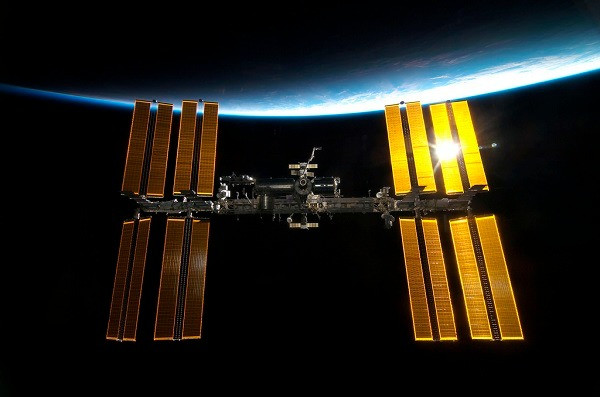
Illustration: The International Space Station backdropped by Earth's horizon and the blackness of space. Original from NASA . Digitally enhanced by rawpixel. via photopin (license)
References
"COP23: Climate Engineering Is Risky But Must Be Explored, Experts Say." Mediaterre. Last updated:November 17, 2017. https://www.mediaterre.org/actu,20171117105402,1.html.
"Tomorrow, We Can (Maybe) Control Hurricanes." Futur.e.s. Last updated May 9, 2018. https://blog.futuresfestivals.com/hurricane-unwinder/.
Flowers, Rebecca. "Worse Than Climate Change: Bad Geoengineering." Vice. Last updated January 31, 2018. https://www.vice.com/fr_ca/article/3k5x5j/pire-que-le-changement-climatique-la-mauvaise-geo-ingenierie.
Fournier, Clément. "Study: Climate Geoengineering: A False Good Idea?" E-RSE.net. Last updated: November 30, 2017. https://e-rse.net/geo-ingenierie-changement-climatique-danger-268930/#gs.VPze3vQ.
"Geoengineering: The Mechanics Of Climate." France Culture. Last updated September 13, 2017. https://www.franceculture.fr/emissions/la-methode-scientifique/geo-ingenierie-les-mecaniciens-du-climat.
"Geoengineering, A Deficient Solution To Climate Change." Bienvenue En 2067 | ICI Radio-Canada.ca Première. Last updated: July 15, 2017. https://ici.radio-canada.ca/premiere/emissions/bienvenue-en-2067/segments/chronique/31062/manchettes-futur-geo-ingenierie-solution-changements-climatiques.
"Le Sud S'intéresse à La Géo-ingénierie Climatique." Euractiv.com. Last updated April 9, 2018. https://www.euractiv.fr/section/climat/news/le-sud-sinteresse-a-la-geo-ingenierie-climatique/.
Noreau, Laurie. "Geoengineering: Climate Manipulators." Quebec Science. Last updated June 25, 2017. https://www.quebecscience.qc.ca/technologie/geoingenierie-manipulateurs-de-climat/.
"We Need Regenerative Agriculture, Not Geoengineering." KundaLight. Last updated January 8, 2018. https://uhxnue.wordpress.com/2018/01/08/nous-avons-besoin-de-lagriculture-regenerative-pas-de-la-geo-ingenierie/.
Perreault, Mathieu. "Une Hausse De 1,5 °C Et La géoingénierie Au Coeur Des Débats à Montréal." La Presse. Last updated: September 9, 2017. http://www.lapresse.ca/environnement/climat/201709/08/01-5131760-une-hausse-de-15-c-et-la-geoingenierie-au-coeur-des-debats-a-montreal.php.
See more articles by this author