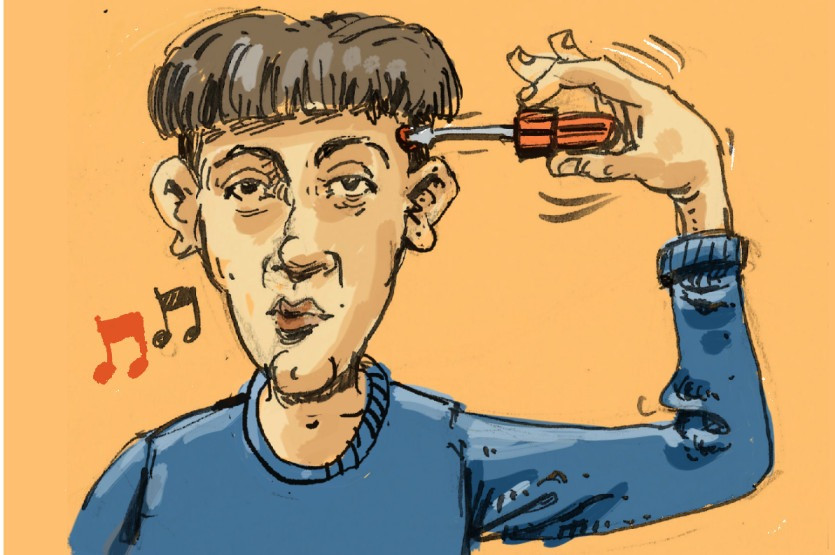
The fate of humanity is on the brink of change. Robots are gaining in strength, speed and skill, artificial intelligences are nibbling away at our areas of expertise, and every PISA-type ranking places our countries among the lowest performers.
It's time to get our act together, and in this heightened competitive field, we have no choice but to train, again and again, to face up to the changes and challenges...

Some authors humorously qualify the desperate energy we devote to perfecting our interpersonal skills and know-how.
La formatite, when training becomes an illness...
Michel Perreault is a Canadian sociologist. The book he published in 2011 bears a title in the form of a desperate cry: "I am not a company!"
According to the author, we are victims of corponoses, i.e. corporate diseases that can be transmitted to humans, just as zoonoses spread from animals to humans. Corponosis translates into the belief that any problem can be solved by a combination of three actions.
- management
- communication
- training.
On the first point, just listen to the linguistic shift of recent years. Everything can be managed: stress, communication with others, emotions, time, problems, pain, weight... Measuring parameters, identifying the elements over which I have control, setting objectives, organizing dashboards, are all symptoms of gestionite, a major consumer of digital applications.
The second is "promotite". Employees, the self-employed, job-seekers, but also instagrammers, youtubers and other social network users are invited to think of themselves as brands, to engage in "personal branding" and to sell themselves using the classic tools of marketing and promotion.
But it's the third point in particular that interests us. Formatization is the pathology transmitted from the company to the individual, which leads people to believe that they need to be constantly trained in order to evolve or just stabilize, and that training, or even personal development, can help us overcome our problems.
Marianne Power and personal development
If there's one area where the thirst for progress is important, it's that of personal development. Self-confidence, assertiveness, mastery of emotions, time and relationships with others occupy entire bookshop shelves. Apps are also taking over, distilling positive messages and precepts for a better life. More than a dozen of these applications exist around Covey's book, The Seven Habits of Those Who Succeed at Everything They Do.
Marianne Power wanted to try them out. She read one bestseller a month and put its teachings into practice. With sincerity and humor, she shares with us the results of the spiritual and physical exercises that the gurus suggested to her.
Marianne Power begins with "Tremble, but dare" by Susan Jeffers. She extracts a few exercises from it. For example, she makes a list of the things that scare her the most, and commits herself in front of her friends to undertake them. Susan Jeffers claims that our fears can be broken down into three stages. We're afraid of doing the action, we're afraid of failing and seeing our ego suffer, especially in front of others, and finally we're afraid of not being able to stand thinking we're bad... As a result, we renounce a certain number of actions. These seemingly insignificant renunciations end up weighing on us. Attempting the things that frighten us should help us to distance ourselves from our fears, to accept them and no longer experience them as obstacles.
For Marianne Power, the list included activities such as public speaking, approaching strangers, parallel parking and even posing nude for artists.

Susan Jeffers encourages us to use and abuse positive messages, formulated in the active voice and present tense. This seems to be a common thread running through many of the books our author has chosen to read.
The intrepid Marianne Power discovered that she could enjoy speaking in front of a group, that she could make people laugh, and that you could approach people on the street without collapsing. Her niche ended with a wheel on the sidewalk, but she's rather proud of it. On the other hand, the posing session had less positive effects on her ego.
Other books have been less convincing about Marianne Power. One of them, for example, simply reiterates that "to want is to be able". Its key ideas would fit on a post-it note. According to our volunteer guinea pig, the book only enriches its author. A mixture of poorly mastered scientific concepts, auto-biography and success-stories support hollow assertions.
Others, with little intellectual pretension, have their effect despite very simple recipes. For example, one author encourages us to repeat to ourselves "nothing to f---" in the face of situations that would otherwise destabilize us.

In addition to the effect of letting off steam, according to the author, this expression invites us to take a step back, to consider that failure is not a tragedy and that it is therefore possible to dare, to tackle our projects without stiffening ourselves in fear of future problems.
Like another author who prescribes his readers to take one refusal a day, many of these books invite us to put failure into perspective, to desensitize ourselves to our fears as we would to an allergen. They encourage us to be in the present, or like Eckhart Tolle, to keep control of the voices that take us back to the past or project us into speculations about the future.

Marianne POWER pursues her quest and sometimes finds answers or discourses that touch her, or carry an originality. But all these books, exercises and seminars aimed at success rather than happiness are gradually changing her. She ends up falling out with one of her best friends, who had supported her in this project. But a guru helps her put into perspective what the previous guru had said, and in the end, the best precepts come from her mother, her friends and the mysterious Greek man she met during the month "one refusal a day"...
Marianne Power comes across a few charlatans and a lot of books written on the sole basis of personal experience and a few revamped references. Most of them aimed at quick material success or individual well-being, these books are undoubtedly another symptom of the corponosis mentioned by Michel Perreault.
Illustrations: Frédéric Duriez
Resources
Michel PERREAULT Je ne suis pas une entreprise! Guide de survie personnelle pour le XXI siècle Editions La Découverte, 2011
Marianne POWER Help me! How personal development didn't change my life Stock 2018
The 7 habits of achievers - Stephen Covey
https://www.decitre.fr/livres/les-7-habitudes-de-ceux-qui-realisent-tout-ce-qu-ils-entreprennent-9782290057926.html
Tremble, but dare - Susan Jeffers
https://www.decitre.fr/livre-audio/tremblez-mais-osez-1-cd-audio-mp3-9782895174691.html
See more articles by this author