How do you tell a story? Some authors have looked for invariants, the ingredients of effective storytelling... They have found patterns, principles and tropes [a figure of speech that uses an analogy] found in stories and cultures far apart.
So there's no magic recipe, but plenty of rules to follow, or to shake up!
Simple as a story
Many stories boil down to a combination of two dynamics: a character, or a group of characters, seeks to achieve a goal, or flees from a threat. He faces obstacles, which he manages to overcome. As a result, he or she or others are changed and mature. Flight and pursuit can be combined, as in The Fugitive, where the hunt for the real culprits doubles as a manhunt in which the protagonist is the target. Harry Potter and his companions are in search of the horcruxes that will neutralize Voldemort, who is pursuing them with his wizards.
Yves Lanvandier goes a step further in his book
Constructing a Story. He shows us that stories are themselves made up of micro-stories. Every chapter of Game of Thrones or Harry Potter, every sequence of a film or series presents us with a character who must overcome obstacles or conflicts to reach a goal, in an arena. If the structure is simple, it can develop and reproduce itself like a fractal figure, or like a romanesco cabbage to use Yves Lavandier's comparison. The general structure reappears in each sequence, where the characters aim for secondary objectives, for which they face smaller obstacles...
To express these in a simple way, and to stand out from the mass of scenarios and projects, the authors formulate pitches. Yves Lavandier suggests we express them as follows:
"In such and such an arena, following such and such a trigger, such and such a character fights against such and such an obstacle to achieve such and such an objective".
The objective is distinct from the stake. It's what's "at stake", what's at stake for the protagonist. In The Fifth Element or Harry Potter, it's the survival of mankind; in other fictions, it's a friendship or a love affair.
Whether it's a book, a film, a few minutes of video footage or even an illustration, the pitch is a useful starting point.
Chuck Williams, screenwriter of numerous Disney-produced films, shows us that Norman Rockwell answers all the questions needed to build a story in a single image. His formulation is even simpler: "where, when, who, what, how and why".
In search of the universal pattern
Numerous authors have tried to find invariants, structures or "tropes" that we come across regularly, and which are all ingredients of a good story.In the '40s, Joseph Campbell tried to demonstrate that stories and myths follow the same pattern, whatever their culture. He introduced the "
hero's journey", which can be applied to many adventure stories, from The Odyssey to Harry Potter, Star Wars to The Matrix.
Inspired by Campbell, Christopher Vogler uses the metaphor of the journey in his
screenwriter's guide. Let's take a look at the main stages.
Act I begins with a presentation of the ordinary world. It contrasts with the world in which the adventures take place. It also introduces the hero and certain characters. The protagonists of The Indestructibles II , for example, are staged in their schools, kitchens or dull office jobs.
The story continues with a "call to adventure". At first, the hero refuses this call, then meets a mentor who changes his mind. Act I ends with the crossing of the first threshold. This is the moment of confrontation with the guardian of the threshold, the first serious obstacle the hero has to face.
Act II begins for Campbell with the "road of trials". For Vogler, this is a series of tests, where the hero encounters successive allies and enemies, and moves closer to the "heart of the cave". More generally, the protagonist arrives in the vicinity of a dangerous place. He will then be confronted with that which frightens him, and will experience his most difficult hours. He will triumph.
Act III begins the journey home. It's not a peaceful ride, and dangers still lurk. The villain is not quite wiped out, and explosions and landslides put ships and vehicles at great risk. "It's a kind of final exam for the hero, who must be put to the test one last time to prove that he's learned his lessons."He then returns with his trophy, which Christopher Vogler calls "the Elixir".
Tropes and narrative tricks
James Harris has made brilliant use of Mendeleev's
periodic table of elements to set the scene for the main tropes. One click takes us to the
tvtropes collaborative site, which offers examples and even variations on the narrative spring presented. Some tropes are so commonplace that they can appear in a commercial or video clip and immediately evoke situations seen in longer scenarios. The examples are so numerous and so precisely detailed that this resource will keep both novice and experienced narrators busy for an entire season.
You'll discover the many ways to start a story, and the resources that weather presents. "It was a dark and stormy night" can be found in many novels, as well as video clips and comic strips. We'll have a little compassion for the "red shirt" characters, who disappear very quickly in a story but serve to show the sensitivity of the hero or the cruelty of the villain!
Other sources offer inspiring archetypes and tropes. In 1924, for example, Georges Polti listed the 36 dramatic situations found in theater, in a book that has not been republished recently.Marie-France Briselance has taken up the challenge, this time adapting the approach to film. These 36 situations are illustrated by no fewer than 350 films. Among them: avenging a crime, destroying, saving, hating, imploring, kidnapping, sacrificing oneself to passion...
Nothing will ever be the same again
In the course of his adventures, the character can transform his environment or achieve his goal. Yves Lavandier distinguishes between stories of intrigue and stories of character. The former focus on the action and conscious objectives of the protagonists. The latter emphasize character transformation and evolution. The two sometimes merge. A story may feature a dramatic protagonist, focused on action and goals, and a "trajectory" protagonist who will evolve and mature over the course of the story. Billy Elliot is goal-oriented, becoming a professional dancer, while his father will experience an internal trajectory.
Inventing characters
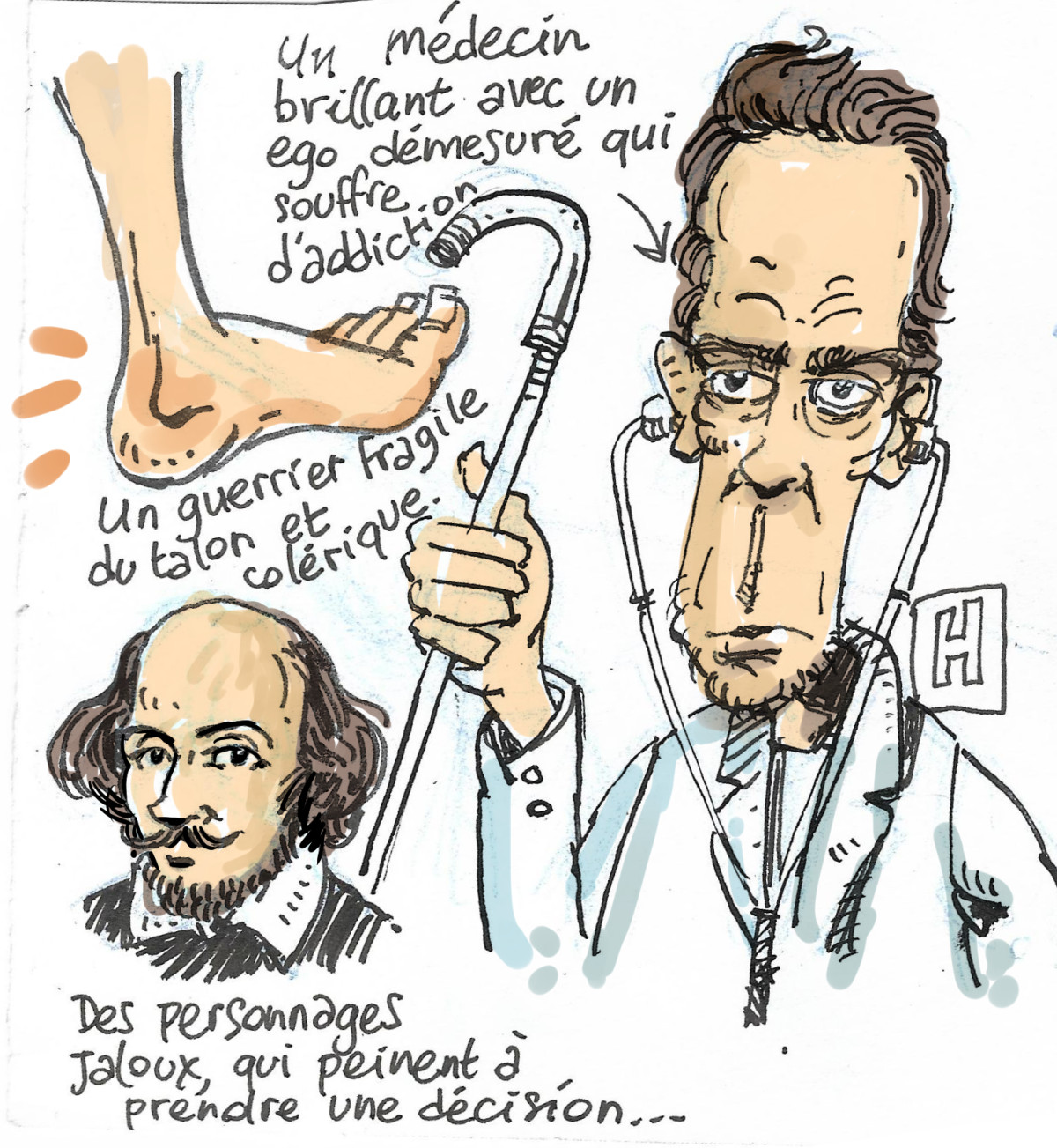
Don't create perfect characters," says Yves Lavandier. They need to have one or more flaws and a few rough edges. Think of Dexter, Doctor House or Shakespeare's characters. They have weak points, whether it's Achile's heel or Superman's kryptonite, but they also sometimes have character traits that play tricks on them, giving rise to stories within stories.
The author encourages us to keep things simple: "aim for the stereotype to which you add a nuance". In life, we are multiple, our identity complex, our character hard to define. But in a story, you have to simplify to take your audience with you.
These characters have a past, ghosts that haunt them, and wounds made of past grief and suffering. Yves Lavandier tells us that they act like rubber bands, explaining an overreaction to an event. This is a classic trope among superheroes, who mark a moment of weakness when a situation rekindles a distant failure.
Among the characters, the authors recommend paying particular attention to the villain, who is one of the most effective obstacles.
To contrast character psychologies, we can use typologies from psychology or other sources.
The Enneagram, which presents nine types of communication and interaction with others, is an inexhaustible source for analyzing or creating stories.
Irrespective of their character, characters have roles in the story. The hero will come across allies, a mentor, antagonists who are sometimes also allies, villains, messengers... The quality of the characters is what makes the hero's journey so interesting;
The search for invariants, or even "recipes" when it comes to creation, may come as a shock and a surprise. Yet it runs through the entire history of literature, particularly the classical period. If the same structure is found in an unpretentious series and a literary masterpiece, it's because creation is not limited to these aspects. In the same way, the rules of picture composition are respected by Rubens and by advertising posters, but we wouldn't confuse them.
Illustrations: Frédéric Duriez
Resources :
See more articles by this author