
In learning, how to move from the individual to the collective
Philosophical, sociological, psychological and educational science points of view to move from the individual to the collective
Publish at December 02 2019 Updated June 28 2023


The spirit of competition is an excellent gas pedal for surpassing oneself, for improving oneself, for simply pushing back the limits of one's abilities even further, verging on the frontiers of the impossible, even doing better than one's peers. The ego brings another actor onto the stage: the other, a friend or foe, visible or hidden.
The literature on personal development, change management and performance is like an ocean: a research object for some, a philanthropic impulse for others, or a niche effect. One only has to look at the mass of information circulating on the Web: seminars of all kinds, products offered for sale by recognized specialists or "gurus" operating on the Web, particularly on social networks, which have become their recent stomping grounds. Competition is also fierce in this area, making it difficult not to fall into the gurus' trap.
While there's no doubt that entering into the spirit of competition is sometimes essential for personal or professional success, it's also worth asking ourselves who we should be targeting when we're in the grip of our own well-honed belief system. Who are we really competing with, and what kind of success are we talking about? Is it the one that is accepted by others and society, or is it the one we aim to achieve for ourselves?
In a society that prides itself on performance, isn't competition the reflection of a chase both against others and against oneself? Which performance are we talking about? The one that pulls us upwards and makes us explore the best of ourselves, or the one that makes us bend under the yoke of systems of thought, that leads us to exhaustion and sometimes makes us abandon our own aspirations along the way?
In the game of competition, there's the other, but above all there's the Self.
What are we really aiming for? What exactly motivates us to succeed? Is it what others see, or is it what we dream of? Can we speak of success when we bend to the good will of our parents' dreams, or when we simply do what society expects of us?
Do we still speak of success when that top executive of an international finance firm, clad in diplomas from prestigious schools, decides to quit everything to devote himself to his true passion, and turns to farming? Examples are becoming more and more numerous, and too few are those who perceive on which side success really lies, so strong is the social formatting.
The model of success shaped by the Western world and built on a scale of values ranging from manual or so-called "small trades" at its base, as for those who work the land, to so-called intellectual professions such as being a surgeon, engineer or, to keep up with the times, a specialist in artificial intelligence, is outdated. Too many people still preach to their offspring that if they do well at school, they'll have a "good job", implying that their work is "intellectual" and denigrating other forms of intelligence at the same time.
One only has to look at school curricula to see the disproportionate importance given to certain subjects and the lack of investment by institutions, or even the denigration of other subjects by parents. Conflict with our own dreams is shaped by our family and social environment, and our own resistance. So-called intellectual work has always been and continues to be wrongly perceived as the path to excellence by too many individuals in many societies. However, it takes all kinds to make a world, and it's thanks to "small jobs" that we can enjoy our chocolate toast in the morning while drinking our coffee, or benefit from a clean working environment.
Many of life's little pleasures are thanks to "small jobs". What would a company or a school be without its employees or its staff in the so-called intellectual professions? Changing the way we look at the world around us and our perception of things, professions and people is essential if we want to succeed in our personal or professional lives.
Is the wind of change blowing? The need for nature, a return to the land and the urgency of climate change are bringing us back to certain professions and lifestyles once perceived as "backward".Aren't certain occupations in contact with nature, once seen as "small jobs" and neglected by the younger generations, now becoming life aspirations in the eyes of a large number of individuals beaten down by the yoke of the famous metro-bus-dodo trio?Many now aspire to more serenity and wish to reconsider their professional choices, while others have taken the plunge and opted for a reconversion that sometimes represents a complete break with their former career path, or even their prejudices.
Success in life sometimes means breaking out of strict social frameworks, and the quest for happiness at work comes into play for employees seeking meaning in their tasks. In a society where stress and hyperactivity go hand in hand with efficiency, performance and a constant desire to improve oneself and one's professional situation, happiness at work is becoming the order of the day.
The gaze of others, the gaze that we sometimes dare not raise and under which we bend to fit into the ready-made box that shines for society, is the very one we need to combat. To do this, don't mistake your adversary: he's not right in front of you. If you were to look in the mirror, you wouldn't see him because he's slumbering inside you...
Nothing is more damaging to oneself than the conviction of one's own thoughts, however false and destructive they may be. Most of the time, we think we're conscious of our actions when we're not, and we're controlled by our unconscious. The driving iceberg that is our unconscious dictates our actions like a clock tells the hours to strike and the hands to turn. That said, let's be wary, because even time is an illusion in "the presentification of the advancing needle". (Martin Heidegger).
Psychologists warn that believing that you're bad or that you're mean because your parents keep saying so is destructive for a child.
Similarly, by reading certain comments made by teachers: "Very good student but too shy", the student ends up believing it, convincing herself and then becoming the self-effacing person her teachers perceive her to be, without looking for the causes of this behavior.
Lack of confidence, lack of self-knowledge, other people's opinions and psychological conditioning limit us. In such cases, recourse to experts is sometimes appropriate.
While it's important to discern the real motivations of some of the personal development professionals who abound online, it's also important to pay attention to certain visions that may really resonate with the person who turns to them. Often, it's not information that we don't know, but the context is such that it doesn't make sense until our personal or professional situation leads us to it, and we're mentally prepared for certain statements to make sense.
This is why Bob Proctor's vision, whatever its motivation, is interesting insofar as it invites us to reconsider the key role of the subconscious in our actions.
It's not our intention to promote Bob Proctor's work, but we thought it would be interesting to discuss his vision here.
The subconscious is governed by a paradigm that he defines as a "multitude of habits", themselves referring to ideas in our subconscious on which the individual acts "without any conscious thought". Action provokes reality and "reaction modifies the conditions, circumstances and environment in our lives. "
Thus, our habits and behaviors are shaped from our earliest childhood by our external environment (family, friends). Our actions are dictated by our unconscious. So far, nothing new for those interested in psychology. Where it gets interesting is when he mentions that the thoughts developed in our minds are in "harmony with our paradigms", i.e. we think what our paradigms think. The reason, according to him, is that "the paradigm controls the vibration of our body, which is also vibration according to the law of vibration, which stipulates that everything in the universe is in motion and nothing is static. In other words, "ideas imprinted in the subconscious control vibration. He gives the example of people brought up in a social environment where it's normal to be lacking and limited, so it becomes normal for them. It will then be unlikely for them to achieve an optimal level of comfort, even if they know intellectually that they can.
As soon as these people imprint in their subconscious ideas of a different type and which are much more rewarding, they find themselves in a situation of discomfort. He believes that learning to change paradigms is the key to success. That's why some people with a high intellectual level and many diplomas sometimes find themselves frustrated when their professional situation doesn't match their skills, while others who may not have had such a brilliant career are more successful. The reason? The paradigm, according to B. Proctor's vision.
At the frontiers of science, where certain convictions collide with beliefs that are little or not at all recognized, there are those who firmly believe in the power of thought. Let's leave the beaten track of science and turn to metaphysical explanations. Our thoughts rule us", "You are what you think" or "You become what you think".
And yet, a growing number of scientists are giving credence to some of these statements.
Some studies have shown a correlation between thoughts and matter. Quantum physics states that everything is energy, and our bodies are energy. Nothing in the universe is static. In the same way, our physical reality is affected by the waves emitted by the thoughts of people in our environment, which explains the advice many people preach, sounding like a rosary of prayers: "Surround yourself with positive people", "Avoid toxic people in your environment, including family members". 
Our worst enemy is not always the one we think! In fact, they often lurk in the back of our minds. We feed it, even cherish it, without even a hint of suspicion.
95% of our behavior is the result of patterns and habits we've acquired since childhood (Brian E. Walsh). False beliefs also have their place, unfortunately, as do negative thoughts that feed our beliefs with harmful ideas that end up being anchored in our minds and perceived as realities:
"You are what you think" (Buddha).
So it's best to guard against frequent invasions of overly obscure thoughts, say meditation enthusiasts accustomed to mental training, or adherents of positive thinking. Doesn't the rise in popularity of meditation classes and other relaxation techniques, or any attempt at spiritual refuge or escape in a quest for peace of mind, reflect the ills that plague today's society: stress, unhappiness at work and burnout?
Take the story of Claire and Mutaleni, who have followed a very similar path. Of course, each of them has had her own personal and family history, her own environment and her own experiences that have shaped who they have become. However, Claire, a brilliant young student with a string of diplomas who has now become an adult, is still unable to get by and live the life she had planned for herself, despite all her hard work and determination. It's because of the economic situation," the more hasty among us may retort, "but isn't that too easy an explanation?
In the first case, we tend to blame the external environment, with its many factors such as job insecurity or poverty, or even unfavourable geographical conditions. And then there are those who take the path of introspection and who, along the way, sometimes discover deep-seated causes from which they will grow if wisdom leads them to explore the outlines. There are many more Claire's than you might think. Education isn't everything, as Bob Proctor reminds us.
Wanting to climb the ladder but having that crazy fear of speaking in front of an audience, having sweaty palms or not being able to concentrate properly because of stress can be disabling. When overwhelmed by these bewildering emotions, many people opt for the strategy of avoidance.
It may sound exaggerated, but glossophobia(fear of public speaking) is the most common phobia among adults. According to psychiatrist Frédéric Franget, it affects 60% of the population. That's a lot of people!
According to specialists on the subject, advancing in one's career implies stepping out of one's comfort zone and daring to confront one's fears, learning to tame them.
Many advocate getting out of this zone, as they believe it to be harmful. For example, for Bill Ekstrom, "what makes us comfortable can ruin us, and it's only in a state of discomfort that we're led to evolve."
The context evoked, however, which was that of a redundancy, should be put into perspective, as it seems difficult to believe that this can be applied to all situations. The case of a glossophobe who has to speak in front of an assembly and loses all his means can be psychologically disastrous. The discomfort caused in the previous case does not have the same psychological impact, as the two situations are not similar. Others, such as Ilios Koutso, Doctor of Psychology and Senior Lecturer, also encourage leaving this zone, which he believes is essential for learning:
"The next discovery of our lives may be just beyond our comfort zone..." (Ilios Koutso
According to Koutso, stepping out of this zone is conducive to creativity and mental agility, "especially as we age. Agility, which he defines as an "executive function", is far more important for learning than IQ, and enables the individual to develop new skills while in his or her learning zone.
Their advice on how to get out of this comfort zone includes challenging oneself to develop new skills, thereby increasing one's sense of efficacy.
In a book entitled "Comfort Zone to Performance Management: Understanding development & performance", the authors take up the very concept of the "comfort zone", a concept that had already been evoked by other authors before, notably those dealing with team management or personal development.
The "famous" comfort zone was described by Alastair White in 2009 as a
"a behavioral state within which a person acts under a condition of neutral anxiety, resorting to a restricted set of behaviors in order to produce a static level of performance, usually without taking risks." (A. White)
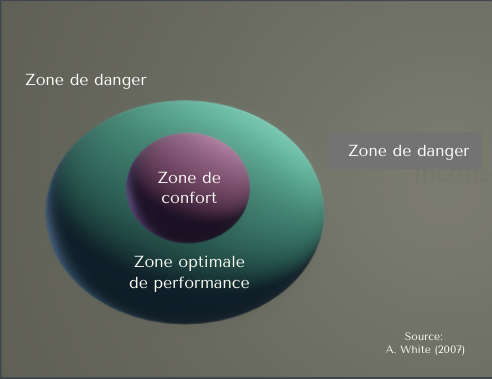 A little further on in the same book, the authors propose a combined vision presenting two comfort zones.
The first would be the initial zone mentioned above, and the second would be characteristic of a new state of the individual, i.e. one generated by a change, a transformation beyond the comfort zone into the optimum performance zone.
Among the skills expected in the 21st century, we can now read the famous recruitment criteria of "team spirit" and "collaboration". Collaboration is encouraged at school and in the workplace, sometimes with little regard for the specific characteristics of each individual.
Can we ask an introverted student to stop being the "self-effacing" person she appears to be to her teachers or fellow students? Yes, of course we can, you may reply. Professors even demand it, in the belief that it's the only way for students to succeed in their studies.
Similarly, in many jobs, the employee is expected to be a "team player". However, one might wonder what happens to the new employee or student in question as an individual with personality components that are sometimes far removed from those of their colleagues or classmates.
Aren't they at a disadvantage from the outset? Can we still speak of fair competition when two individuals, one introverted and the other extroverted, face the same challenge? Collaborative spaces are multiplying in schools and university libraries. The same is true of companies, which are proud of their new collaborative workspaces. Gone are the individual offices for some companies, such as many that operate in start-up mode, and in their place are offices ready for collaboration.
New independent collaborative workspaces have also emerged to adapt to new working styles. But what about the individual? Aren't we trying to shape a kind of worker with extensive social skills, to the detriment of his own personality and his sometimes enormous need for space? His comfort zone may not be limited to his desk.
According to Susan Cain, forcing employees to work in an open office is counter-productive, as it puts them at a disadvantage, and forcing introverts to act like extroverts is very stressful, as it's not their natural behavior. As a result, their work is affected, particularly their ability to concentrate in an environment that has become "too noisy".
Paradoxically, advice is abundant for introverts, but the issue is much less addressed when it comes to the other side of the fence: that of business leaders, who must learn to create optimal conditions for each of their employees to work in a conducive environment, such as having permission to be alone, having control over their environment, being able to dose sensory stimuli or even being in a state of "psychological safety".
These are skills that can be learned, some will say, but how many of them will make the effort to try and understand the emotions aroused or the state of anxiety or even anguish that this can generate in some introverts? What's more, even if it turns out that some introverts do manage to get out of their so-called comfort zone and venture into what some specialists call the "danger zone", how long will they be able to stay in this zone of effort? What about the effects or negative emotions of frustration or anxiety generated? As soon as an individual is in the effort zone with a view to developing their performance, they are in conflict with who they are.
Motivation and anxiety are sub-attributes of performance, but too much stress or anxiety alters performance (Alstair White).
Susan Cain's position also echoes that of Melody Guilding, coach, writer and professor of human behavior at Hunter College in New York, who also maintains that leaving the comfort zone is counter-productive, despite the praise of many personal development preachers.
In an article published in The Guardian in November 2018, Wilding stresses the need to do away with the "get out of your comfort zone" injunction, which she believes encourages the cult of performance that led her to burnout. She's been there, done that, and now she's pointing the finger at those performance enthusiasts who take a dim view of staying in that zone. In passing, she quotes a comment spotted on a social network: "The comfort zone is a beautiful place, but nothing grows there." We may indeed be tempted to want to get out of it at all costs in order to improve our performance, but this can also be to the detriment of our health and well-being.
On the contrary, our teacher and social worker is a firm believer in the hospitality of this zone. For her, being constantly outside this zone is harmful. On the contrary, we need to recognize this zone and respect it, so as to find a refuge from all forms of exaggerated anxiety in which we can recharge our batteries.
Illustrations: Jason caruso
References
From comfort zone to performance management: understanding develoment and performance (Alasdair White)
https://www.researchgate.net/publication/228957278_From_Comfort_Zone_to_Performance_Management
Please stop telling me to leave my comfort zone
h ttps:// www.theguardian.com/us-news/2018/nov/16/comfort-zone-mental-health
Why the Open-Office Environment Is Bad for Introverts
https://www.business2community.com/books/why-the-open-office-environment-is-bad-for-introverts-02237843
Change your habits, change your life (Bob Proctor)
https://www.youtube.com/watch?v=4MzwuMo0rTk&t=301s
Getting out of your comfort zone: an essential requirement for learning (Ilios Kotsou)
https://www.rtbf.be/lapremiere/article/detail_sortir-de-sa-zone-de-confort-un-imperatif-indispensable-a-l-apprentissage?id=10038971
You might also like:
In learning, how to move from the individual to the collective
Philosophical, sociological, psychological and educational science points of view to move from the individual to the collective
Can AI Be Impartial in the Recruitment Process?
Human beings have a predisposition to judge their fellow man. Consequently, one might think that professional or academic recruitment should rely on artificial intelligences. After all, they should not have the cognitive biases that we have. But this is not always true, as experiments and studies show that they learn from our discriminatory actions.
Recognition at all costs and self-fulfilment
Recognition is the most common way of giving value to others, based on their involvement. However, a frantic quest for recognition can have a negative impact on self-fulfilment. Focusing more on collective recognition will enhance a system's success and create a solid foundation for openness to others and fruitful collaboration.
If it seems unthinkable to call students by a gender-neutral pronoun, Sweden has done it. Since the late 1990s, the Scandinavian country has respected the gender identity of both adults and children. While this is not always palpable in the general population, this giant step inspires other countries to follow suit.
The threshold effect in group learning
Studies attest to the importance of collective ecosystems conducive to "exponential learning" within a group.