Publish at December 08 2019Updated February 07 2024
When a legendary witch comes to the rescue of an island's culture
Gran mèr Kal , kél èr i lé?
Gran Mèr* Kal, kél èr i lé*?
There was a time when the name of this witch, so famous on Reunion Island, was heard loud and clear in school playgrounds:
Gran Mèr Kal, kél èr i lé?" the children would shout.
-It's twenty-three o'clock
- Gran Mèr Kal, kèl èr i lé?
- It's midnight. I'm coming !!!!" cried the witch.
Chased away by the wicked witch (a child chosen for the occasion), all the frightened children fled.
Midnight. Ah, that fateful hour of transition between the sacred and profane worlds, when suddenly everything becomes an excuse to hide: witches are out, ghosts come wandering in, spirits of the dead linger outside! Beware of those who are not safe at this late hour! And let's not forget the island's many beliefs:
- Don't go under a tree at night, it's bad for you", warned the elders.
And what aboutGran Mèr Kal?
Who was this famous grandmother of Réunionese legend?
Everyone on Reunion Island has heard of this oral legend, at least the older generations. It reflects a flamboyant imagination, sometimes reflecting fantasy, sometimes imbued with a certain ideology. There are many versions of this story, and legend lends her many origins. According to some sources, she was a slave living in the south of the island, but this version is disputed.
According to others, she was a wicked woman who mistreated slaves.
At least, this is the version that comes out most often, such as the one in "Contes et légendes de l'île de la Réunion" by Isabelle Hoareau, published by Orphie.
According to this version, Gran Mèr Kal lived on a large plantation with many slaves; she was ruthless, and her slaves paid the price for her great wickedness. One day, Mafate, a slave on the plantation, tired of this life of misery and injustice, went maroon* ("fled") into the forest.
He took refuge in the heart of the island, in a paradisiacal natural setting with rivers, hundred-year-old trees and a marvellous natural environment, and hoped to bring the other slaves from the plantation there. Unfortunately, on the night of the escape, his plan failed because another slave denounced him, but he still managed to escape.
Using his knowledge of the properties of plants, he prepared a mixture for Gran Mèr. She transformed herself into a night bird and took to the skies, crying"Tout Tout!" And so, all the slaves were freed and lived happily ever after with their great brown chief Mafate. Gran Mèr Kal's ultimate and eternal punishment was to come and warn each family when danger was about to strike...
Another version even attributes to her the wrath of the Piton de la Fournaise volcano on Reunion Island. She is said to live in the volcano and to kidnap children who are dirty, who don't obey their parents or who hang around outside at night, and lock them up in the volcano...
A witch on the borderline between the imaginary and the real, fuelling fear...
The story of a wicked witch corroborates the unfortunate habit of the island's elders of scaring children. It was common to hear parents telling children, "If you don't behave, Gran Mèr Kal will come and get you! This threat is not specific to the witch of legends. In fact, beliefs abound on the island, and "zistwar bébèt" - by which we mean scary stories - fuel the island's legends.
In the beliefs of the local Réunionese people, venturing under a tree at certain times of the day can sometimes lead to strange experiences: these hours are called"bad hours", or"mové lèr" as they say in Réunionese Creole, as the trees are said to be frequented by spirits. As children, it was not uncommon to hear parents warn their offspring: "alé" pas mars dann' boi 6 zèr" (don't venture into the woods at 6 p.m.). And that wasn't the only time:
Noon,
Six o'clock in the morning,
... and of course the most famous of all hours: Midnight!
Many local beliefs associate the tree with a place highly prized by spirits. On Reunion Island, many anecdotes linked to passages under trees have marked the childhoods of young and old alike, anecdotes perpetuated by parents, grandparents and all deceased great-grandparents.
Where do these beliefs come from? Without further research, it would be difficult to define them, as the literature on the subject is sparse. What we can say so far is that the anecdote about the tree is based on various belief systems: African, Malagasy, Indian and European, which have spread into Creole thought [1].
An interesting extract on the link between this belief and the tree would position its origin in Hinduism:
[Certain deities have an ambiguous status in Malbar society. Thus, the brotherhood of gods collectively called Mini (who are reputed to stand in the foliage of certain trees) has given rise to beliefs in spirits of the same name, often likened to wandering souls. Their danger comes from the fact that they are liable to pounce on the unwary who pass unprotected under the tree where they are perched, to seize him by possessing him].
It has to be said that the island has no shortage of strange stories. Superstitions for some, realities for others, everyone is free to believe or smile.
An island under the winds... influences from elsewhere
Scare stories have had their heyday. With the advent of television, then the Internet and its host of distractions and video games, Gran Mèr Kal has faded somewhat into obscurity, as children's interests have turned more towards other interests and other characters from fairy tales and fiction, to the great detriment of the island's legendary characters: Ti Jean, Gran Diab, Toto.
Oral transmission is less and less common, a fact that storytellers regret. Despite the fact that local stories now have a material support in the form of books, they are struggling to become known and popular among the younger generation, who are more attracted by the Snow Queen or other stories.
What's more, with the phenomenon of globalization, Réunion Island, a French department located in the Indian Ocean, is also affected by other cultural influences from elsewhere, sometimes even from very far away, as is the case with Halloween. Nor is it spared by the attraction of young and old alike to this custom from the other side of the Atlantic, and local culture takes quite a hit, much to the despair of local storytellers and cultural activists who deplore the lack of interest in their island's culture among the younger generation.
The history of this Indian Ocean island is marked by its slave-owning past and the many migrations from Africa, Europe, Madagascar, India and China that have made up its multicultural rainbow population. This mix of cultures has given the population an open-mindedness and tolerance of different cultures, traditions and religions. This cultural mix is reflected in its legends, with their influences from elsewhere.
However, while open-mindedness is tolerant of outside influences, it is far less tolerant of local culture being neglected or even overshadowed, as in the case of Reunionese literature, which is already suffering from the lack of investment by certain local decision-makers in taking this reality into account.
Some writers even allude to this cultural "intrusion", as can be seen in the book "Mais que fait donc Grand-Mère Kalle" by Joëlle Ecormier (a screenshot of the video of the story is attached). It shows the main character, Grand-Mère Kalle, furious and kicking a pumpkin. The cultural reference here is clear.
We can also read that Grand-Mère Kalle "doesn't like her stories told just when it's Halloween." What's more, in the video, the narrator even adds"By the way, Halloween didn't exist before!" implying that because of this tradition across the Atlantic, it's been consigned to oblivion.
Legends have populated children's imaginations before. The memories are memorable. And yet, the local oral tradition struggles to gain the recognition it deserves.
Gran Mèr Kal or when a legendary witch comes to counter Halloween...
An initiative by the cultural department of a commune in the east of the island aims to bring Reunion's culture, and in particular its tales and legends, back into the spotlight.
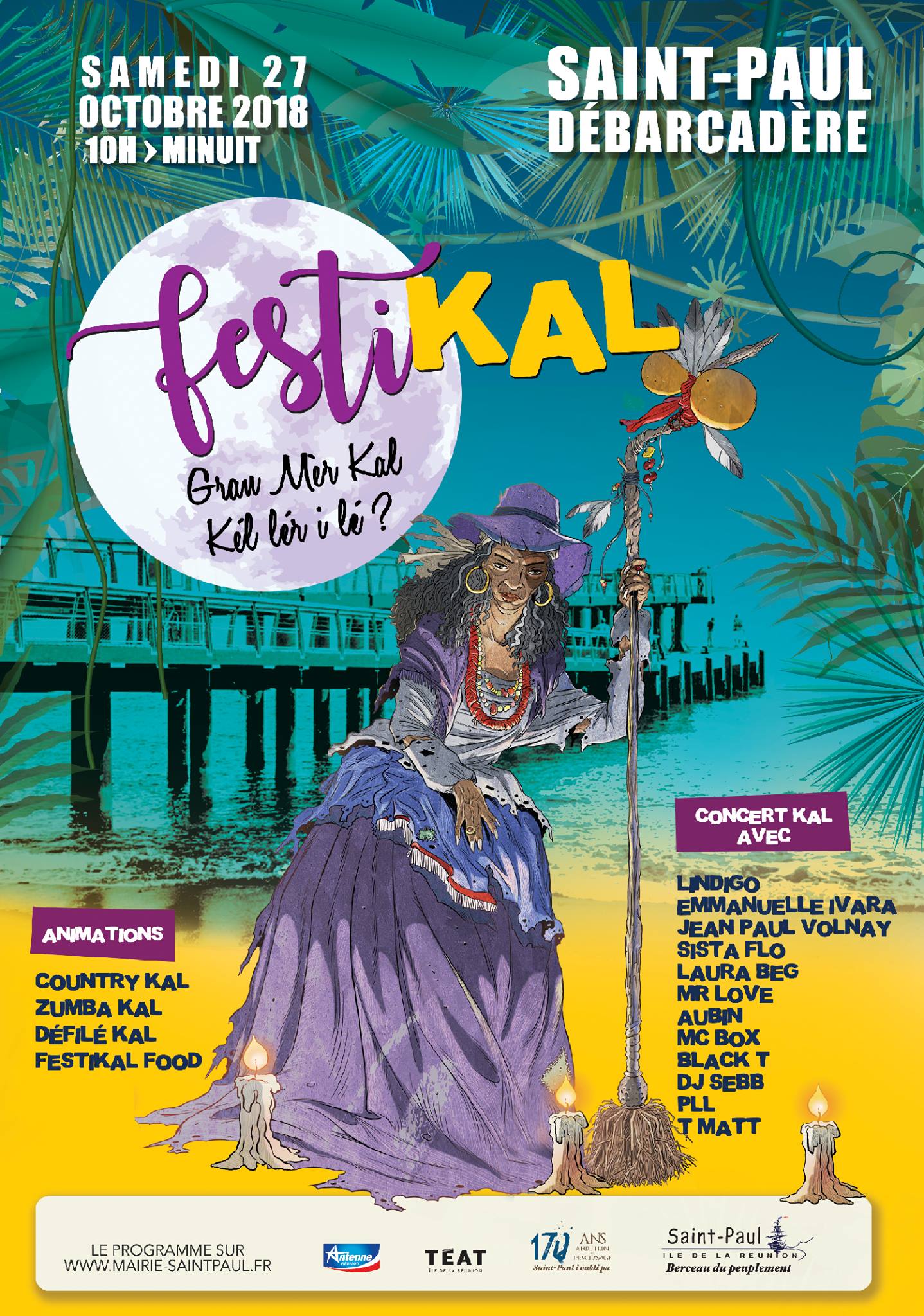
In fact, an event called Festikal was set up a few years ago to promote or rediscover the island's literary cultural heritage and, at the same time, counter Halloween. The date of the fortnight-long event coincides with Halloween, which enjoys a certain popularity if the many events organized around the island for the occasion are anything to go by.
On the program are a number of oral storytelling sessions organized over several days and in different parts of the commune, tales and legends from Reunion told by storytellers, some of them in Reunionese Creole (the mother tongue of a large majority of the island's population) and of course the famous scary legends, all in a sometimes festive atmosphere...
While it's true that the festive side of things sometimes wins out, and that Halloween may still be in the imagination of these little children in spite of its diverted purpose, it's nevertheless a good initiative that serves to enhance the local culture.
So, Gran Mèr Kal, kél èr i lé?????
Illustrations:
Header: Sabrina Budel Posters Festikal: Photos Commune de Saint-Paul Image Gran Mèr Kal: video screen capture Département de la Réunion Photo: screen capture Imaz Press réunion
Notes:
*Gran Mèr: the Creole spelling has been retained, as it is tolerated in written form in the context of Reunion's strong Creole/French bilingualism.
*Gran Mèr Kal, kél èr i lé?*= Creole translation of the French "Grand-Mère Kal, quelle heure est-il?
aller marron: to run away from the master's plantation (referring to slaves)
A marron: noun meaning a runaway slave
References
Mais que fait grand-mère Kalle ? ( Joëlle Ecormier , Nathalie Millet)
From collective intelligence to social networks, from good data to fake news... cognitive biases to knowledge management, our society is evolving when it comes to the nature of our thoughts in both form and content.
More and more people are rethinking their lifestyles. Housing is at the heart of these concerns, as it represents a point of attachment and a major budgetary constraint. Some people are living differently and doing very well. They are proof that for many people, being is definitely better than having.
The education sector, among others, has voiced its fears about AI loud and clear. Would students use them to do their homework? How would pedagogy change in the years to come? A few years later, learners talk about their perceptions of this tool.
The Catholic Institute of Lille is an institution of higher learning that is launching a social innovation project by setting up a living lab, a school ground for its students. A daring way to create the world of tomorrow?


 However, while open-mindedness is tolerant of outside influences, it is far less tolerant of local culture being neglected or even overshadowed, as in the case of Reunionese literature, which is already suffering from the lack of investment by certain local decision-makers in taking this reality into account.
  While it's true that the festive side of things sometimes wins out, and that Halloween may still be in the imagination of these little children in spite of its diverted purpose, it's nevertheless a good initiative that serves to enhance the local culture.