Problem situation
What would be the value of a wealth of knowledge about complex theories in entrepreneurship, the global economic market or the 3D modeling process for a commercial product, if this fragmented knowledge could not be mobilized by its holder in a real and complex business situation?
In other words, not being able to make the link between these pieces of knowledge would be far more damaging than not mastering everything about them. Interactions between knowledge are indispensable when it comes to knowing how to act, because isn't that the ultimate goal of all learning? This is even more true in the field of entrepreneurship, where knowing how to act, knowing how to know how to behave and knowing how to be.
In this sense, entrepreneurship education is an excellent entry point for developing the learner's savoir-agir. As one of the approaches on which active pedagogy is based, the problem situation is an excellent way of achieving pedagogical objectives.
"(...) school-based learning offers the best opportunity to develop entrepreneurial attitudes" (Kearney, 1999).
A range of skills has been identified in various research studies with regard to entrepreneurial attitudes. These attitudes, transposed to the school or academic setting, emerge in the deployment of a meticulously deployed entrepreneurial pedagogy.
Kearney's 4 pillars of entrepreneurial education
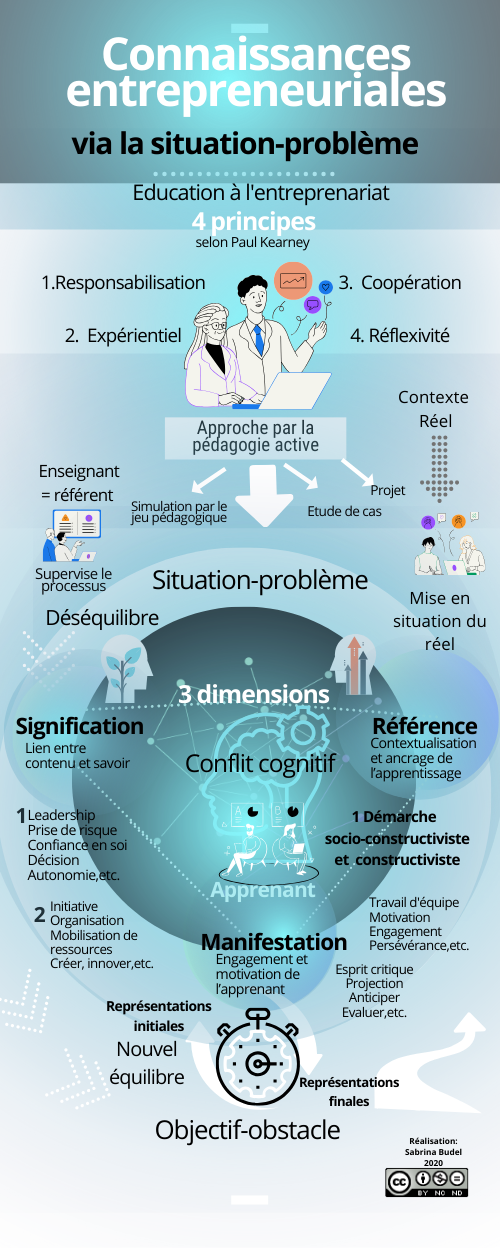
One of the pioneers of entrepreneurial education, Kearnkey, defined four key principles:
- Learner empowerment , which aims to make the learner the master of his or her own learning, moving from being a "student" to an entrepreneur of his or her own learning and life. The teacher must also be careful not to remain in a magisterial posture, as this will disempower the learner. They must delegate while supervising the learning process. His role is akin to that of a guide or referent.
- Experiential learning: learning must reflect reality. In other words, it must enable the learner to develop skills that will be useful in his or her future professional life. Projects, case studies and role-playing simulations are ideal for recreating a learning framework based on reality.
- Cooperation: learning here is part of the constructivist and socio-constructivist trend. Pedagogical activity is planned in such a way that learners have the opportunity to interact with their peers in order to construct their own learning. The sum of intelligences is always greater than individual intelligence. For this reason, the given task must not be too easy, so that it can only be carried out by peers.
- Reflexivity: metacognition is essential to enable learners to step back and take a look at the learning they have done, to see what worked and what was less positive.
Failures are often formative, and becoming aware of them through self-analysis will enable the learner to anticipate future actions and plan new ones. In the same way that an entrepreneur plans meetings with his project team, it is also necessary for this metacognition to take place during the process, in order to reduce any readjustment gaps that may arise.
Learning from problem situations
Let's be clear: the problem situation is not a problem. Rather, it should be seen as a situation that leads not to a unique solution, as in a mathematical problem where the solution is known in advance, but rather as a means of achieving a given learning outcome, with defined objectives, distributed tasks and clear instructions.
The problem-situation is a
"didactic situation in which the subject is presented with a task that he or she cannot complete without carrying out specific learning. This learning, which is the real objective of the problem situation, is achieved by removing the obstacle to completing the task. In this way, production imposes acquisition, both of which must be assessed separately.
Like any didactic situation, the problem-situation must be constructed on the basis of a triple diagnostic assessment of motivations, skills and abilities." (Meirieu, 1992)
The cooperative learning framework must give rise to a cognitive conflict between learners, which also requires a certain cognitive flexibility on the part of the learner, i.e. the ability to submit his or her point of view and take into account that of others simultaneously. This cognitive flexibility will enable the learner to respond satisfactorily to the problem situation presented.
Constructing entrepreneurial knowledge via the problem situation
Entrepreneurial pedagogy (also known as entrepreneurial pedagogy) is based on the use of problem situations.
Entrepreneurial pedagogy involves putting the learning objective into action, and implies an active pedagogy. Several approaches are possible, such as pedagogical projects, case studies, game-based simulations and, of course, problem-based situations.
Building a training program based on entrepreneurial pedagogy requires know-how that Deleuze defines around three fundamental dimensions, which he himself calls the "logical proposition":
- signification, which refers to the link between content and the nature of knowledge
- reference, which tends to place learning in a context that can be found in reality. We can also make the connection with one of the key principles of Kearney's pillars of entrepreneurship education, i.e. experiential learning.
- the event that must engage and motivate the learner in the proposed task.
Computer graphics: entrepreneurial knowledge and problem situations
Feedback
Situation-problem, project-based teaching and role-playing in a university distance learning course
Several years ago, I attended several seminars on the design of techno-pedagogical teaching devices. As part of these seminars, we were presented with several problem situations. One of them was particularly interesting in that the instructions required the simulation of different learner roles: group leader - team leader - designer - tutor - reporter.
Here, there can be a certain sense of stepping out of the comfort zone insofar as students who, in their actual professional status, could find themselves in a superior role vis-à-vis other peers in the team.
For example, in the same group, university professors rubbed shoulders with trainers, secondary school teachers or other learner/student profiles in continuing or initial training, or technology professionals. This was a stimulating challenge, insofar as I found myself in charge of a team of my training peers, some of whom were professors in higher education.
In addition, many of the skills underlying Kearney's four principles mentioned above were also required, as I had to demonstrate :
- self-confidence and initiative to lead the group of teachers/learners
- organization in planning the group's work (meeting deadlines)
- autonomy in individual work
- team and conflict management
- communication (diplomacy, intercultural communication).
One of the tricky aspects to take into account was the cultural diversity of the group. Learning to work in this cross-cultural group synergy was extremely enriching, and the situation was made all the more complex by the fact that it involved long-distance collaboration.
This involved skills specific to this type of work:
- remote communication, and therefore mastery of communication codes in remote teamwork.
- autonomy in online learning
- organization
This also implied managing different levels of distance: geographical distance and, to complete the picture, time zones with fairly substantial discrepancies.
- psychological distance (mobilizing peer support)
- cognitive distance
As far as technological distance was concerned, for the most part we were already familiar with the mediatized training environment and the various collaborative tools at our disposal. Apart from a few connection problems for some learners, which also had an impact on the smooth implementation of the project.
For this seminar, we were asked to look at a collective project involving the deployment of a distance learning system on the theme of an introduction to sustainable development.
In concrete terms, we were all placed in a simulation of a real-life situation. This simulation of the real, translated as a reference by Deleuze or experiential learning, was an intrinsic source of motivation.
As professionals subsequently called upon to support the implementation of such pedagogical systems, the project made sense and also echoed Deleuze's second dimension in the use of the problem-situation, which is meaning itself. What's more, the third dimension was more than obvious.
In concrete terms, the project was based on not one but several problem-situations that had already been approached in a similar way. Our task was to mobilize all the skills and knowledge we had already acquired to respond effectively to the deployment of the system.
Ultimately, to echo the introductory statement, the interactions between this acquired knowledge and the achievement of a "proposal" by mobilizing both the learner's savoir-agir and savoir-être, while taking advantage of the supervisor's know-how, were fundamental to the success of the learning project.
In short, entrepreneurial pedagogy is an excellent way of developing new learning. The sine qua non, of course, remains the delicate and judicious handling of the various choices made by the teacher.
Illustration: Adobe Stock by Par FS-Stock
Computer graphics: S. Budel
References
Experimenting and cooperating to learn to undertake
Un livre de référence pour les équipes pédagogiques des cursus d'entrepreneuriat - Caroline Verzat
https://www.cairn.info/revue-entreprendre-et-innover-2011-3-page-113.htm
Using problem situations to build entrepreneurial knowledge - Olivier Toutain
https://www.cairn.info/revue-entreprendre-et-innover-2011-3-page-127.htm
Training for entrepreneurship?
Reflections on the pedagogical approach to entrepreneurship - Bernard Surlemont
https://shs.cairn.info/revue-entreprendre-et-innover-2011-3-page-113?lang=fr
Entrepreneurial pedagogy: an approach to developing cross-disciplinary skills - Mélissa Philippe
https://eductive.ca/ressource/la-pedagogie-entrepreneuriale-une-approche-pour-le-developpement-de-competences-transversales/
Les situations-problèmes... vingt ans après - Philippe Meirieu
https://www.meirieu.com/OUTILSDEFORMATION/situationsproblemes.htm
See more articles by this author