
85% of the jobs that will be practiced in 2030 do not yet exist... probable or improbable?
Let's try to see more clearly what is really evolving in the professions, beyond the job titles.
Publish at June 01 2020 Updated February 23 2023


What organization, what key skills and what management to rebuild after the crisis? The organizations that would have been presented as examples of success a few months earlier are no longer so, employees' aspirations are different and teams are dispersed while it is more necessary than ever to be a group... However, many solutions are undoubtedly emerging for a few years.
He disappeared in 1905 during a trip to the North Pole. He was thought to be dead. But now he is found in 1969, frozen, but alive and with the appearance and health of a 25 year old. He is thawed, treated, and to avoid a fatal emotional shock, he is made to believe that he is still in 1905... This is in a few words the scenario of Hibernatus where the main character, Hubert de Tartas hosts his wife's grandfather by simulating the activity of a bourgeois house in 1905.
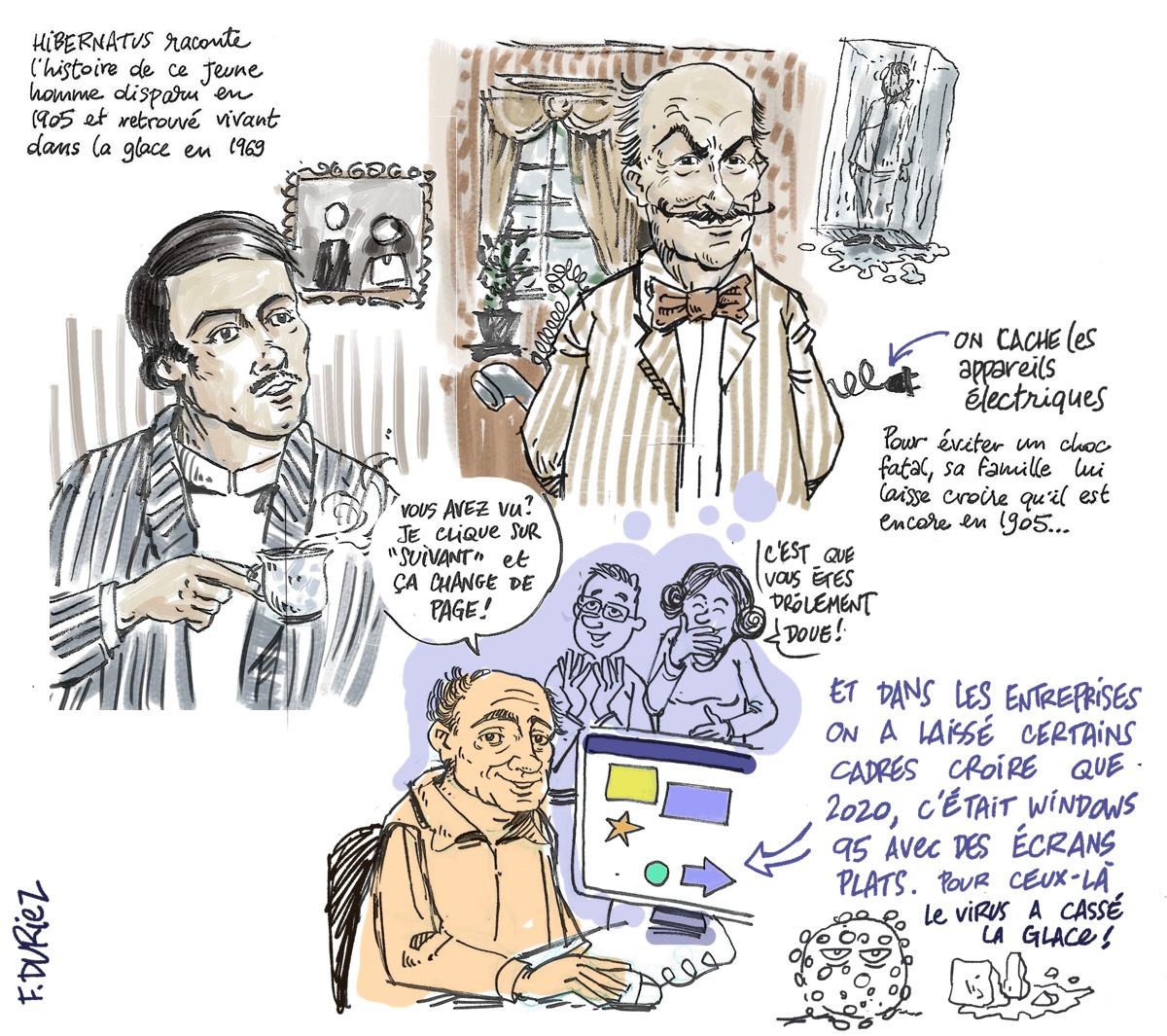
Hubert de Tartas is exposed to a series of twists and turns until he breaks down and reveals to the survivor the deception, and the technological leap he went through in his ice block while unconscious: television, rockets into space, automobiles...
This story offers a parallel to what many people have experienced in recent months. Protected from modernity and digitality by colleagues and assistants, they had stayed out of the digital world and they didn't mind. With a few rudiments of Word and PowerPoint and a browser to visit a search engine, they could give the change by keeping their time counter blocked on the year 1999. Google had replaced Altavista and the screens had gone flat. Otherwise, nothing.
Processing video, image, sound, communicating on networks, confronting without getting lost the platforms of administrations, feeding or using databases, working on a cloud... Never. In March 2020, many executives were particularly concerned by this very low "digital literacy". They were sometimes surrounded by eager people who saved them too much effort on their computers. They were blocked from updates so they wouldn't get confused. But now, the confinement suddenly made it necessary to use digital technology intensively to ensure continuity. And many experienced a shock similar to that of Paul Fournier, the 25-year-old grandfather in Hibernatus.
So many teachers discovered distance learning and sometimes shared more with colleagues... It was often personal initiatives, peer-to-peer help, suggestions from students or parents that led to solutions. In business, it was necessary to rely on informal know-how, often acquired elsewhere, to ensure continuity. It is difficult to go backwards. The development of individual and collective skills has led to needs for autonomy, sharing with peers, and participation in reflections.
In an article on Let's Talk HR, Mickael Vandepitte continues this analysis. The health crisis of early 2020 will have forced companies to develop their digital skills, teams to flesh out their communication skills and leaders to redefine their management style.
How do you develop a sense of belonging when no one has set foot in your company for more than 2 months? How do you coordinate when some are on site and others stay home. Sharing values, culture and strategy when ...
Adrien Chignard is a psychologist. In an interview, he imagines three reactions to the return of containment. Some managers will have a martial speech: "We lost almost three months, you had time to rest, now you have to redouble your energy!" In four words : "the vacations are over".
Others will get the departments and workshops back up and running without question, mechanically, as if meeting after a long weekend or a week of vacation. Finally, some managers will let the teams speak and allow expression based on simple questions. They will open the floor to what they experienced during the confinement, what they missed, what they would like to keep from the adjustments of this period. Consistent with the work of psychologist Karl Weick, he invites them to produce meaning with the teams, about the changes they experienced.
Raphaël H. Cohen proposes some concrete questions. Catherine Besse, for her part, imagines a hosting scenario.
Everyone has experienced the crisis individually. Economic fear, family stress, overwork, feelings of abandonment. Some may say to themselves, "I left, no one noticed. I came back. No one noticed"...
Psychologists and caregivers have been quick to urge companies to be mindful of the consequences of unchosen and abrupt telecommuting in an environment of personal and professional uncertainty. Boris Cirulnyk urges building collective resilience by making room for listening, expression and relationship. Catherine Tourette-Turgis also emphasizes listening, presence, flexibility and caring.
Freek Vermeulen confirms to us that crises reveal the ineffectiveness of certain habits. For example, after a prolonged strike, some people who have adopted cycling do not return to the habit of public transport. In times of crisis, unsustainable solutions are also put in place that will disappear. Should we regret our commitment and efforts? Not according to Freek Vermeulen. Because the group has developed skills in experimentation...

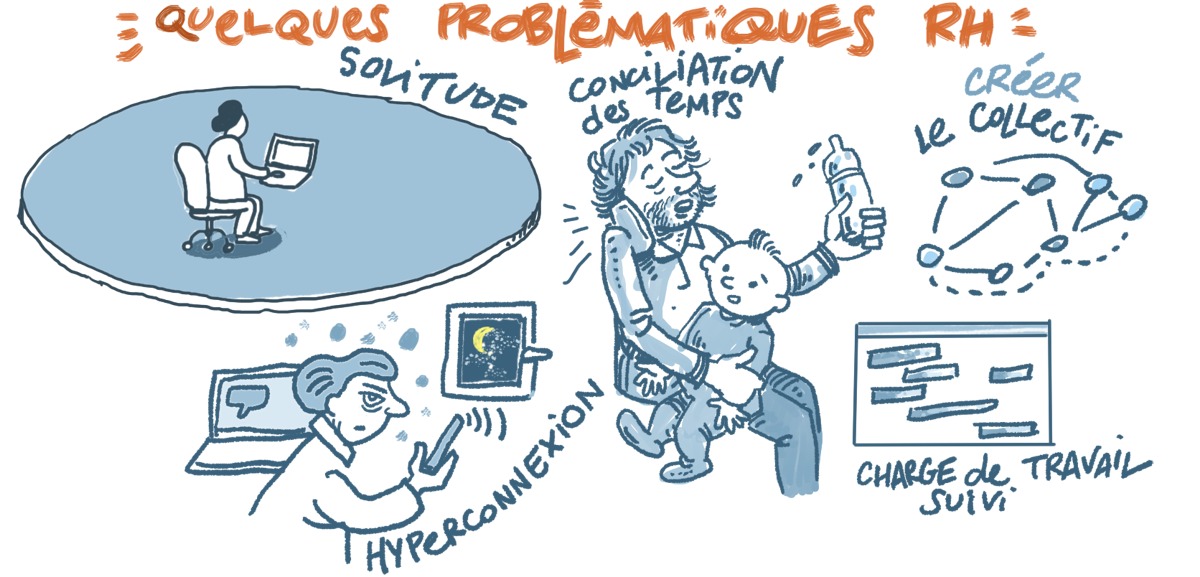
In a very pragmatic way, the new business counter offers us a guide to adapting human resources to the new environment. In particular, the authors share a very useful list of psychosocial risks that should be anticipated, some of which are illustrated below.
Crossing someone in a hallway, sitting next to a colleague and seeing that the chairs are touching, hearing a facilitator clear his throat to clear his voice : harmless moments a few months ago. Nightmares today. The spatial organization of companies must be rethought according to the interactions. Architects must imagine the situations of communication, meeting, displacement and redesign the spaces to take into account the changes of needs. Because we no longer pass each other as we used to in a corridor, we no longer meet in the same way...
The large work area (open-space) seems to have lived in its old form. A restaurant in China, a call center in Korea have cast doubt on the air currents propelled by air conditioners in large spaces... In both cases, a single misplaced person could have contaminated several dozen. And even if nothing is scientifically established, nobody wants to take the risk. The desk, chair and computer station shared between several colleagues are also in trouble, at least in their classic form.
Benoît Serre, from the national association of human resources directors (ANDRH) insists on the necessary reorganization of time and space and on the need for security felt by the teams.
In 2019, an argument had to be made to work from home. As of May 2020, you may have to argue to explain that you have to come to the office... Face-to-face has to make sense. But times and spaces are no longer watertight. In training, we are starting to talk about comodal to refer to these training or teaching courses where we work both face-to-face and at a distance. It's not about doing the same thing, but about intelligently dividing roles and creating interactions around activities or sequences.
Remote, the entire organization holds together because of the availability of people, applications and connections. The company of the 2020s must be able to continue a business by radically changing its means, shaking up its supply chains and dispersing or gathering its teams. Versatility, cross-functional skills, mutual adjustments that no longer involve long meetings are the new survival factors. Supply logistics, changing distribution channels in the industry are also essential.
But above all, "plan B" has become essential in the preparation of any action. An application overloads, bandwidth runs out, a key employee on a project lacks a network or is personally affected by a difficulty, a supplier is affected by a stock or production shortage... So many scenarios where you have to react quickly and know how to "cobble together" solutions with what you have.
Illustrations : Frédéric Duriez
Resources
Fabienne Broucaret - My happy job - Top 10 articles to read for the post-confinement era - April 23, 2020 - accessed May 30, 2020
https://www.myhappyjob.fr/reprise-du-travail-top-10-des-articles-a-lire-pour-preparer-lapres-confinement/
on-management :
Raphael H. Cohen - how to rethink your managerial posture, Harvard Business Review - May 2020 - accessed May 30, 2020
https://www.hbrfrance.fr/chroniques-experts/2020/05/30299-comment-repenser-sa-posture-de-manager/
Catherine Besse - https://www.speciman.fr/coronavirus-manager-retour-travail-apres-confinement/ accessed May 30, 2020
Executive Mail - interview with Boris Cirulnyk : After the coronavirus crisis, the performance culture will be criticized
http://courriercadres.com/management/conducting-change/boris-cyrulnik-apres-la-crise-du-coronavirus-la-culture-de-la-performance-sera-critiquee-20042020 accessed May 30, 2020
Romane Ganeval - Welcome to the jungle - interview with Catherine Tourette-Turgis - Back to work : "Thinking that everything will go back to the way it was, it's illusory"
https://www.welcometothejungle.com/en/articles/interview-after-containment-enterprise
Mickael Vandepitte - Let's Talk HR : "Containment : an opportunity to capitalize on emerging skills - published April 29, 2020 - accessed May 30, 2020
https://www.parlonsrh.com/confinement-opportunite-de-capitaliser-sur-les-competences-emergentes/
Mounia H. Hocine, Anne-Sophie Godon-Rensonnet, Jérôme Lanfranca - The New Enterprise Counter - Deconfinement : how to prepare for the return to work? - accessed May 30, 2020
https://lecomptoirdelanouvelleentreprise.com/deconfinement-comment-preparer-le-retour-au-travail/
And more generally, the special dossier compiled by Le comptoir de la nouvelle entreprise devoted to telecommuting.
https://lecomptoirdelanouvelleentreprise.com/dossiers/dossier-special-le-teletravail-en-periode-de-confinement/
Melanie Roosen - interview with Freek Vermeulen - innovation-DNA- bad managerial habits are comparable to viruses - published May 14, 2020 - accessed May 30, 2020.
https://www.ladn.eu/entreprises-innovating/new-governments/bad-management-habits-comparable-virus/
Florence Mehrez, interview with Benoît Serre - Actuel-RH - Legislative Editions - online April 22, 2020 - accessed May 31, 2020
https://www.actuel-rh.fr/content/les-entreprises-doivent-des-present-preparer-le-deconfinement
Adrien Chignard - interview with Psychology Magazine - How to properly manage the return to work after containment - accessed May 31, 2020
https://www.psychologies.com/Actualites/Vie-pro/Comment-bien-manager-le-retour-au-travail-apres-le-confinement
You might also like:
85% of the jobs that will be practiced in 2030 do not yet exist... probable or improbable?
Let's try to see more clearly what is really evolving in the professions, beyond the job titles.
Massively multiplayer online role-playing games in education and training
Massively multiplayer online role-playing games (MMORGPs) are now one of the most dynamic segments in the video game industry. But what about education? What experiments or educational uses can and have been carried out using MMORPGs?
Some contributions to a mythology of training
The world of training is full of stories that we pass on to each other and that illustrate major pedagogical principles. These stories crystallize around characters, objects or even concepts. They form a collective mythology that is shared and told regularly, consolidating our representations. In this article, I offer you a partial, disorganized and subjective sample of the stories that weave a mythology.
Promote inductive teaching methods and take risks
As a teacher, if you're in a school with a questionable mentality, consider changing before you're disgusted with the profession. But whatever happens, do what you think is best for your learners, and challenge yourself at the same time, because everyone makes mistakes.


