Approaches to teacher professional autonomy
While the literature on learner autonomy is vast
in didactics, the literature on teacher autonomy is much less
much less extensive. It is a concept that is both vague and
It is a concept which is both vague and multiform and which emerged in the field of didactics
late, which depends both on the teacher himself as an individual
himself as an individual
with his personal and professional identity
but also on the much wider context of the
context of the latter :
institutions, families, educational policies as well as
institutional policies themselves.
All
First, there is autonomy, which is perceived by many as the freedom to act, the freedom of one's pedagogical choices.
For others, defining it would be a matter of defining the contours of
what it is not rather than what it could be.
Thus, the Belgian psychologist Polet-Masset
affirms that it is neither
individualism, neither the independence, nor the dependence. To believe
that it would be then the disorder, the freedom or the constraint
would also be false according to him.
him. In the same way, the autonomy
is not absolute power nor the absence of identity.
The autonomy of the teacher is described according to C. Martinez as the one who:
- "Accepts responsibility for what he/she experiences, makes decisions according to his/her personal criteria and makes choices about the interventions and pedagogical methods, which he/she uses in the classroom;
- Exhibits a sufficient degree of assurance in his/her role in the classroom. This is important because it touches on the person, his or her professional identity, and his or her representations of himself or herself;
- Is able to go beyond confrontation with the class group to enter into communication with students individually and adopt a creative functioning toward students."
Professional autonomy
professional under control...
When we talk about
autonomy, many
are inclined to talk about freedom, independence, but is this a red herring?
" While
official rhetoric insists on the necessary "professionalization" and the conversion of teachers to the
model of the reflective practitioner,
we can ask ourselves if we are not, on the contrary, witnessing a
loss of power
and autonomy of teachers in their daily practice, which
which leads one to speak
to speak of deprofessionalization rather than professionalization.
professionalization. " (Christian Maroy)
The professional autonomy
autonomy may seem like a paradox when we know that teachers are
when we know that they are placed under institutional constraints and under
the yoke of pedagogical reforms that constrain their freedom of
freedom of exercise and practice. If the professionalization of the teacher through
professionalization of the teacher through training is promoted by the educational
educational authorities as participating in their professional development
leading to greater autonomy, this professionalization also has a
also has a less envious side. Indeed, it is
perceived by some practitioners as " deprofessionalizing ".
This form of professionalization reduces the freedom
for the teacher to train when he or she wishes and on the
This form of professionalization reduces the teacher's freedom to train when he or she wishes and on the choices to be made regarding the objects of knowledge and skills to be
acquire. If the incentive to adopt a practitioner's approach
seems to give the teacher more autonomy,
the injunction to adopt predetermined practices based on
approaches that are increasingly socio-constructivist in their approach to learning
learning, the imposed modes of evaluation thwart the pedagogical
the pedagogical freedom of the latter according to C. Mauroy.
From
Moreover, the obligation of results via the success programs
for all is an additional layer of pressure that Christian Mauroy emphasizes in his analysis . In addition, they must face
parental interference in class councils, which has the effect of calling into question the
class councils, which has the effect of calling into question their
professional skills.
Better at the top level?
A
freedom that seems to take off more in higher education, where the teacher is no longer under the pressure of academic inspections
academic inspections, unlike in primary and secondary schools, but is this
But is it enough? Not so sure.
In effect, the incentive to
to use specific pedagogical approaches also reduces the teacher's
also reduces the teacher's margin of action in the choice of his or her
practices. One example is competency-based approaches, which also restrict freedom of strategic choice in practice, which is contrary to pedagogical freedom.
It
The same is true for the teacher in certain educational systems
so-called "spoon feeding " characterized by the pedagogy of
of " performance " in which the learner is only a good head to
only a good head to fill and where the teacher has still not left his pedestal of
pedestal of the masterly holder of knowledge, with little freedom in his
free in his strategic choices. So is autonomy a lure?
autonomy, is it a lure?
The components of the teacher's professional autonomy
For N. Monnier & N. Yassine-Diab, autonomy is not a lure; in other words, it is very much present. There would be several forms of it.
Three
visions of the professional autonomy of the teacher in French higher education have been identified
by Monnier and Yassine-Diab in a study conducted
among language teachers. The study reports
a rate of
- 54% of a vision of professional autonomy
centered versus
- 33% learner-centered and
- 13% for
a blended approach.
They
would be associated with adaptation, constraints, investment
investment, and...fun.
Adaptation
to the students, to their needs in order to prepare them
to their needs in order to prepare them as well as possible for their professional insertion, to their rhythm and
level but also to be free to adapt its teaching to the
characteristics of the group.
Autonomy would also be linked to
investment : being able to invest in projects and
in a desired degree.
It would also refer to pleasure, pleasure
of teaching linked to the realization of a childhood dream
teaching is part of their DNA for some, part of their identity.
The notion of passion is also present.
The interaction with students, colleagues stimulates, emulates and incites change.
and encourages change.
Finally,
autonomy is also for teachers jeopardized by constraints related to a
constraints related to a deterioration of working conditions, a lack of student
the lack of motivation of students, large classes or a heterogeneous
heterogeneous public. Similarly, human, material and administrative constraints
or administrative constraints work against the autonomy of the respondents in the study.
respondents of the study.
In addition, the study a leads to the definition of the components of the teacher's professional autonomy. These components are articulated at the heart of three axes that are professionalism, professionality as well as pedagogical and didactic knowledge.
power and freedom
knowledge and expertise
creativity and innovation
lucidity and analysis
collaboration and reflection
ethical reflection
Power to act or power in terms of skills? Both, according to the study's findings. As for knowledge and expertise, no one would be acting autonomously without mastering the essence of the discipline being taught.
Approaches
of Educational Innovation
" An
innovation is a measurable improvement that is deliberate, sustainable and
unlikely to occur frequently "(Huberman)
It
carries with it creativity, originality (Cros) and presents itself
with its share of new ideas, experiments, reforms, change
reforms, change, improvement.
From
In general, innovation involves both processes, services
processes, services, programs and partnerships. In
education, an innovative intervention must result in improved
improve learning and lead to greater equity.
It must also contribute to providing solutions to simple problems and be
simple problems as well as being of the same magnitude as the problem
it is trying to solve (UNICEF).
Innovation
innovation has been discussed by several researchers who have
defined its attributes.
- First, it refers to the " new "
(Cros), to renewal through the introduction of a practice
" borrowed " from other fields of activity.
- Some speak of " transfer " of practice. As
As M. E. Lacroix and P. Potvin point out, in education, several
innovation: we speak of pedagogical innovation, innovation in education
innovation, innovation in education, school innovation or simply
or simply innovation in training. It starts from an
intention on the observation of inadequate practices, a situation or
situation or maladjustment and aims to improve the objectives through a process
relative to the targeted objectives through a process of change
on a situation, a method or an operation (Cros).
(Cros).
Who
who says innovation, necessarily says change or modification at the level
of practice it is then also a question of innovative practice.
innovative.
However,
However, innovating for the sake of innovating is not innovative in itself, nor is it
innovative practice in education must result in the success of the students and the
should result in learner success and improved outcomes for learners.
of their results. Innovation is part of his
professional development process (F. Muller).
Innovation does not necessarily result
necessarily result from any use of technology but
since ICT is ubiquitous in our everyday lives
and in education, innovation often involves the use of tools,
methods or practices that partially, piecemeal, or fully utilize technology,
partially, piecemeal, or wholly involving technology.
The innovative teacher
innovative teacher is not necessarily the one
who adopts practices related to ICT but rather the one who learns and
and questions his or her practices and who adopts a reflective attitude
reflexive attitude towards his or her practices. A
A teacher who learns is a student who succeeds (F. Muller).
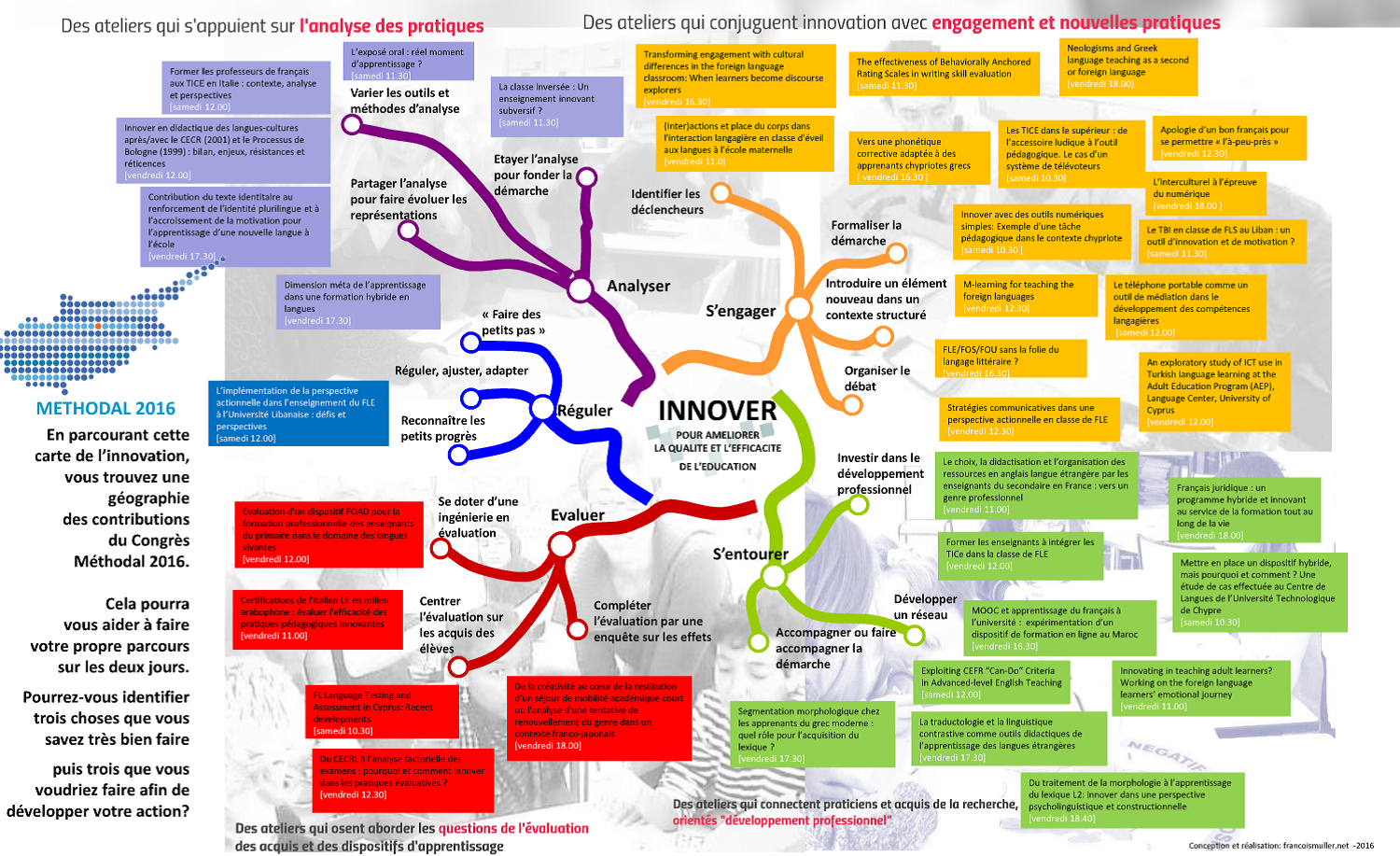
Innovating to improve the quality and effectiveness of education
is, according to François Muller :
to commit
identifying triggers, formalizing
triggers, formalizing one's approach, introducing a new element into a
new element into a structured context
analyze
by sharing his or her analyses to change representations
or by supporting his/her analysis with a view to founding his/her approach, by
varying the tools and methods of analysis
regulate,
with small steps, regulating, adjusting, recognizing the
" small progress "
evaluate,
by engineering assessment, focusing assessments on learning outcomes, and supplementing
assessments on learning outcomes and supplementing the assessment with an
an investigation of effects
surround yourself,
investing in professional development, developing a network, or coaching or
network, or by accompanying the process or having it accompanied.
process.
Regarding
the
innovative practices
innovative practicesin
education,
the Information Network on Educational Success (INES)
distinguishes various types depending on the actors (teachers, staff
,administrator, or a school). For the teacher, innovative
innovative practices refer to teaching practices,
also
also known as teaching practices
teaching practices
teaching practices as well as innovative didactic practices.
practices.
On
the question of creativity and innovation, one might
then ask what are the decisive factors among autonomous
autonomous teachers influencing pedagogical innovation.
The hypothesis
put forward by
Androniki Charitonidou according to
that the autonomous teacher is more inclined to innovate his/her
practice was confirmed by the results of the study. The study
conducted among Greek language teachers in higher education had
the purpose of the study was to investigate the autonomy
of teachers and
aimed to determine the
elements characterizing
the autonomous teacher and how they influence the decision to
the implementation of a pedagogical innovation .
Teacher autonomy is described according to C. Martinez as the one who :
- "Accepts responsibility for what he/she experiences, makes decisions based on his/her personal criteria and makes choices about the interventions and pedagogical methods, which he/she uses in the classroom;
- Demonstrates a sufficient degree of confidence in his/her role in the classroom. This point is important because it touches on the person, his professional identity and his representations of himself;
- Is able to go beyond confrontation with the class-group to enter into communication with the students individually and adopt a creative functioning towards the students."
It is on the basis of this definition by Martinez that A. Charitonidou and G. Loannitou conducted their study having as a focal point the three determinants stated at the very beginning, i.e. acceptance, assurance as well as overcoming the confrontation with the group-class. The findings of their study resulted in highlighting the following factors:
the
representations of self: being able
representations of innovation: rich
Relationships between teachers and their classes: interested students.
the
values: citizenship, discovery of others, regaining confidence
By
In addition, the authors also highlighted reasons identified in teacher discourse that did not encourage them to innovate:
the
representations of innovation: difficult
the
representations of his group: need to master his subject,
age
the
representations of oneself: lack of confidence
the
feelings: fear
the
means: inadequate training, teaching materials not
provided
The author
concludes his study with the following recommendations :
" to innovate the teacher must be able to demonstrate
autonomy and to do so, he or she must develop
skills ".
Autonomy
professional, motivation and integration of ICT
The
professional development has already been the subject of numerous studies.
many studies. When this development has as its context
the integration of ICT, the question of motivation arises
for the teacher. What are the motivating factors for teachers when they
What are the motivating factors for teachers when they want to integrate ICT into their practices?
The possibility of professional development, educational policies and the
educational policies and the organization of teaching work are the three
three determining factors in the use of ICT by teachers (Karsenti and
(Karsenti & al.), which necessarily implies a direct link with the professional
This necessarily implies a direct link with the professional competence to integrate these same
ICT.
The components that underlie this competence refer to the exercise of
to the exercise of critical thinking, the ability to evaluate the potential of
the potential of digital tools, to use these tools as well as to be able to use
and to be able to use ICT effectively for research, information processing and
research, information processing, use of networks, etc.
networks, etc.
Finally,
These teachers must be able to help learners to appropriate ICTs (Karsenti & al.).
take ownership of ICT (Karsenti & al.).
Behind
this professional competence to integrate ICT, there is of course the
obviously the motivation of teachers in the professional development
professional development related to ICT already highlighted by numerous
research. The multiple curricular reforms have the
disadvantage of not sufficiently taking into account the commitment and
and motivation of teachers (Fullan), even though these are central to their
central to their professional development. Professional development
professional development aims to professionalize the teacher, giving him or her
status of a professional who continuously constructs his or her knowledge
knowledge in complete autonomy in order to master his or her teaching interventions.
pedagogical interventions.
Motivation to continue
In
a study of the determinants of teacher motivation
in ongoing professional development in an ICT context, based
self-determination theory (Deci & Ryan) and complemented by the
supplemented by the Technology Acceptance Model (TAM),
T. Karsenti and A. Rasmy have highlighted four main sources of motivation
motivation that are :
These
four determinants lead to the satisfaction of basic psychological needs
psychological needs, which is the driving force behind motivation in
professional development. Among these determinants, the feeling
of autonomy is the most significant in explaining human
human behavior. The feeling of autonomy has been studied here
studied here in terms of the teacher's responsibility, the choices
made in terms of learning activities, participation in the development of
participation in the development of activities, the possibility of giving
to give their opinions on the training contents as well as decisions regarding the
decisions regarding the approach to vocational training.
professional training.
The study shows low satisfaction
with regard to the feeling of autonomy. Yet this feeling is a major
major importance of motivation in adult learning according to the self-determination
adults according to the theory of self-determination, which, according to the
the author of the study, is " disturbing ".
The author
further emphasizes that " the teacher who engages in
a process of professional development, must identify the
components of this practice as well as the values that
constitute. "
Autonomy as a precursor to innovation
At
view of the elements presented above, and considering the
characteristics of innovation that
presents within it the seeds of creativity, adaptation and
adaptation and
change, of new ideas
new ideas and experimentation, we can
from these data, we can deduce that
to innovate, the need
of autonomy must first and foremost be
be satisfied in the teacher.
" Developing
professional autonomy is therefore a matter of developing a multitude of skills that
multitude of skills that participate in its development. "
This is
in any case what Nolwena Monnier affirms.
Nolwena Monnier
and
Nadia Yassine-Diab
à
through the different components presented in their study and which make up the
that make up the teacher's professional autonomy, which are
are the
powers and freedom, knowledge and expertise, creativity
and
innovation, lucidity
and analysis,
adaptation
and change,
collaboration
and reflection
and finally ethical reflection.
ethical reflection.
By
cross-referencing with the components of the teacher's professional autonomy
autonomy defined by N. Monnier and N. Yassine-Diab, we can see that they are in line with the components of the teacher's professional autonomy.
Yassine-Diab, we can see that they are similar to the
components of innovation as defined by Cros, which are the capacities for
creative thinking, motivation, and expertise.
Deciding
of an innovative practice is indeed a matter of a certain degree of
of autonomy, but innovation is not the work of an isolated individual.
isolated. It is part of a wider circle, that of the
with which it interacts. In short, just as
autonomy cannot develop in a too restrictive and regulated framework that leaves
framework that leaves the teacher little room for manoeuvre,
innovation in education, particularly that initiated and implemented by the teacher, cannot be
innovation in education, particularly that initiated and implemented by the teacher, cannot emerge in a
too arid a terrain. In other words, one can sow the seed of innovation but it will not germinate.
innovation but it will only germinate if the external conditions are
external conditions are favorable...
Illustration: Adobe Stock by Worawut
References
Teacher autonomy : what elements characterize the autonomous teacher and how they influence the decision to implement an educational innovation ? (Androniki Charitonidou &
Gina Loannitou)
https://gerflint.fr/Base/France9/androniki.pdf
What professional autonomy for teachers? The Case of the French Community of Belgium (Christian Maroy)
https://www.researchgate.net/publication/272436649_Quelle_autonomie_professionnelle_pour_les_enseignants
Professional autonomy for teachers in French higher education: fiction or reality? (Nolwena MONNIER & Nadia
YASSINE-DIAB)
https://hal.archives-ouvertes.fr/hal-01235438/file/autonomie%20professionnelle%20des%20enseignants%20-%20EDL%2022.pdf
Educationand innovation (UNICEF)
https://www.unicef.org/french/education/bege_73537.html
The
Innovative Practices in Education (M.E. Lacroix & P. Potvin)
http://rire.ctreq.qc.ca/les-pratiques-innovantes-en-education-version-integrale/
http://www.karsenti.ca/livre_rifeff_2016.pdf
The determinants of teacher motivation in the context of ongoing professional development related to technology integration (Aziz Rasmy and Thierry Karsenti)
https://www.erudit.org/fr/revues/ritpu/2016-v13-n1-ritpu02924/1038875ar.pdf
Factors influencing the use of information and communication technologies among secondary school teacher candidates -( S. Villeneuve, T. Karsenti, S. Collin) by P.
Lenormand
https://eformation.hypotheses.org/575
The Innovation Map (François Muller)
https://methodal.net/IMG/png/1-5.png?1490782739
The
professional development is... (F. Muller)
https://www.youtube.com/watch?v=ETf8gUOSjdE
https://www.agreenium.fr/sites/default/files/linnovation_en_pedagogie_et_les_modeles_dapprentissage_f.cros_002.pdf
See more articles by this author