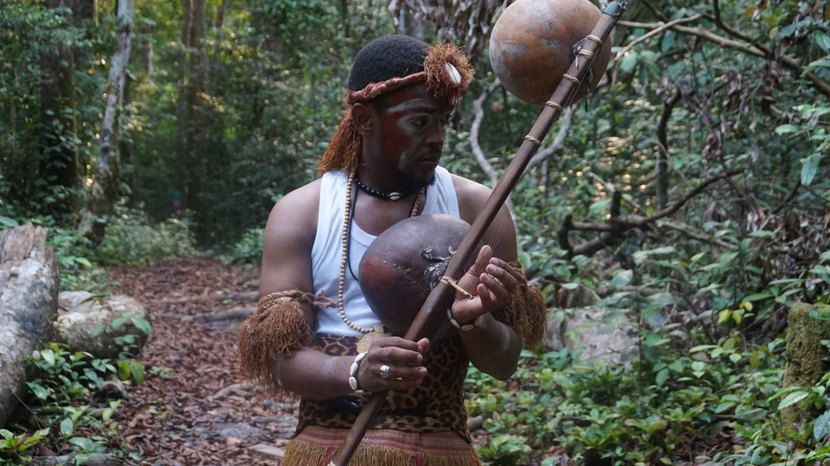
Understanding the transmission of oral knowledge through the Mvet
Understand the explicit functions of the mvet and highlight its implicit functions that go beyond the musical instrument.
Publish at January 12 2021 Updated April 20 2023


The circulation of ideas, knowledge, and concepts is a research object in itself. Human displacements are studied trans-secularly, through long history, from antiquity to the twenty-first century; trans-disciplinarily, both interdisciplinary and multi-disciplinary; and finally cross-culturally, through a comparative reading of various cultures.
The first observation shows the role of natural routes and physical proximity. Historians and archaeologists trace the movements of human ideas from their artifacts, pottery shards or currency. Thus the routes of amber, tin, copper or the Silk Road make humans circulate their brains their languages and ways of thinking.
The great communication routes along the rivers or the seas ensure the links. The mare nostrum or Mediterranean has been particularly studied as a crossroads and matrix of multiple civilizations.
Population migrations in search of favorable conditions, resources, food, or else land produce cross-fertilization and exchanges of ideas that are found in lexicons in the form of words. Indo-European peoples, nomadic peoples take with them their genes, their languages, their customs, their cultures, their objects.
Trade with other peoples transits over long distances or simply at the border, think of the Roman limes, edge of the empire or the Great Wall of China, a variety of goods. Contemporary emigrations and immigrations, conquests and escapes have led to Romanization, Arabization, Frenchization or Americanization of entire territories. Today, vacations and the diversity of means of transportation, study courses around the world, or the internationalization of companies (cf French example) propel cultural and ideological seeds everywhere we don't expect them. Our lifestyles our packaging and our pollution work like bottles in the sea.
The porosity of living environments participates in the dissemination, school environments, business environments, family environments mix more or less and hybridize way of life, way of feeding ourselves, of living or feeling the world. It is a real creolization that we are witnessing.
In this respect, the experience of work is probably one of the most powerful gas pedals of the integration of new ideas: professional mobilities, peer support and multiple forms of learning contribute to the speed of circulation and mixing. Social circulation is exacerbated by the density of recreational, cultural, associative and religious meeting places. The fabric and dynamism of crossing spaces increases serendipity, i.e., the encounter of a good idea with a mind prepared to receive it.
Everyday objects or objects of knowledge accompany ideas and concepts and support their diffusion. In addition to word of mouth or oral tradition, the objects themselves are the materialization of a thought and a use. Among them, artistic objects, books, codexes, parchments, tablets and engraved seals codify the beliefs of an era and are left to posterity on their route of penetration of territories (e.g., Silk Road, Amber Road, salt, spice and rum routes).
Today research articles, scientific publications scholarly books and their translations make human knowledge accessible and constantly clarifies it. The means of dissemination and communication are first of all human gatherings, of small groups or on the occasion of large events. With the printing press, journals and magazines increased dissemination and of course Internet has produced a new acceleration. Wherever one is in the world, powerful translation engines facilitate shifts from one linguistic sphere to another.
The French Revolution had a role as a catalyst and disseminator of ideas. It functioned as a kind of boiling point where anything seemed possible. It spread throughout Europe. But this explosion would have been prepared by the Enlightenment which combined high culture means or on the contrary more frugal means crossing all social classes:
"The ideas of the Enlightenment were spread all over Europe, thanks to meetings with philosophers in literary salons, cafés (then forbidden to women) and also by books and newspapers sold all over the place by peddlers"hermione.com
While religions and cultural traditions proved powerful vectors of circulation, the pictorial statuary of cathedrals or the illuminations of missals gave way to the gods of commerce. Advertising and marketing have provided our imaginations with ready-made ideas relayed by the soft power of mass media and cinema.
Culture is a soft power it plays the role of Trojan horse of the economic expansion of countries. It spreads the ideas of the world according to the nations' conception of it. From the soft power of American Hollywood films, to the 525 Confucius institutes to organizations defending the French-speaking world, each promotes a certain idea of science, living together or aesthetics.
Standardization movements by international agencies also influence certain ideas at the expense of others just as producers of international laws and arbitration connect with certain sensibilities and influence the adoption of one idea over another.
Sources
The circulation of knowledge has become a field of research
https://www.cairn.info/revue-anthropologie-des-connaissances-2014-1-page-221.htm
As well as the circulation of concepts in training for example the concept of reflective practitioner theorized by Schon.
https://www.cairn.info/revue-le-francais-aujourd-hui-2015-1-page-5.htm
Kirsten Koop, Anne-Laure Amilhat Szary. Globalization and circulation of scientific concepts between North and South: Direction of a special issue of "L'information géographique: Vol. 75, 2011/1. Armand Colin. L'information géographique, pp.100, 2011.
halshs-00817175?
Les cahiers du journalisme - L'accélération de la circulation
of information: a historical perspective,
Economic, Technical, and Social
https://www.cahiersdujournalisme.net/pdf/22_23/12_GEORGE.pdf
Clionauts Hollywood and American Soft Power
https://www.clionautes.org/hollywood-et-le-soft-power-americain.html
The Spread of Revolutionary Ideas in Europe
https://www.assistancescolaire.com/eleve/4e/histoire/reviser-une-notion/la-diffusion-des-idees-revolutionnaires-en-europe-4_his_18
Serendipity the Happy Chance
http://4cristol.over-blog.com/article-la-serendipite-le-hasard-heu
You might also like:
Understanding the transmission of oral knowledge through the Mvet
Understand the explicit functions of the mvet and highlight its implicit functions that go beyond the musical instrument.
Jing in collective intelligence facilitation
The concept of Jing from Chinese medicine nourishes the posture of facilitator in collective intelligence, but it is a personal discipline and a philosophy to cultivate it
Learning by walking: four types of reflexive and embodied walks
On the road, everyone's network is on the move
Soka's contribution to education
The Soka movement has been active and influential in the field of education since the 1930s, serving personal and social development and drawing inspiration from Buddhism to create value.
Metavers in education: innovation or gadget?
Is the metaverse the next educational evolution? Some people see incredible potential, but others advocate caution before jumping into the virtual world. Indeed, the novelty of the technology makes it difficult to draw conclusions of any kind, either for or against.