The term "resilient" has become so popular that we sometimes wonder what it actually means. After appearing discreetly in the field of physics, it is becoming very popular in psychology and personal development. It refers to the qualities of a person who has emerged from great hardship, transformed but not destroyed. Resilience factors include those elements of the environment that enable a person to bounce back or avoid collapse.
But now the metaphor is spreading everywhere: a company can be resilient, a human group and, why not, a city? One might be inclined to be wary.
On January 21 and 22, POPSU organized a symposium to identify avenues for reflection and action. The following article presents a small part of these contributions. In addition to its interesting content, this remote colloquium also impressed by the quality of the images and the fluidity of the transitions.
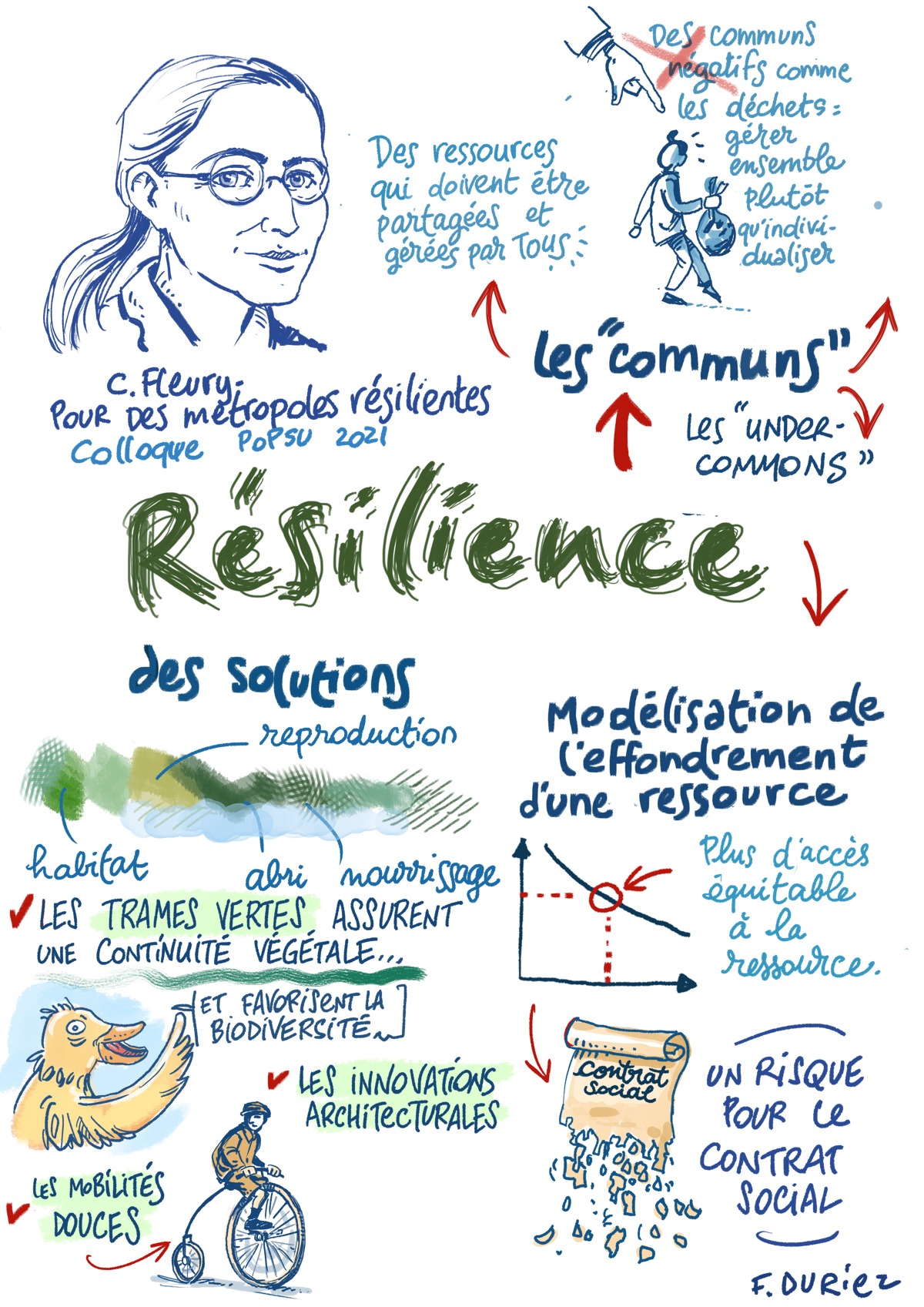
In the closing remarks of the first day, Cynthia Fleury takes a few seconds to clarify and justify this semantic borrowing. The term "resilience" in this context is a metaphor for approaching the question of large cities and metropolises in an emotional and sensitive way, enabling us to start thinking about what we have an intuition for, what we feel, but cannot yet model.
Cynthia Fleury - Resilience through commons and capabilities
1. Shared management of the commons
The commons are those riches that belong to us all, and which must therefore be shared and managed by all. C. Fleury proposes a broad vision. Some commons are negative. For example, waste management must be a collective responsibility. Finally, she evokes the "undercommons". The term designates the bond between people who have been denied access to a resource, and who unite, not on the basis of common ownership, but by the fact that they belong to the community of those who have been excluded.
Alternative communities in collective housing outside any legal framework, or rural areas that have passed through disaster, are human groups forced to invent new organizations, which could well inspire big cities.
2. Actions
Resilience is also based on initiatives, principles of action and shared experience. Cynthia Fleury cites just a few.
1. Soft mobility is a different way of getting around, but also of living together. It's all about low-carbon transport. They include bicycles and energy-efficient public transport, as well as rollerblades, scooters and other equipment that pedestrians in big cities don't find particularly gentle!
2. Positive-energy architecture
3. Green and blue networks. This term describes a continuity of green or wet surfaces, which reconcile a pleasant living environment with the preservation of species. They can exist within an urban framework, or extend over larger areas between towns. The aim is to enable species to live, feed, hide, nest and so on. This approach is the subject of a mooc offered by Tela Botanica in February 2021.
3. A tool: collapse modeling.
The term is chilling, but the reality is no less so. Collapse modeling determines the point at which a resource is no longer available in sufficient quantity to ensure its equitable distribution. While some authors claim that, faced with this adversity, humans are inventing solutions and sharing rules, Cynthia Fleury believes that the social contract is in jeopardy.
Resilience and capabilities
Cynthia Fleury makes the link between the city, the metropolis and the notion of capability, as developed by Amartya Sen and above all Martha Nussbaum.
- Life : being able to lead a life of normal length.
- Health of the body: being able to enjoy good health, adequate food and decent shelter.
- Body integrity : being able to move around, be safe, have sexual satisfaction and make reproductive choices.
- Senses, imagination and thought : to be able to use one's senses, to imagine, to think, to be informed, to receive an adequate education, to express oneself freely, to have experiences that bring pleasure, to avoid unnecessary pain.
- Emotions: being capable of attachment, love and association, not having one's emotional development constrained by fear and anxiety.
- Practical reason : to be able to form a conception of the good and to participate in a critical reflection on the organization of one's life. Freedom of conscience and religion.
- Affiliation: A) to be able to live with and for others, to interact socially, to imagine the situation of others. Involves freedom of assembly and speech. B) To have the basis of self-respect, to be treated with dignity. Implies the prohibition of all discrimination.
- Other species: living in harmony with other animal species.
- Be able to laugh, play and enjoy leisure activities.
- Control over one's environment : A) Be capable of political participation. B) To be able to own property, to have a job, to be protected from arbitrary arrest.
The list is ambitious. For cities to be resilient, they need to develop resilience factors around individuals.
Rob Hopkins: resilience through imagination
Rob Hopkins is the initiator of the Transition Towns movement. He proposes a "sundial" of imagination applied to the city. Imagination is the most important ability in the face of a changing and uncertain environment, but it is a collective imagination that unfolds in an urban theater. Imagination therefore needs to be democratized.
The axes of the dial are :
- places that encourage expression and collective imagination, be they streets, neighborhoods, natural or even virtual spaces. These places give us the feeling that another world is possible, helping us to project a new vision of what the future could be. They give us a "foretaste of a different future". Hopkins offers a more radical, one-off example. Extinction Rebellion blocked London's Waterloo Bridge for two weeks to install trees. Crossing the bridge was seen by local residents as a moment of relaxation and openness, so much so that many were in favor of making the installation permanent.
- Architectures and practices. For Rob Hopkins, contemporary architecture destroys the imagination. He encourages property developers to work more with artists, and gives us the example of Hundertwasser and his colorful, irregular buildings. But above all, the public must be involved, providing their own answers, sometimes to the point of prototyping. For Rob Hopkins, a very rich approach is to start his collective intelligence actions with the question "What if...".
- Space and time. Rob Hopkins reminds us that Einstein got his best ideas from cycling in the forest. You can't invent when you're under the stress of deadlines.
- Pacts: The author gives us the example of Bologna, which has created an office of civic imagination. Inhabitants brainstormed about creative or animated possibilities, and the city proposed pacts. Citizen commitment, municipal support and resources. 500 pacts have been signed, giving rise to ideas such as transforming a derelict building into a music school.

Resilient, sober cities
Sabine Barles is a professor at Panthéon-Sorbonne University. She moderated a fascinating round-table discussion on the subject of sobriety. In her opening remarks, she reminded us that sobriety means bringing together extraction, production, consumption and waste treatment.
Gilles Billen, Director of Research at the Université Pierrre et Marie Curie, reminds us that for a long time, Paris lived on food production that extended 150 km around it. Nowadays, the food we eat in our metropolises comes from all over the world. The carbon footprint is enormous. Relocating and reducing animal protein consumption are serious options for the 2050 horizon.
For her part, architect Nicola Delon informs us that most of the waste in a city like Paris comes from construction and public works. Concrete depletes sand reserves and the reinforcements that support it corrode. Concrete's image of solidity and durability is misleading, and restoring buildings based on this material is costly. Nicola Delon proposes a return to bio-sourced materials, such as wood and earth.
Patrick Boucheron: resilience through a balance of power
Patrick Boucheron provides a historical perspective. A specialist in the Middle Ages, Italian cities and the history of power, he gives us three versions of urban structures, which can shed light on the problems of contemporary metropolises.
Florence is a powerful and attractive city, with a high concentration of power figures. "It dominates its rivals Siena and Pisa, but does not crush them," says the historian. It's a model of intercommunality: all the cities interact, but none is powerful enough to stifle the others.
Naples, on the other hand, appears according to Boucheron as a voracious, predatory capital that cannibalizes its neighbors to the point where none can claim to be its rival.
Another model exists. That of Northern Italy. Milan is a metropolis that organizes its domination in a structured way.
According to Patrick Boucheron, "for a long time, Italy was a country of cities, and because it was a country of cities, it was resistant to the nationalization of power". Centuries later, metropolises still appear as spaces of resistance, of counter-power to the State.
In the United States, when the head of state was denying global warming, the major metropolises proved capable of inventing solutions and mobilizing jointly.

These few insights, which do not capture the richness of the two-day conference, call for a multi-disciplinary analysis of resilience. They also show that there is still room for optimism, for action and for the commitment of players from different horizons.
Researchers, politicians and technicians have been able to tackle the issues in a spirit of listening and imagination.
References
PUCA/POPSU - Plateforme d'observation des projets et stratégies urbains. Pour des métropoles résilientes - métropoles en transition cherchent trajectoires territoriales - Colloque organisé à l'Assemblée nationale française - January 21 and 22, 2021 - (in French only)
http://www.urbanisme-puca.gouv.fr/les-conferences-popsu-r121.html
Rob Hopkins From What is to What if, June 2020 - Actes Sud
https://www.decitre.fr/livres/from-what-is-to-what-if-9781603589055.html#ae85
Rob Hopkins https://www.robhopkins.net/
Patrick Boucheron - Métropole, un objet d'histoire dans la longue durée des villes - constructive - published 2010, accessed January 31, 2021
http://www.constructif.fr/bibliotheque/2010-6/la-metropole-un-objet-d-histoire-dans-la-longue-duree-des-villes.html?item_id=3027
See more articles by this author