A cell does not have a brain, yet the brain is composed of cells. Is the organization of cells the underlying principle of brain function? Scientists are trying to find explanations for knowledge. This has resulted in artificial neural networks that are based on probabilistic learning methods and are modulated by various thresholds that satisfy or do not satisfy predetermined criteria. The level of the "thresholds" is most often established by the activity in the possibility field; over time the most efficient possibility logically becomes the most used.
This is for an artificial neural network, equipped with electronic memory and a database. In the case of a cell, the question was what could it possibly remember and more importantly how?
The Blob to the Rescue
The blob is a single-celled being that neither fits the definition of a plant, animal, or fungus. It moves, it can photosynthesize, and it can spread by spores. It can also reach a large size, we are talking about several square meters. It's just a huge protoplasm that can separate and merge again. It has also been found that it learns, can communicate its knowledge, and remember.
For some of its memory, it is not clear how it accumulates its preferences, but as for its computational abilities, it is known to use its tracks: if they are dry, it is no; it has been there before and it is worthless. Otherwise, if there are no tracks, it's "maybe", we can try. If it's good, we go that way. The simplicity of the system allows it to quickly find the best route, the best solution. Its memory and database are external, deposited on the territory. The principle of the memory palace finds a concrete illustration here.
Where it becomes fascinating is that the blob can communicate the preference, the result to be sought, the principle, to another blob, without the latter having experienced it. A form of coding of a principle is realized and can be shared. What works is valued. In three hours, the transferred information is encoded into the cores of the blob.
Networked Learning
Once a value can be communicated to a process, it becomes relevant to teach and learn. It is assumed that the entire educational corpus is composed of principles that are potentially useful to those who learn them.
A blob probably assigns value to everything it can eat and the ways it can get it. We also assign value to what we can eat and the ways we get it, whether by hunting, herding, gathering, or farming. More generally, we value anything that enhances our ability to have, do and be. Sometimes we also go astray by developing short-sighted solutions. But by communicating, we will eventually find the optimal solution, based on our results.
So, if theoretical learning can be passed on, in practice it will be validated. The feedback obtained seems essential to the adaptation and maintenance of any process. For example, the analysis of data and the circumstances of any anomaly, whether it is an unexpected result or an accident, is important. Teaching in the absence of application or feedback will never be as effective as participatory teaching, with application and shared feedback.
If a cell learns, there is a good chance that its learning principles will remain valid for us too.
It's one of the first sciences taught, yet it has a reputation for complexity. Many legends revolve around mathematics, such as that only a few individuals could be proficient at it. It is also said to regulate the universe. But these and many other assertions are unfounded myths that maintain an elitist attitude towards maths.
Seniors have a role to play in giving younger generations a better balance when it comes to the virtual world. For one thing, they come from a much less cyber-dependent era. What's more, they have real-life experience, decades of life experience and a better relationship with nature. It's a good idea to make the most of them and reconnect them with the younger generation.
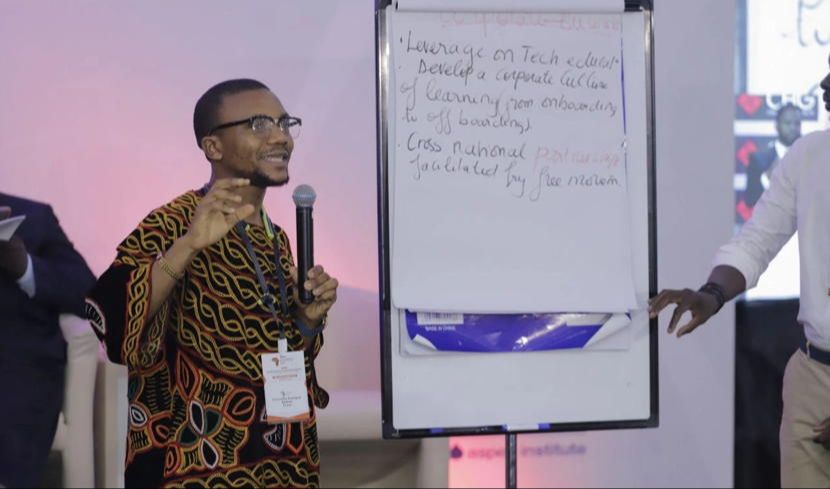
At the 2nd conference on L&D in Africa, the need for an L&D Institute came out strongly from the conversations. L&D practitioners recognized the urgency to have a common platform to advocate, champion and regulate L&D interventions and practices across the continent. This article explains why it’s urgent to create an African L&D Institute (ALDI) and how you can contribute to make it a reality.
Security can become an invisible prison when it pushes us to flee the unknown rather than venture into it. Dependence and freedom are not always opposites; it all depends on the awareness with which we choose our bonds. An attachment lived freely, with always the possibility of breaking free, becomes in itself a real adventure.