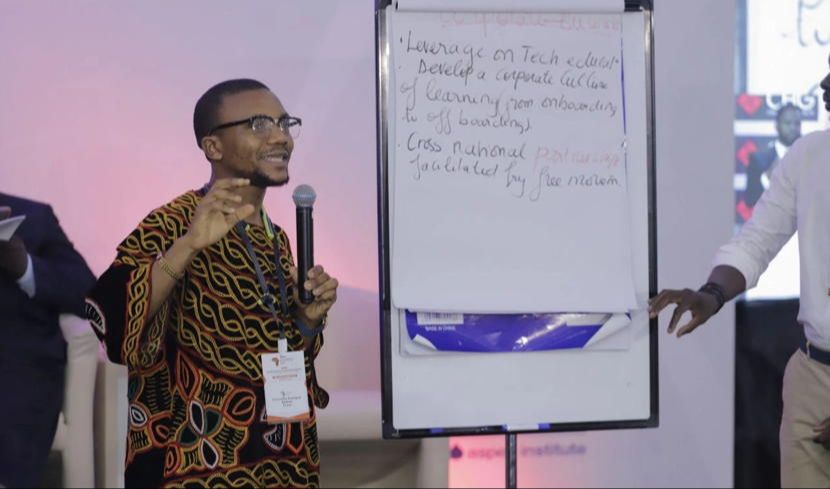
At the second
conference on L&D in Africa, the need for an L&D (Learning and Development) Institute
came out strongly from the conversations. L&D
practitioners from across Africa, present at this conference, recognized the
urgency for the continent to have a common platform to advocate, champion and
regulate L&D interventions and practices across the continent.
This article explains why it’s urgent to create an African L&D Institute (ALDI) and
how you can contribute to make it a reality.
Brief
overview of Learning and Development in Africa
As you may know,
L&D as a professional and regulated practice, is an emerging field in
Africa, still struggling to earn its value in the African corporate setting.
According to Martin
Wanjohi:
“While many organizations established L&D departments,
their effectiveness remained unrealized. Often, these departments existed
merely to fill organizational charts, lacking a clearly defined career path for
L&D practitioners and a competency framework to guide them. Consequently,
the potential for L&D growth was stunted. To compensate for the knowledge
gap, African L&D practitioners had to depend on external organizations such
as the Association of Talent Development and the International Society of
Performance Improvement, which promote best practices in L&D in the USA,
Europe, and Canada. While these resources were valuable, they underscore the
need for localized expertise and support within the African context.”
Because the
L&D industry in Africa is still burgeoning, there are few existing challenges,
such as lack of resources, infrastructure, policies, standards and
coordination.
As of 2021, only 5% of African workers have access to formalized
training programs, a stark contrast to the global average of 14% (World
Economic Forum, 2021). This deficiency in structured learning opportunities
puts African professionals at a disadvantage in the global job market,
hindering economic progress on the continent.
However, Edtech investment in
Africa has been growing rapidly in recent years, with a significant increase in
funding compared to other countries. According to a report by Class Central,
Africa accounted for 14% of global edtech investment in 2020, up from 3% in 2017.
This growth is attributed to the increasing demand for digital learning
solutions due to the pandemic and the need for accessible and affordable
education.
On
the continent, there are some countries worth mentioning when it comes to
L&D. One is Rwanda whose emphasis on education and skills
development has contributed significantly to its remarkable economic growth. The
other is Nigeria, whose burgeoning tech ecosystem also demonstrates
the potential for rapid growth when skilled professionals are supported by the
right educational and training programs.
The World Bank expects that by 2100
Africa will have the largest share of the global workforce, with 22 million
Africans joining the workforce each year. As digital disruption continues to
transform the workplace and the rise of the digital economy gains momentum,
many question where Africa's youth will fit into the labor market and what role
L&D can play in helping to prepare them for future jobs and skillsets.
Even
though there have been several independent and isolated initiatives, I believe
that a corporate body such as the L&D institute would help coordinate
actions and advocacy for corporate education, training, research, advocacy and
networking opportunities for L&D practitioners and enthusiasts in the
organizational and personal development space. It would help fill that gap, for
a continental platform with the mandate to design L&D regulations that are
relevant to African corporate culture, promote indigenous L&D practices and
establish standards and norms to coordinate all the various expression of
L&D on the continent from public speaking, to Master of Conference,
teachers, instructional designer etc.
Why
now?
As
previously indicated, an L&D Institute would bridge the knowledge gap by
providing specialized training programs, workshops, and resources designed
to empower professionals across various industries. This not only enhances
individual skills but also contributes to the overall productivity and
competitiveness of African businesses.
Second,
a well-equipped L&D Institute would serve as a breeding ground for
innovation. By offering cutting-edge courses and workshops, it would
stimulate creativity and problem-solving abilities among professionals,
catalyzing economic growth and technological advancement on the continent.
Thirdly,
it will also help address specific regional challenges. Africa is a
diverse continent with unique challenges in each region. A dedicated L&D
Institute can customize its programs to address specific regional needs,
whether it's agricultural innovations in sub-Saharan Africa or fintech
advancements in North Africa.
Fourthly,
investing in continuous learning is directly linked to improved
employability. This L&D Institute will equip professionals with the
skills and knowledge required to excel in their respective fields, thereby
increasing their chances of career advancement and job security. By aligning
curriculum with international best practices, ALDI can prepare African
professionals to compete on a global scale, attracting international
investment and partnerships.
7 advantages of creating an L&D Institute for Africa
A
learning and development institute for Africa would have multiple benefits for
the continent, such as:
- Improving
the skills and competencies of L&D professionals to design, deliver, evaluate and
improve learning interventions that meet the needs and expectations of diverse
learners and stakeholders.
- Creating
a platform for sharing best practices, experiences, innovations and
solutions among L&D professionals across different sectors, disciplines and
regions.
- Building
a community of practice that fosters collaboration, peer learning,
mentoring and support among L&D professionals.
- Developing
standards, frameworks, certifications
and guidelines for quality assurance, accreditation and recognition of
L&D programs and providers.
- Conducting
research and generating evidence on the impact, effectiveness and
challenges of L&D interventions in various contexts and domains.
- Advocating for the importance, value and relevance
of L&D for achieving the Sustainable Development Goals (SDGs) and the
African Union's Agenda 2063.
- Influencing
policies and strategies
that support the development and integration of L&D in national and
regional development plans.
Your Role to Make this a reality!
If
you are in the L&D industry in Africa or beyon, there are several ways you could
contribute in advancing this project unto completion:
- Spread
the word about the need
for an L&D Institute in Africa through social media, blogs, podcasts, seminars,
your newsletter or industry conferences. You can share this article, engage
with professionals, policymakers, and educational institutions to build a
collective voice.
- Forge
partnerships with
industry leaders, educational institutions, and governmental bodies. For
example, connect with us at the L&D
Africa Conference to explore how our collective efforts can garner the
necessary resources and support to initiate the institute. For example, the
next L&D Africa conference could be in East Africa, if interested to
partner or join the WhatsApp Group, indicate in comment section or inbox me.
- Support
or initiate advocacy campaigns
or initiatives that promote L&D in your context. You can use tools such as
petitions, letters, videos or infographics to raise awareness or influence
decision-makers. This may involve lobbying for funding, accreditation, and
regulatory support.
- Contribute
to research or publications on L&D practices in your country or company.
You can submit your papers or articles to journals such as International Journal of
Lifelong Education or African
Journal of Training & Development.
- Organize
skill-sharing sessions within professional networks and communities. You can
also join the growing community of L&D professionals in Africa, where you
could learn about initiatives from others in the continent, access
opportunities for collaboration, networking etc.
Prosperity for all
With the
advent of the Fourth Industrial Revolution, the need for upskilling and
reskilling is more pressing than ever. Automation, artificial intelligence, and
digital technologies are reshaping industries globally and Africa cannot
afford to lag behind. The establishment of an L&D Institute is not only
timely but also essential for African professionals to thrive in the evolving
job market.
This is not
just an opportunity; it's an imperative. It is not just an investment in human
capital; it is an investment in the future prosperity of Africa.
By investing
in the education and development of African professionals, we are investing in
the continent's future prosperity and global competitiveness.
Let's join
hands, advocate for change, and make this institute a reality for a
brighter, more empowered Africa.
See more articles by this author