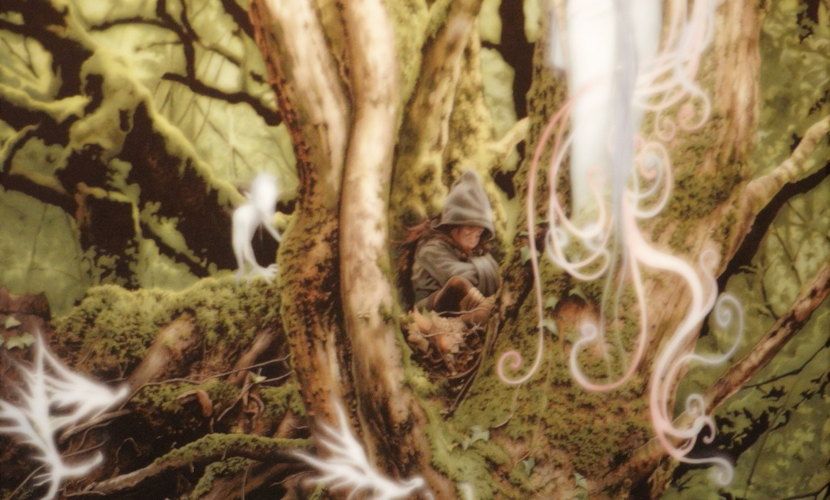
"The word realism means nothing. To a certain extent, everything is realistic. There is no boundary between the imaginary and the real."
Federico Fellini
Projecting ourselves into imaginary worlds to innovate
Imaginary worlds play an important role in developing our skills to innovate in pedagogy. They provide a backdrop for creativity. They allow learners to imagine scenarios and stories that can serve as the basis for new concepts and ideas. Imaginary worlds are often captivating and immersive, which can foster learner engagement in a given context.
By creating a stimulating and playful learning environment that is shifted from the real world, learners are pushed to become more involved in their own education by creating the rules of the world in which they are invited to operate. By providing an immersive learning experience, learners discover and understand new ideas in a concrete way. This approach to learning is often more effective than traditional methods that are limited to the transmission of information because it engages the body and an element of imagination.
Nothing is impossible in an imaginary world and it stimulates the ability to overcome obstacles and persevere in the face of adversity. Depending on the complexity and difficulty of the scenarios, learners develop resilience and the ability to adapt to change.
Examples of three worlds carried by literature and film
The Harry Potter book series by J.K. Rowling influences pedagogical practices by encouraging teachers to take a more interactive and immersive approach to teaching. Characters in the series use hands-on, engaging learning methods, such as spell classes at Hogwarts, that emphasize experimentation and practical application of concepts learned in the classroom.
Teachers can draw inspiration from the emphasis that characters in the series place on independent learning and intellectual curiosity. Harry Potter would also have become an initiatory novel for young people and teens, a true generational marker and real lessons that children learn from Harry Potter
The work of Tolkien, particularly The Lord of the Rings, emphasizes the importance of learning through hands-on experience. Characters, such as Frodo and Sam, learn by traveling and encountering different peoples and cultures. Teachers can encourage students to get out of the classroom and into the real world for a more rewarding education. But, that's not all, the Lord of the Rings is particularly inspiring for learning medieval literature, so well did Tolkien master the fundamentals
As a result, the Medieval Studies program at the University of California, Berkeley, has launched a course entitled "The Lord of the Rings and Medieval Literature." This course examines the influence of medieval texts on J.R.R. Tolkien's The Lord of the Rings and shows how the characters in the series learn during their adventure.
In the World of Narnia series of books, Lewis emphasizes the importance of creativity and imagination in learning. The characters explore a fantasy world filled with magical creatures and magical landscapes, which stimulates their curiosity and creativity.
Teachers can use this as inspiration to encourage students to use their imagination to explore academic topics and create original projects to demonstrate their understanding of concepts. For example, the "Narnia Day" project launched by St. John's Primary School in England is a learning day inspired by the World of Narnia. Students participate in activities based on the world of Narnia to explore academic subjects, such as history, literature and science.
This project shows how students rubbed up against works of fiction mobilize cognitive resources to explore serious subjects. The University of Le Mans has even created pedagogical resources to build learning sequences and save teachers time
Learning through the imagination an anthropological trait?
Behind these examples of learning through fiction, a deeper phenomenon nestles, that of a our mind's pronounced taste for imaginary worlds, for Edgar Dubourg, a researcher in cognitive science at the École Normale, having studied 10,000 films, "the percentage of films whose action takes place in an imaginary world has doubled", reaching 10 to 20% of production. This phenomenon would be all the more striking in Western societies consuming an increasing share of fiction. Des personality traits would be particularly identifiable in individuals such as
- agreeability (liking to be surrounded, having empathy),
- neuroticism (reaction to negative elements, linked to depression, ruminations),
- extroversion (enjoy group activities and have fun, reaction to positive emotions),
- the conscientiousness (ability to organize, plan for the future, tidy up)
- and, finally, openness and experience.
The contributions of Dubourg and his colleagues encourage us to bring fiction further into school classrooms because the appeal of timeless narratives allows for the reconstruction of the world, for understanding its values in action, and for offering figures of positive identification, all of which are very useful, when education does not know where to act.
Let's hope that Star War helps us better understand good and evil and that Avatar is better able to educate us about ecology.
Source:
Université du Mans. Narnia Guide pédagogique
https://umtice2.univ-lemans.fr/pluginfile.php/559428/mod_resource/content/1/narnia%20guide%20pedagogique-1.pdf
Covenant Narnia Day https://www.covenant.nsw.edu.au/news/year-4-narnia-day
Legendre, F. (1984). Imagination and pedagogy. https://bbf.enssib.fr/consulter/bbf-1984-03-0259-003
Science and the Future. Why we increasingly love fantasy worlds
https://www.sciencesetavenir.fr/sante/cerveau-et-psy/cerveau-socio-et-fiction-pourquoi-aimons-nous-de-plus-en-plus-les-mondes-imaginaires_170097
When Hogwarts Helps Us Understand the Transformations of the English Education System. History of a "failing" school Marc Demeuse, Antoine Derobertmasure. In L'école à travers le cinéma
https://www.cairn.info/l-ecole-a-travers-le-cinema--9782804708733-page-345.htm
Radio France Grand bien vous faire https://www.radiofrance.fr/franceinter/podcasts/grand-bien-vous-fasse/grand-bien-vous-fasse-du-mercés-16-fevrier-2022-3825894
6 Lessons Kids Can Learn from Harry Potter
https://etreparents.com/6-lecons-que-les-enfants-peuvent-tirer-de-la-saga-harry-potter/
Radio France. How Tolkien wrote the Lord of the Rings
https://www.radiofrance.fr/franceculture/comment-tolkien-a-ecrit-le-seigneur-des-anneaux-2821954
Dubourg, E., & Baumard, N. (2022). Why imaginary worlds? The psychological foundations and cultural evolution of fictions with imaginary worlds. Behavioral and Brain Sciences, 45, e276.
https://hal.science/hal-03419898/file/Dubourg%20Baumard%202021%20Why%20Imaginary%20Worlds.pdf
See more articles by this author