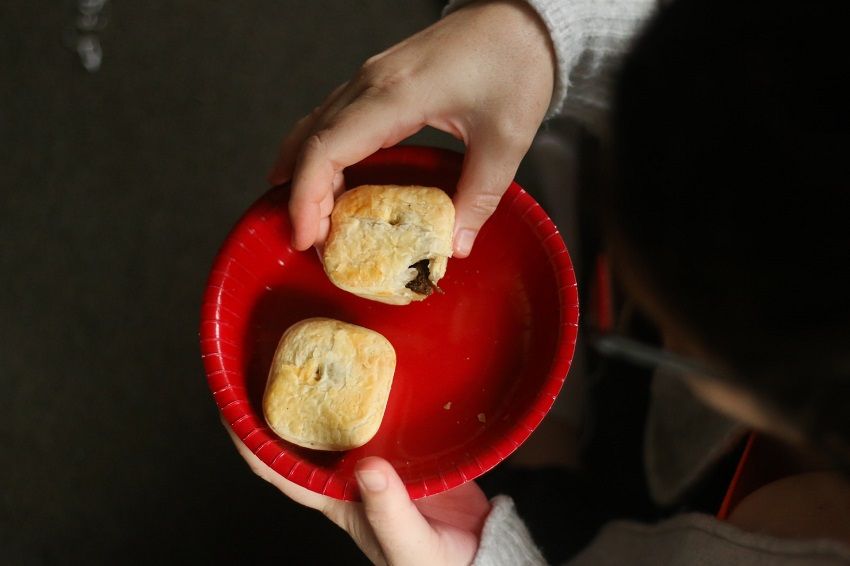
Table art varies from one society to another. Some use cutlery, some chopsticks and others fingers. While in other parts of the world, eating with the fingers is an act of sheer barbarism, in Africa, for example, it is a cultural practice that is imposed by certain foods.
The use of cutlery (fork, spoon) did not appear in Europe until the 16th century, first in Italy and France, then in England and Germany. It's easy to see why eating with the fingers was the norm. The poet Ovid recommended taking food with the tips of the hands, and not dipping the fingers into the sauce beyond the first phalanges. It seems that Louis XIV preferred to eat with his fingers rather than with the fork, which he fiercely denigrated.
Often considered a natural rather than a cultural act, according to historian and author Patrick Rambourg, a specialist in the art of the table, the opposite is true in Africa, where it's considered a cultural practice.
How do you eat with your fingers?
First and foremost, we recommend that you wash your hands with soap and water for reasons of hygiene. When it comes to setting up the dish, it's sometimes served on a large tray that can accommodate six to eight people (sometimes more) of various ages, or you can be alone with your dish. In this case, the individual eats as he or she pleases. In the first case, a good quantity of food is laid out so that everyone can eat to their heart's content. Generally, when sharing a meal, a mat is laid out on the ground to serve as a dining area. The geometric figure formed is the circle, symbolizing equality, as if to remind each participant that they are equal.
Once all the members have gathered, it's the eldest who opens the hostilities. Everyone is called upon to eat in front of him or her; no one is allowed to start with the fish or meat commonly referred to as "the obstacles". This is only possible at the end of the meal. The centerpiece remains the preserve of the eldest child, who is responsible for dividing up the meat or fish equally. It's important to keep a certain distance between the tray on which the meal is served and your mouth, as you don't want any food you've already had to swallow to come out and fall into the communal plate. It's important to put your left hand underneath your right when grasping food. This is to prevent the food from falling out, otherwise you'll be told not to waste food. It should be noted that not all dishes are eaten with the hands.
In some African countries, such as Ethiopia and Morocco, this is the norm. In Cameroon, for example, foufou varieties, whether corn or cassava, are eaten with the fingers. This supplement is usually accompanied by a sticky soup such as okra to aid digestion. Taro is served with either a yellow or black sauce. This is a typical dish of part of the Grassfield people of Cameroon, eaten only with the fingers. To eat it any other way, i.e. with a spoon or fork, is considered sacrilege. Eating with your fingers has its rules, but you need to understand the philosophy behind the practice, especially when sharing your plate with others.
Why eat with your fingers?
Eating with the fingers is not an exclusively African practice. We see it in concepts such as finger food, which originated in the United States and is often associated with junk food. Swiss geriatrician Charles-Henri Rapin claims that eating with the fingers enables people suffering from dementia to feed themselves independently. Aside from the medical benefits, eating with your fingers, whether alone or with others, conveys a set of teachings that shape the individual's personality. For example, it teaches moderation and self-control.
As far as moderation is concerned, when you eat with your fingers, you can only take as much food as your hand can hold. Knowing that not everyone has the same proportion of hand, the individual realizes sooner that inequality is natural and learns to live with it. So, until you've finished what's in your hand, you can't take another handful of food.
As for the art of self-control, it's worth pointing out that when you're eating in a group, you can only take what's in front of you. The individual then learns that it is forbidden to envy another's thing. As a result, they make do with what they have. Eating with the fingers in Africa, whether in a group or alone, is part of the education of the individual, who learns to control himself when feeding. The practice is also a way of discovering flavors in a different way. Some say that fingers bring a new taste to the meal. And for others, eating with the fingers means eating more slowly, which facilitates digestion and reduces weight gain. It's a strong argument that will hopefully see this practice reused beyond the African continent.
Photo: Callum Hill / Unsplash
REFERENCES
AUDUREAU William, 2019, " Manger avec la main, c'est naturel, manger avec la fourchette, c'est culturel ", Le Monde, online https://www.lemonde.fr/les-decodeurs/article/2019/01/25/manger-avec-la-main-c-est-naturel-manger-avec-une-fourchette-c-est-culturel_5414718_4355770.html
CHEVE Joëlle, 2019, "Manger avec les mains", online https://www.historia.fr/manger-avec-les-mains
ESPACE SENIOR, "Le finger-food, une nouvelle forme d'autonomie pour les adultes âgés désorientés?", online https://urlz.fr/mo4o
LINECOACH, "Finger food" online https://www.linecoaching.com/maigrir/dossiers/la-finger-food
SHAMSIVOIRE, "Devoir de mémoire: pourquoi les africains mangent avec les mains?" online https://ci.opera.news/ci/fr/fashion-beauty/5ad7360b837f3c60430d8c76ebc3ef3d
WIKIPEDIA, "Finger food " https://boowiki.info/art/styles-cuisine/finger-food.html
See more articles by this author