Articles

Publish at October 03 2023 Updated October 03 2023

Design thinking in the age of artificial intelligence

History and method of design thinking

Design thinking - unsplash

"There are three possible reactions to any design: yes, no, and WAHOU! The third is the one I'm aiming for."

Milton Glaser, co-founder of New York Magazine

The origins of design thinking

Brainstorming was invented in the 50s, and in the 60s a design training program was created at Stanford. A landmark book, "Design Thinking", published by MIT Press, was written by Peter Rowe. Design thinking is a project creation method developed at Stanford University in the USA in the 1980s by Rolf Faste. In 1991, Idéo popularized its methods, which focus on the customer experience, and the method was widely adopted.

In addition to technological solutions, the aim is to explore the user experience. Today, the term Ux Design is used to describe user experience design. The approach is based on two key principles.

The first principle is that of an iterative process, i.e. you can return to previous stages if the current one is inconclusive. This distinguishes design thinking from a linear project process.

The second principle lies in the cooperative operation of diverse, multi-disciplinary teams of different ages and experience at each stage. It should also be noted that design thinking is a process that places people at the heart of experimentation with new solutions, with a logic of rapid, methodical prototyping.

The 5 key stages of the design thinking method

The design thinking process is led by a "facilitator" or designer, who remains neutral and does not seek to influence participants.

  • Step 1 - Use empathy

    In the manner of an anthropologist, this involves defining the target audience and obtaining a clear vision of the problems encountered by users and what they need. It's about understanding their context, what they say they think and feel. Surveys and contextual immersion are the best solution, but it's also possible to fill in an "Empathy Map", organize a survey, lead a focus group or conduct a user test, meet users in the street, or create personas that embody users.

    The use of AI in data analysis makes it possible to gather more precise information on users' needs and preferences during the first stage, that of empathy. Thanks to advanced algorithms, it has become easier to understand the context, emotions and behaviors of users.

  • Step 2 - Diagnosis

    In this stage, the aim is to understand the nature of the challenge, the points of friction and the problems faced by users, for example, by establishing a "user journey" or experience map, or based on critical incidents. The aim is to identify what is minimum, what is normal and what would be a real break in the service provided.

    This stage brings together the most frequent needs and root causes of user-centered "stated problems". It resolutely sets aside the organization's desire. The stated problems are used as a compass to guide the entire process. This step is important to bring out the objective to be achieved and the constraints to be taken into account.

    ALI can be integrated to help identify friction points and user problems more effectively. Machine learning algorithms analyze the data collected and identify trends and insights more quickly. However, AI has its limits in terms of contextual understanding and taking emotional nuances into account, which always requires human input for full comprehension.

  • Step 3 - Build the concept

    Create the concept that will deliver the solution using a diverse team to generate a wealth of ideas, based on 3 stages
    * Ice-breaking games within the group, to express personal feelings.
    * Brainstorming to stimulate creativity (here 20 methods). During this stage, it's possible to propose new constraints or change the rules along the way, to get the group out of its routine,
    * The selection of the best viable, feasible ideas according to the criteria and constraints set out in the diagnosis.

    In this phase, AI can play a crucial role in facilitating idea generation. AI tools can be used to stimulate team creativity by suggesting innovative concepts based on the analysis of previously collected data.

  • Step 4 - Prototyping

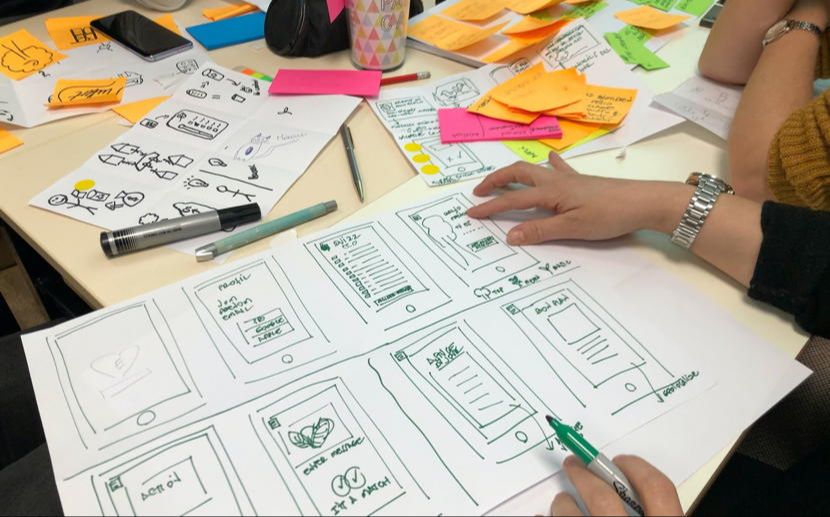
    The prototyping stage consists of moving as quickly as possible towards the materialization of a solution, and expressing it in creative form using a drawing (poster, metaphor, figurative drawing, plan), in the form of a cut-out, a digital model, an assembly for example, or even in the form of a video and its more or less complex storyline ranging from a hero's journey to a novel-like composition.

    The prototype can also be a role-playing game or a theatrical stage on which to play out the imagined solutions. Whatever its form, the prototype aims for simplicity and rapidity. It needs to be usable quickly enough to be understood by users and to benefit from their feedback. It doesn't need to be aesthetic or functional at this stage. Its function is to suggest the solution in preparation. This stage is often resource-intensive, and deserves to be anticipated with a prototyping kit including a variety of creative materials (weft, colored paper, cardboard for mock-ups, a variety of felt pens, glue, scotch tape, scissors, gum, paper board, stapler, wood, wire, Lego, modeling clay, digital tablet etc.).

    The prototyping stage can benefit from AI. Computer-aided design software can create prototypes faster and more accurately. What's more, AI-based simulations can be used to evaluate how prototypes work and predict their effect on the user experience. This speeds up iterations and saves time, multiplying the number of possible prototypes.

  • Step 5 Testing

    The testing stage consists of exposing the prototypes to users to understand what they think, feel and are motivated by. If the design thinking session takes place with several teams, a pre-test crossing the opinions of the teams is possible. It's also possible to address a prototype to a mass of online users and circulate it to receive a variety of opinions in rapid iteration. This is known as crowdtesting. This solution is particularly well-suited to software or any other digital solution.

    Finally, in the testing stage, AI can be used to collect and analyze user feedback in an automated way. Chatbots and semantic analysis systems enable a deeper understanding of user reactions, but again, AI cannot always interpret human emotions with the same precision as a human being.

    Each stage gives rise to specific animations and a choice of workshops, the challenge of which is to maintain fluidity, creativity and focus on users' problems. At any point in this step-by-step process, it is possible to return to an earlier stage, as the logic is less linear than it is iterative, aiming above all for agility and adjustment. A.I. is now able to help explore a wider range of paths, and even to help evaluate the best options.

Design culture carried by businesses and spaces

Today, design culture is spreading in the private sphere, as much as in the public sphere(public policy design), with the method being applied to places, services, training devices ( e.g. MOOCs), products and sometimes even organizational processes.

This culture is seeing the development of its professionals (designers, design managers, graphic artists) and its studio and lab spaces of expression (cf. the Lab Bible). The method is set to expand further with the power of A.I., which contributes its share of creativity, analysis, testing and critical evaluation at every stage. All that remains is to combine these skills for optimum use that enhances human creativity.

Sources

Asana Brainstorming Techniques https://asana.com/fr/resources/brainstorming-techniques

Rowe, P. G. (1991). Design thinking. MIT press.

Hrimag. Rolf Faste's 7 steps to design thinking
https:// www.hrimag.com/Les-7-etapes-du-Design-Thinking-selon-Rolf-Faste

Design thinking explained https://www.youtube.com/watch?v=I7pD0U3JUvs

Cabinet Ideo https://cantwait.ideo.com

Usabilis Ux Designhttps://www.usabilis.com/ux-design/

Les cahiers de l'innovation. What is design thinking https://www.lescahiersdelinnovation.com/qu-est-ce-que-le-design-thinking/

Klap What is design thinking https://www.klap.io/definition-design-thinking/

Empathy card https://agoora.fr/carte-empathie/

Video Cagette https://www.youtube.com/watch?v=YkP9zrO-Q9Q

Crowtesting https://www.50a.fr/0/crowdtesting

Le lab des labs https://www.codesign-it.com/publications/le-lab-des-labs-en-telechargement-libre

Adiméo Which workshops for a successful UX approach
https://www.adimeo.com/blog/quels-ateliers-pour-un-demarche-ux-reussie

University of Collaborative Public Innovation
https://universiteinnovationpublique.wordpress.com/2019/06/13/presentation-generale/

Cavignaux-Bros, D., & Cristol, D. (2020). Participatory design and co-design-The case of a MOOC on public innovation. Learner and user experience research. https://edtechbooks. org/ux/participatory_and_co_design

Blog-UX What is the user journey? https://blog-ux.com/quest-ce-que-le-parcours-utilisateur/


See more articles by this author

Files

  • New metaphors

Thot Cursus RSS
Need a RSS reader ? : FeedBin, Feedly, NewsBlur


Don't want to see ads? Subscribe!

Superprof: the platform to find the best private tutors  in the United States.


Receive our File of the week by email

Stay informed about digital learning in all its forms. Great ideas and resources. Take advantage, it's free!