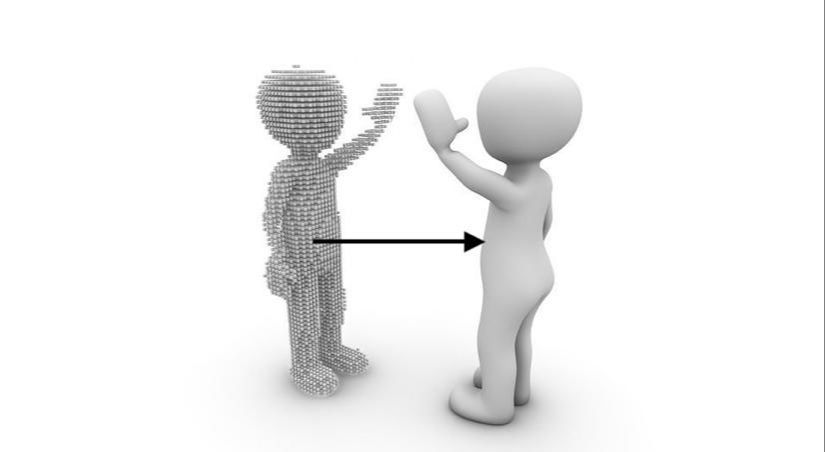
The digitization of the planet has brought about profound changes. Now, people of different origins can exchange information thousands of kilometers apart, without moving an inch, at breakneck speed. In short, borders are dissolving, and the world is now truly interconnected. Faced with this revolution, it was necessary at some point to establish a vocabulary adapted to the new situation, reflecting the complexity of the phenomenon, while at the same time making this unprecedented communication tool comprehensible to laymen.
At this point, two concerns arise: should we make a complete break with the traditional vocabulary, which is proving to be rather limited in its ability to translate the new reality offered by digital technology, or should we use creativity and innovation, given the context? In place of these proposals, digital jargon borrowed heavily from Anglo-Saxon culture, inspired by existing realities as explanatory elements, has naturally imposed itself.
In this search for equivalence, linguistics came into its own. Evocations - or, more precisely, metaphors - from a variety of fields have proved extremely useful. It's clear, then, that these metaphors are at the heart of digital technology. But what are they? Are they as effective as they seem? Why use metaphor?
Metaphors in digital use
Drawing on existing realities, digital language comes from a number of sources, such as liquid vocabulary (in reference to what relates to water), and epidemiological vocabulary, among others.
To water
We have recorded a range of evocations relating to the maritime, fluvial and hydraulic domains, such as surfing, crawling or crawling, navigating, being exposed to phishing or pirates. So, on the Internet, we surf like a surfer on giant waves, we navigate thanks to Explorer like a ship's captain, we can just as easily be exposed to phishing and pirates.
Bio
As far as the epidemiological metaphor is concerned, the term viral is the one most often used. On the one hand, through the qualification of a foreign body harmful to the functioning of the machine, virus, and on the other through neologisms in the field of digital communication. We also speak of viral marketing. Here, the virality of communication, far from being necessarily harmful as in the field of medicine, simply refers to a strong capacity to spread information, in the image of biological viruses.
In either case, it's clear that the source of digital language is plural, and that digital technology is endowed with symbolism and images that enable us to "organize a network of analogies around the organizing term", as Jamet puts it. But doesn't this reference to a tangible reality obscure our understanding of the newly contextualized word?
The limits of metaphor
While it's true that metaphor has great evocative power, it does have its limits when it comes to being understood by the receiver. Aware of this fact, Ugo Roux, in his article "La métaphore numérique et ses limites" (Digital metaphor and its limits), points out that the misuse of viral metaphor, from a political point of view, as a tool of stigmatization and exclusion has given it a bad name. Consequently, any nominal association followed by "viral" would inspire in the speaker what is harmful, frightening, threatening and detestable; given that the virus is a foreign body, an enemy to be fought and eliminated. Wilson goes a step further, joking that if someone were to introduce themselves to him as a "viral marketer", he'd certainly take to his heels.
Aside from metaphor's acknowledged failure of comprehension, Morelli notes the relativity of the representation of metaphorized objects. To explain this relativity, he invokes Gaston Bachelard, who, drawing on the inadequacy of geometrical representation, recognizes that "sooner or later, in most fields, we are forced to note that this first geometrical representation, based on a naive realism of spatial properties, implies hidden conveniences, topological laws less clearly solidary to immediately apparent metric relations, in short, essential links deeper than the links of familiar geometrical representation". In other words, the relativity of metaphor takes its essence from the decontextualization of the stated object.
Despite the misleading evidence that often leads us to associate a stated object with an evoked element, metaphor has nonetheless taken over the digital sector. How can this be explained?
Why the use of metaphors?
Digital is not the only field to use the evocative power of metaphors. In any case, according to Hess, this figure of speech serves two purposes:
- on the one hand, it makes a concept accessible,
- and secondly, to think about an object.
Digital technology is no exception. From this point of view, Morelli notes that the use of metaphors "goes hand in hand with a professional, and sometimes scientific, need to image situations, to simplify their immediate comprehension through the evocative power of the metaphorical use of pre-existing notions, and thus to facilitate their circulation through networks". In other words, the aim of digital metaphorization is to circumscribe professionals' fields of intervention, to make notions more digestible, and to facilitate their circulation through networks.
In short, metaphors are at the heart of the digital world, and play a key role in making it accessible to all. Even if this metaphorization has limits of intelligibility due to the decontextualization of the stated object.
Moreover, if there's one thing worth mentioning about metaphors in the digital world, it's the fact that you need to be familiar with the stated object, otherwise you won't be able to make analogies and thus grasp the real meaning of the metaphor, since it may refer to a precise disciplinary field. Otherwise, the metaphor is used without knowing what it refers to.
References
BERNARDOT Marc, 2018, "Plongée dans les métaphores et représentations liquides de la société numérique", réseaux communication et territoires, p. 29-60, online
https://doi.org/10.4000/netcom.2886
MORELLI Pierre, 2017, "De l'emploi des métaphores dans la communication numérique. S'interroger au-delà des apparences immédiates", International Conference Comprendre la transition V. Developing communication via dialogue/Understanding translation V. Developing communication via dialogue, Faculty of Journalism and Communication Sciences (FJSC, University of Bucharest, Romania); Université Lumière Lyon 2, pp.9-24, online https://hal.univ-lorraine.fr/hal-01721578
ROUX Ugo, "La métaphore virale et ses limites", Technologie de l'information, culture et sociétés, online https://journals.openedition.org/terminal/7299
See more articles by this author