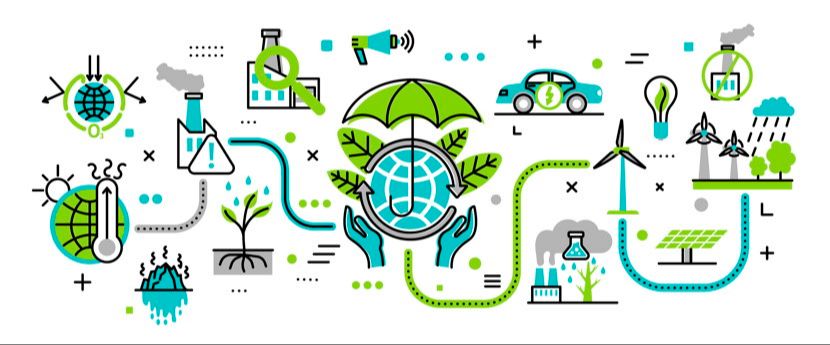
"Climate change happened because of human behavior, so it's natural that it's up to human beings to solve this problem. It may not be too late if we take decisive action today."
Ban Ki-moon (2014)
Managing change
In traditional change management approaches(Perret 1996), progress is often seen as linear and inescapable, controlled by managers. However, this simplistic vision ignores the harmful consequences of deleterious innovation, which can lead to gradual wear and tear on organizational resources and capacities, as well as damage to living things. To overcome this limitation, we need to promote a more reflexive approach to innovation, taking into account its long-term effects and focusing on sustainable and ethical solutions.
Traditional change management approaches often focus on linear, formal, contractual and decontextualized technical processes. This results in a top-down approach where change is imposed on employees, without taking into account their involvement and emotions.
Employees are fed up with the "make-up concertation" or the soothing, repetitive interventions of consulting firms. They either wait it out or move on. This approach reduces the effectiveness of change management processes, because it overlooks the importance of employee buy-in and commitment. It is essential to adopt a more participative approach, involving employees at all levels and recognizing their contribution to the transformation process.
Transforming organically
To overcome the limitations of current approaches, it is necessary to adopt a more organic approach to transformation, which recognizes the importance of the affective and emotional. Individuals react differently to change, and it's crucial to take their feelings, fears and aspirations into account. By fostering a culture of listening and support, organizations can encourage greater acceptance of change and better adaptation to new realities. And sometimes it's management that resists change and continues to deny the scale of societal transformation and the climatic effects on their business.
Metamorphosis (de Vulpian 2021) represents a profound and radical change that emerges from within the organization. It can be driven by any player in the organization. Unlike an external approach, where change is imposed, metamorphosis encourages the organization's internal players to take the initiative and lead the transformation process.
This requires a climate conducive to innovation, experimentation and continuous learning. By encouraging autonomy, collaboration and creativity, organizations can foster an internal metamorphosis that is more sustainable and better accepted by stakeholders.
Towards transition
The U-shaped curve is often used to represent the process of change. Traditionally, this curve is associated with Kübler-Ross' (1975) mourning curve (shock, denial, despondency, acceptance, rebound), where individuals go through different emotional phases before accepting change. They should enter a mourning process.
To this vision it is possible to propose a new curve, the presence curve proposed by Otto Scharmer (2018)[1]. This curve emphasizes deep connection with oneself, with others and with the emerging future. It encourages individuals to listen attentively, suspend judgment and open their minds to new perspectives. By adopting this approach, change management approaches can foster deeper, more meaningful transformation.
In today's context of growing environmental concerns, change management includes the imperatives of ecological transition. Organizations must take into account the challenges of sustainable development, social responsibility and environmental preservation, or risk being rejected by their employees or fought from within. This may involve radical changes in practices, business models and organizational values. Radicality is needed to challenge existing practices and explore new paths towards sustainability.
Organizational learning will come through management unlearning
To overcome the limitations outlined above, it is essential to adopt new practices focused on transition rather than linear change. This includes a more reflexive approach to innovation, a recognition of the importance of the affective and emotional, an encouragement of internal metamorphosis, a shift from the U-curve to being present to the world's challenges, and an integration of ecological transition.
We are living through what Émile Durkheim[2] (Besnard 1987) called "anomie", a transitional stage where an old system is slow to collapse and a new one struggles to emerge. By embracing these new practices, organizations can better manage change and adapt sustainably to the challenges of a changing world.
The cost is high for leaders, who must enrich their "power over" with "power with" and "power to". As long as they pretend to change everything so that nothing changes, the same difficulties, seizures, tensions, slowdowns and loss of value will persist. Our leaders must learn to unlearn.
Illustration: RoseStudio - DepositPhotos
Sources
Perret, V. (1996, May). Managing organizational change: articulating ambivalent representations. In 5th International Conference on Strategic Management (pp. 13-15). https://www. researchgate.net/profile/Veronique-Perret/publication/255632642_La_gestion_du_changement_organisationnel_Articulation_de_representations_ambivalentes/links/00b4953bba2a3b9de5000000/La-gestion-du-changement-organisationnel-Articulation-de-representations-ambivalentes.pdf
de Vulpian, A. (2021). Éloge de la métamorphose: en marche vers une nouvelle humanité. BoD-Books on Demand.
Kübler-Ross, E. (1975). The last moments of life. Labor et fides.
Scharmer, O. (2018). The essentials of Theory U: basic principles and applications . Berrett-Koehler Publishers.
Besnard, P. (1987). L'anomie, ses usages et ses fonctions dans la discipline sociologique depuis Durkheim . FeniXX.
________________
[1] Theory U - DIALOGUE IC (dialogue-ic. com ) https://dialogue-ic.com/article-la-theorie-u-otto-scharmer/
[2] Definition: Anomie (toupie .org ) https://www.toupie.org/Dictionnaire/Anomie.htm
See more articles by this author