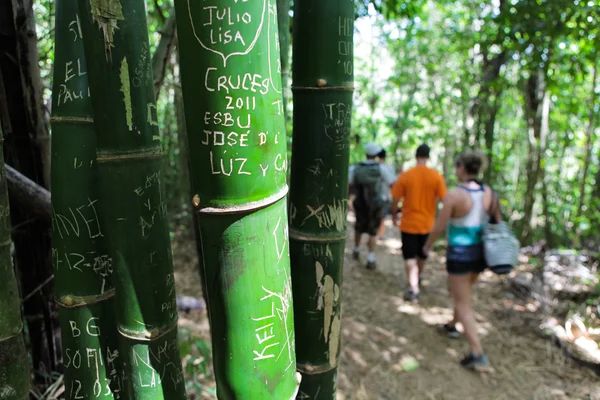
Tourism is an enriching activity for people of all ages, bringing them into contact with other socio-cultural worlds and enabling them to learn from others... but the passage of tens of thousands of tourists to protected sites steeped in history presents a risk of degradation, even if it generates profits for the host land. The question is: how can we generate revenue while preserving protected sites?
Élise Maudry intends to answer this question in her Master's dissertation, the subject of which is: Developing the territory through a sustainable tourism approach: a response to the challenges of protected tourist sites?
Her research question is: "In what way can developing the territory through a sustainable tourism approach help to meet the challenges of protected tourist sites?" This central question is backed up by a number of subsidiary questions: What is sustainable tourism, and can it help meet the challenges of promoting and preserving these tourist sites? What is the role of landscape architects, and how can they work to implement developments that meet the objectives of sustainable tourism?
To carry out this study, Élise Maudry selected the protected sites of the Parc National (PN) des Calanques and the Parc Naturel Régional (PNR) du Verdon. Her research focuses on the birth of sustainable tourism, the added value of site development, and the role of the landscape architect.
The birth of sustainable tourism
Contrary to popular belief, tourism is not an activity that has always been practiced. In fact, the Industrial Revolution marked the beginnings of a tourism industry that stemmed from a desire to get away from the routine imposed by industrialization. The popularity of tourism began with the construction of the railroads, followed by the regulation of paid vacations. It was now possible to generate income and have a good time at the same time.
Hotels and seaside resorts sprang up like mushrooms, and tourism democratized to become a mass activity, leading to the transformation of tourist locations (Le Gargasson, Messaoudi, Leriche, 2017) to improve the offer.
In the second half of the twentieth century, improving the offer was tantamount to developing infrastructures (accommodation, digging up ports, creating freeways, expressways and dual carriageways) capable of accommodating thousands of tourists. But these developments rarely took the protection of the natural environment into account.
In the 1990s, however, environmental awareness began to develop, with the aim of striking a balance between the enhancement and preservation of sites. Legal provisions reinforced this awareness, notably the "Mountain and Coastal" laws and protection systems drawn up in the 1980s as a result of the 1987 Bruntland report on sustainable development.
From then on, sustainable development and tourism became more closely linked. The idea was to develop tourism based on criteria of sustainability and long-term ecological supportability, economic viability and ethical and social fairness.
The notion of sustainable tourism has been enshrined in a number of historic events and instruments: the 1992 Rio Summit, the UNWTO (World Tourism Organization) General Assembly adopting the Global Code of Ethics for Tourism, the 2002 World Summit on Sustainable Development in Johannesburg, the European Charter for Sustainable Tourism, all of which bear witness to the international determination to establish responsible tourism practices.
These are not the only measures taken to ensure sustainable tourism. Development measures are also called for within sites to limit their degradation. One example is the use of soft transport.
Development, a response to the challenges of enhancing and preserving "protected" tourist sites
Responsible tourism relies on the will of tourists and service providers. This ecological trend is leading to the development of protected areas, such as the Calanques and Verdon national parks.
The former, a concept originating in the United States, was exported to France during the 20th century. The law of July 22, 1960, later revised on April 14, 2006, creating the national parks, was the first nature protection tool. As for the second, it appeared between 1960 and 1970, under the leadership of Pompidou and General de Gaulle, as a response to the challenges of urbanization, preservation of sensitive natural environments and rurality. The management policy for these areas is governed by the European Charter for Tourism and the EUROPARC program respectively, imposing a balance between management and preservation of the environment, while allowing the public to visit, with a view to guaranteeing sustainable tourism.
While it's true that the survival of protected areas depends on the visits of tourists, these mass visits - the Calanques park registers an average of 2 million visitors per year - have perverse effects, such as the soil and flora problems, resulting in the degradation of soil and flora due to the regular strolling of tourists, who, for lack of information and facilities conducive to the preservation of the site, degrade the site. Sites therefore need to be developed by a number of different trades, such as landscapers, to ensure their sustainability.
Site development and validation of the development project depend on the identity of the site. To do this, the development measures taken must respect this identity, or even the problems encountered by the sites, with a view to reducing tourist wandering and ensuring their legibility and practicability. Thus, for the Calanques site, it was suggested to use limestone, given its strong presence on the site, and the dry stone technique to ensure the permeability of the structures and limit erosion...
The landscape architect is the project manager. His task is to propose a system that blends into the original natural space, in order to preserve the site and enhance its use. How does he achieve this?
Understanding the area, the key to design
Designing a landscape to suit a site is no mean feat. It's important for the landscape designer to understand, through observation, the identity of the territory, the uses of the site and the value assigned to them, in order to provide a work of enhancement adapted to the personal development of visitors and the site itself. This is not the only role. Landscape architects also act as mediators between users and the land. He makes them aware of the impact of their actions on the site. For, to ensure its sustainability, the community must be involved.
Preservation projects have been observed on the Calanques and Verdon sites. These include the Life Habitats Calanques mission and the Opération Grand Site des Gorges du Verdon.
By way of conclusion, we note that :
- Sustainable tourism combines site enhancement and preservation,
- Land-use planning seems to be the solution to avoid site degradation.
- Landscape architects play a multifaceted role in the success of their work.
Illustration: klemsy - DepositPhotos
Reference
Maudry Elise, 2019, Aménager le territoire par une démarche de tourisme durable: une réponse aux enjeux des sites touristiques protégés? - AGROCAMPUS OUEST - Life sciences - online
https://dumas.ccsd.cnrs.fr/dumas-02331368
See more articles by this author