The stereotypical image of a scientist is of a person in a white lab coat, manipulating test tubes or recording data on a computer. However, scientific research has, with a few exceptions, no standard dress code and doesn't always take place in a laboratory. Many of them go directly into the field to observe their subjects.
Better still, with the advent of digital tools, research has begun to make inroads with the general public. Participatory science has gained in popularity over the last decade, thanks in part to the proliferation of connected devices. This "citizen science" has been seen as a winning strategy on all levels.
On the one hand, researchers can access a great deal of data without having to travel; a considerable advantage for natural sciences such as biology, zoology or even medicine. On the other hand, we hope that the general public will have a better grasp of the scientific process. In a world that sometimes rejects science, understanding the work of scientists would help reduce misinformation... in theory, in fact research shows that citizens do not come away with a greater understanding. Nevertheless, some have wondered whether the introduction of practices at school might not be more productive in this respect.
Integrating a scientific approach
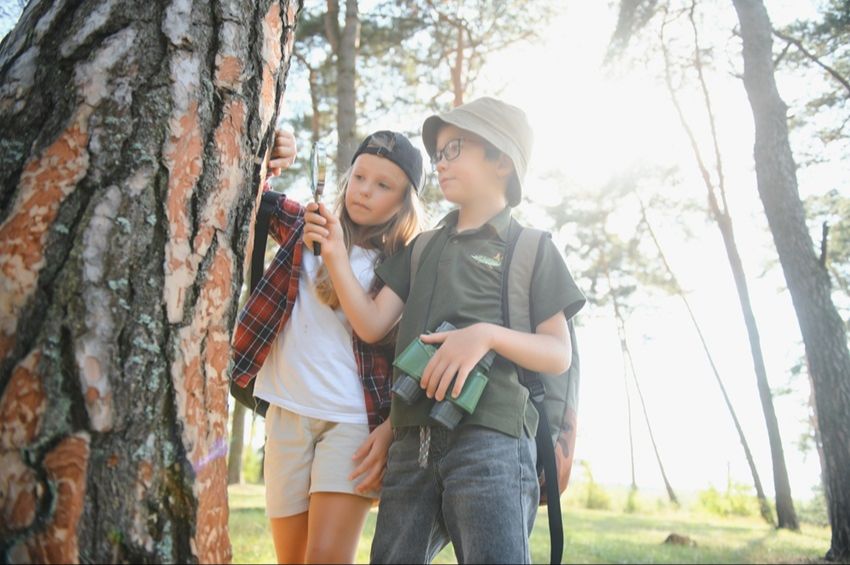
So, little by little, participatory science projects have been specifically designed to be integrated into the school curriculum. The idea is to work with pupils on the scientific approach and different ways of analyzing their local environment. Whether it's trees, soil or wildlife, young learners begin to inventory different natural elements and share their findings with teachers and, in turn, scientists.
The teacher's role is to guide them in this process. As summarized in this study of classes participating in the "Tree bodyguards" (then "Oak bodyguards") project, a program to study the effects of insect herbivore damage in relation to climate change:
The results show that teachers, through their didactic and pedagogical choices, can recreate disciplinary and epistemological authenticity. Disciplinary authenticity seems to be reinforced by epistemological authenticity.
This would be a welcome development for any school wishing to embark on participatory science. However, the paragraph that follows in the conclusion dampens the spirits a little:
However, the results also show that the students are very much guided by the teacher throughout the sequence. At no point do they intervene in the scientific process. They follow the instructions provided by their teacher and, indirectly, by the scientists.
indirectly by the scientists.
This is one of the limits of this type of approach. The teachers inevitably observe the protocols and framework required by the researchers, only to impose them on the students. So, while they are certainly involved in the process, do they really learn anything from it? The study doubts this, and would like to see participatory research modules offer a little more freedom of action, so that learners can take greater ownership of the process.
All the more so since, while interesting in many ways, the use of participatory science by teachers still seems limited. They can't really juggle between the subject matter (in ecology, for example) and epistemological needs, which take precedence over everything else. This lack of co-construction may also explain the limited use of participatory science.
In France, however, there is a way of supporting teaching staff: the "Maisons pour la science". These university-based structures would be the perfect bridge between research and teaching. The people working there could help teachers to co-construct activities that would both place the educational project within the framework of research, while not forgetting the pedagogical aspect that is essential to interest young people in the scientific approach.
Diverse programs (almost) all year round
The beauty of the current state of participatory science is the variety and number of programs in force. French teachers are spoilt for choice when it comes to getting involved. Among the "simplest" projects is the INPN (Inventaine national du patrimoine naturel), which invites classes to record the biodiversity of their school. Simply use the free mobile application to work with your pupils to record wild plant and animal species during a selected period of the year.
For more specific activities, there are those concerning trees proposed by the "Tree bodyguards" collective. Others, such as qubs, focus on the biodiversity of soil and snails, while Vigie-Nature école asks you to look at species of birds, bats, flowers and even algae for those living by the sea.
Before the start of the new school year, however, teachers should be well informed about the timing of these projects. While some can be carried out all year round, others must be carried out during specific periods. For example, the "Vigie-Chiro" bat watch takes place from September to November, and snail watching is best done in October and spring. This page lists a large number of these projects, the school levels involved and, above all, the optimum times to carry them out.
Participatory science can be an enriching activity for students. It allows them to get to know local nature and, in part, to understand the work of scientists. All that's needed is for the activities to be more carefully thought out, so as to mesh knowledge with the scientific approach and offer a complete experience. And what if the world of science played a part in offering learners opportunities to really put themselves in the shoes of researchers?
Photo: fotosedrik / Depositphotos
References :
"Arbor'ECOL - a participatory tree observatory for schools." OPEN Portal. Last update : November 2022. https://www.open-sciences-participatives.org/actu/392.
Castagneyrol, Bastien. "Les sciences participatives, un outil pédagogique à développer." The Conversation. Last updated: October 28, 2021. https://theconversation.com/les-sciences-participatives-un-outil-pedagogique-a-developper-169183.
Castagneyrol, Bastien. "Citizen science: promises not (yet) quite fulfilled." The Conversation. last updated September 11, 2019. https://theconversation.com/sciences-citoyennes-des-promesses-pas-encore-tout-a-fait-realisees-122827#Echobox=1568242777.
Castagneyrol, Bastien, Aurélie Coulon, and Florence Vuillaume. "Participatory science for schoolchildren." Enseignement.sfecologie.org. Last updated December 18, 2022. https://enseignement.sfecologie.org/sciences-participatives-pour-scolaires/.
Drapeau Picard, André-Philippe. "Participatory sciences: killing three birds with one stone." Espace pour la vie Montréal. Last updated: May 3, 2023. https://m.espacepourlavie.ca/blogue/les-sciences-participatives-faire-d-une-pierre-trois-coups.
Hily, Arthur. "Thanks to participatory science, research comes to school." WE DEMAIN. Last updated July 21, 2023. https://www.wedemain.fr/articlesponso/grace-aux-sciences-participatives-la-recherche-sinvite-a-lecole/.
"Participatory science with my school." OPEN Portal. last updated: September 2018. https://www.open-sciences-participatives.org/actu/55.
Perron, Séverine, and Patricia Marzin. "Les projets de sciences participatives à l'École: pour quelle authenticité de l'enseignement-apprentissage en sciences? Case of the Oak bodyguards project in France." ResearchGate. last updated: December 2022. https://www.researchgate.net/publication/365265578_Les_projets_de_sciences_participatives_a_l%27Ecole_pour_quelle_authenticite_de_l%27enseignement-apprentissages_en_sciences_Cas_du_projet_Oak_bodyguards_en_France.
Pédouan, Xavier. "Sciences à l'école, sciences participatives." Sciences De La Vie Et De La Terre. Last updated June 15, 2023. https://ent2d.ac-bordeaux.fr/disciplines/svt/sciences-a-lecole-sciences-participatives/.
Robin-Havret, Victor, Sarah Figuet, Patrick Haffner, Sébastien Turpin, and Simon Benateau. "Inventaire de la biodiversité de mon établissement scolaire." HAL Open Science. last updated June 28, 2023. https://mnhn.hal.science/mnhn-04144993/document.
See more articles by this author