Despite all the ups and downs of human nature, the scientific method has enabled us to build up an increasingly ramified and reliable body of knowledge. No matter how many lies, threats, divine or financial arguments have been used, verifiable demonstration always ends up separating what works from what is elusive and the interests of individuals. Sometimes bona fide errors or disturbed observations throw a field into confusion, but the rigor of the method eventually re-establishes the facts, unravels the mystery or discovers a new field of research.
Scientific knowledge is built on the tools and knowledge of those who came before. Einstein couldn't have come up with his theory 3,000 years ago. It took the Michelson-Morley experiment on the speed of light and the resulting Lorentz equations for him to deduce his famous theory. Before him, there were many others to pave the way for discovery. Chemistry, physics and biology all follow this path of slow progress and unexpected leaps.
The history of science clearly illustrates the method to follow when learning science: master the basics, progress gradually, tolerate no vagueness or doubt.
And artificial intelligence was
We may know how to calculate, but we usually use a spreadsheet or calculator to do our calculations. An engineer may know how to derive and integrate, but he'll use a computer for most of his needs, and put the results to the test in simulations and verifications. That's fine for applications, but is it the same for research? A programmer needs to have a good grasp of mathematical principles, their usefulness and limitations, if he is to program his tools properly.
Personally, I'm still in the dark when it comes to understanding parallel programming and quantum supercomputers. Those who develop these tools can ask their computers to find better methods, but the fact remains that they will have to provide them with the necessary primers, a direction, a vision of what they want.
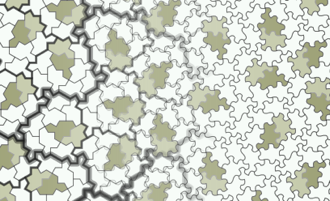
For example, the aperiodic mono tile was developed by a team of researchers aided by artificial intelligence. Without it, the demonstration would have been very difficult. The challenge was to find a tile whose assembly does not produce a crystalline regularity that repeats itself. The problem was thousands of years old.
Once the solution has been found, it's easy to say "we should have thought of that", and that's exactly where A.I. needs our input. We give it the problem and provide it with the rules, data and everything else it needs to solve the problem. We connect it to reality. If the connection is bad, the result will be the same.
You can theorize and argue all you like, but it's only through experimentation that you'll know whether your theory or explanation is valid. The A.I. itself is the object of testing: as long as its predictions are verified, we trust it, but as soon as experimentation shows otherwise, its value falls, and we fall back on human intelligence to detect the causes of the failure. Hence the need to understand the principles, rules and relationships at work.
An applied molecular chemistry application such as 3D-QSAR is a good illustration of this phenomenon: its reputation grows as its predictions are verified; its results improve as its designers better master the relationships between observations and structures. Without mastery of the basics, no progress is possible.
Science teaching has a duty to arouse interest and curiosity at the outset, but above all to inculcate the basics and principles and to progress them to an adequate mastery, according to the expressed ambitions and needs of each student. Artificial intelligence certainly has the potential to enhance our capabilities, but it can't do much without our skills.
Illustration: ALLVISIONN - DepositPhotos
References
History of science portal - https://fr.wikipedia.org/wiki/Portail:Histoire_des_sciences
An aperiodic monotile - David Smith, Joseph Samuel Myers, Craig S. Kaplan, Chaim Goodman-Strauss
https://arxiv.org/abs/2303.10798
Single-tile aperiodic paving without overturning?https://les-mathematiques.net/vanilla/discussion/2334577/pavage-aperiodique-a-tuile-unique-sans-retournement
Asking the right question is half the battle
https://blogs.mediapart.fr/wawa/blog/200123/poser-la-bonne-question-cest-la-moitie-de-savoir
3D-QSAR - https://www.3d-qsar.com/
See more articles by this author