Tests of vigilance and attention
Measuring attention remains a concern in many settings. Some work tasks are not very error tolerant. Here are a series of sample tests to measure attention in children and adults.
Publish at November 20 2023 Updated April 01 2025


Text-to-speech is not a new service. Shortly after our debut at Thot in 1997, we offered this service on our pages, but for reasons of cost and number of uses, we abandoned it around the year 2000. Progress since then has made this technology much more accessible and useful for a variety of purposes.
The intelligibility of texts read by synthetic voices systematically came up against several obstacles, both technical and semantic, such as foreign terms, company names and abbreviations that were mispronounced, often rendering them incomprehensible.
Secondly, the quality of the texts, with their punctuation, grammar and spelling errors, often made them difficult to read.
Languages other than English were often poorly served, with voices that were robotic, atonal and lacking in diversity. Regional accents were never taken into account.
Finally, users had virtually no control over reading speed, intonation or style.
Thanks to artificial intelligence, all these difficulties are now overcome by the use of elaborate language models, multilingual dictionaries of previously unimaginable richness, and banks of contexts, accents and intonations that make text interpretation lively and adaptable to the content and the intended audience.
We tested the Eleven Labs system, which is available in 29 languages, including all international languages and less common languages such as Arabic, Hindi, Malay and Filipino.
We submitted this text and had it read by different voices. The interpretation is astonishing and the result impressive right from the start.
The generation may take a few minutes, but the result lives up to expectations.
A history of all your interpretations is kept and can be reused at will.
All files can be exported in mp3 format.
APIs are also available for systematic and intensive use.
Some players are only available in version v1. In this version, if numbers are written in numerals, they will be recited in English. To have them in your language, they must be written in text: for example, "twenty-nine" instead of "29". If you take a voice from version 1 with version 2, you will observe a significant variation in style, accent or volume which is not representative of the level of quality possible with version 2.
Don't forget to select your starting language and choose a reader that matches the style of your text.
Eleven Labs speech synthesis
Illustration: Nataly-Nete - DepositPhotos
You might also like:
Tests of vigilance and attention
Measuring attention remains a concern in many settings. Some work tasks are not very error tolerant. Here are a series of sample tests to measure attention in children and adults.
A fun game about heredity and genetics - Welcome to Thingdom
How do you talk to children about genetics and heredity? A British museum has come up with the method: design a game in which you create a line of adorable creatures with precise objectives. The game is fun, colorful and easy to learn. Even adults will succumb to the charms of the bugs and their large families.
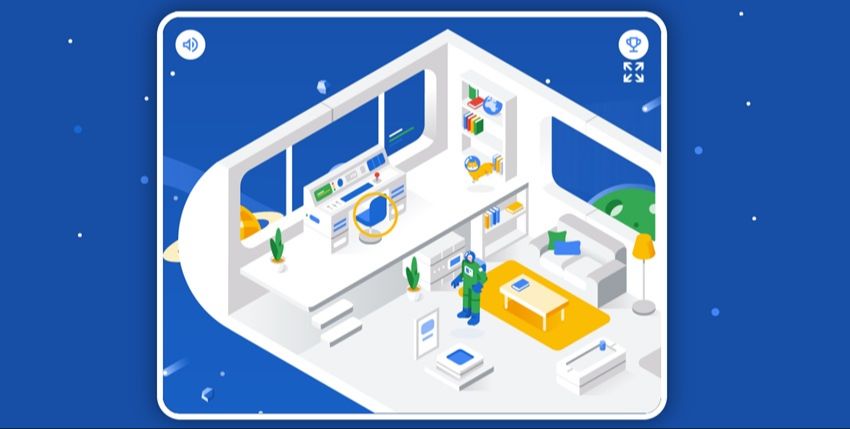
"Space Shelter: Google's cybersecurity game
All our lives have an online component. As a result, a large proportion of Internet users are at risk of being tricked by hackers. A short game invites Internet users to remember certain elements of cybersecurity using a space theme.
The sharing economy has led to small changes in various economic sectors such as transportation, housing, etc. This approach has changed the relationship of citizens for different services, now cheaper and offered by their fellow citizens. However, who actually benefits from this new economy? The people or the companies in question? A U.S. newsgame shows how the life of Uber drivers isn't as lucrative as one might think.
Koam, playing with balanced nutrition
A veritable showcase for public health, Koam was developed by Nutrikeo, a consulting firm specializing in nutritional strategies. Supported by BPI France, the Nouvelle Aquitaine region and Europe, Koam is the result of two years' work by a team of leading specialists in nutrition, childhood, pedagogy, sociology, digital and behavioral theory.