Critical thinking in the age of artificial intelligence
Three philosophers of human experience discuss the pressing need for critical thinking in the age of generative AI
Publish at January 17 2024 Updated January 17 2024


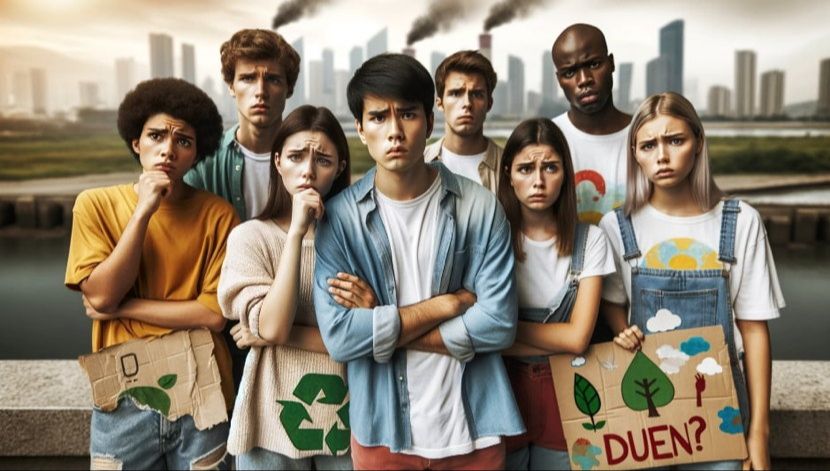
Many media and politicians broadcast and repeat distressing environmental news, creating an atmosphere of anxiety, especially among young people.
Among this negative news, the cries of alarm about climate change occupy an important place, if not the top spot. A term has emerged to describe how young people feel about this: eco-anxiety.
The study entitled"Dans la tête des éco-anxieux" (In the minds of eco-anxious people) carried out in 2022 by the Institut Jean Jaurès, highlights the extent of the phenomenon and the malaise and consequences among young people. Here are three key points from the study:
Eco-rage among young people reflects an intense and well-informed frustration with current responses to climate change. This anger is not limited to superficial discontent. For some, it is rooted in a critical understanding of environmental policies and their implementation. Many young people have a burning desire to see concrete and immediate action from governments and businesses. They are calling for stronger policies and bolder initiatives to tackle climate change effectively, reflecting a demand for responsibility and action at all levels of decision-making. Paradoxically, many of them also fly on city-trips, revealing a certain cognitive dissonance, not to say incoherence.
The anxiety-hope duality in the context of climate change, as experienced by young people, is complex.
This duality creates a dynamic where anxiety and hope feed off each other, motivating young people to remain engaged and active in environmental issues.
Young people's thinking about motherhood and fatherhood is strongly influenced by their ecological concerns. Many of them consider the environmental impact of population growth and the future challenges their children could face as a result of climate change.
A few different ways of looking at the issue can make it a lot less anxiety-provoking.
In dealing with climate challenges, it's important to recognize the importance of taking a step back from the things that are beyond our control. Focusing exclusively on the things we can't change can lead to feelings of powerlessness and anxiety.
By accepting the existence of factors beyond our control, we can better channel our energy and attention into concrete, achievable actions. This keeps us engaged and effective, while maintaining our mental well-being and long-term motivation.
Here are a few suggestions for daily gestures that can help us feel that we are acting coherently with the climate situation:
By adopting these reflexes on a daily basis, at our own pace and within our means, we can feel a greater coherence between our convictions and our lifestyle. Every gesture is important!
Adopting eco-responsible gestures on a daily basis can actually help reduce eco-anxiety or anxiety linked to climate change. There are several reasons for this:
Future climate forecasts are widely shared by the media and political figures, and can give rise to legitimate concerns. Let's not give in to panic, but prepare to face up to the situation and act at our own level. It is likely that humanity will be able to demonstrate its ingenuity and solidarity in adapting to the challenges ahead.
Our species possesses a remarkable capacity for innovation and resilience, and throughout history we have demonstrated that through collaboration, science and technology, we can overcome even seemingly insurmountable situations. The fight against climate change will be no exception.
Admittedly, the scale of the task may seem daunting. But rather than giving in to panic or fatalism, we need to cultivate optimism.
You might also like:
Critical thinking in the age of artificial intelligence
Three philosophers of human experience discuss the pressing need for critical thinking in the age of generative AI
Students overwhelmed by online information
They were born with social networks, yet teenagers are still likely to believe misinformation online. Especially since it is for most of them their main source of information. Hence the crying call from experts for cyber citizenship to be taught from the earliest years of school.
When self-censorship blocks a group's creativity, and how to get out of it?
Nothing beats group reflection, hence the popularity of brainstorming and steering meetings. Many come away with mixed feelings, but few would dare question the principle. Yet researchers have shown that personal image, self-censorship and group dynamics can sometimes render creativity techniques ineffective. Fortunately, there are antidotes!
Stock market games to understand the economy and investment vehicles
Young people are developing an attraction for the financial markets, especially since Bitcoin has become the talk of the town. All too often motivated by the promise of financial gains without any traditional effort, this attraction needs to be channeled. That's what educational stock market games are all about.