Physics loves to undo the preconceptions we have of our world. For a long time, it was said that the Earth was at the center of the world, until astronomers realized that this was false. Subsequently, we believed that our solar system was unique. Once again, cosmologists have debunked this impression with concrete observations. So, will the next certainty to be demolished be the uniqueness of our universe?
Popular culture has seized on the idea of the multiverse to play on the concept of possibilities, of heroes becoming villains or vice versa. But does this theory hold water? For the moment, there's nothing to confirm it. Certain physics theses support the idea of multiple universes. Already, the notion of infinity, which our brains have a hard time understanding, could justify the whole thing. The following image is often used: if we had an infinite number of monkeys over an infinite period of time, it would be possible for one of them to rewrite the entire play "Hamlet". Admittedly, the percentage is very small, but it does exist.
The second theory is that of eternal inflation. The Big Bang unleashed an insane amount of cosmic energy. What remained was an excess of energy that physicists call "vacuum energy". But nature abhors a vacuum, and so this immense inflation of the universe would have given rise to an expansion that could have led to the creation of other universes. A bit like bread dough that rises and creates holes in certain places. Incidentally, this type of reproduction can be seen in many natural domains in the same way, for example, in living cells.
Finally, the values of the fundamental constants raise many questions. We know that gravity corresponds to a precise equation, as does the speed of light. Yet physicists are unable to understand how these numbers were generated.
Is it simply chance or the act of a divine being? Or is it, as some suspect, a series of reproductions of universes so that some have the right conditions to host life, planets and stars, and others don't? There's still a lot of work to be done to prove these multiple universes. Perhaps the future will reveal that we all have doubles in parallel universes, having made different choices or living in alternative worlds?
To a layman, music is just a tune performed by a musician. Yet, if he were to play Meludia, he would learn all the rudiments and terms associated with musical practice.
Many serious games address the topic of sustainable development. Yet before such solutions were proposed, innovative people had to go against the social grain and fight to improve their environment. A humorous adventure game, hosted by the National Film Board, teaches children the attitudes they need to adopt to make a difference.
An original approach to depression. The game's metaphor is well conceived, a little dark and informative about a problem that affects millions of people.
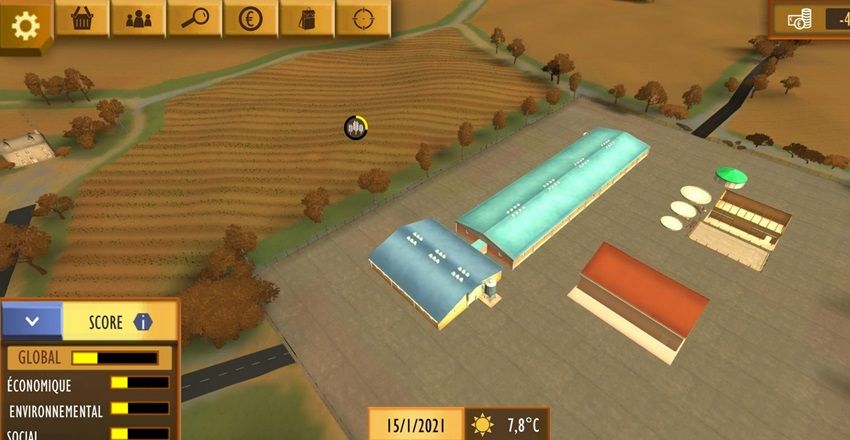
There's nothing simple about being a farmer. You have to plan your activities throughout the year, make sure you have the right machinery, maintain it and so on. All with a view to ecology. A serious French game seeks to teach agroecology.