The interdependence of life reveals a well-known property: "The whole is greater than the sum of its parts". Without bacteria, plankton, worms and everything else that crawls around, we wouldn't survive very long. Without the plumber, the farmer, the mechanic or virtually any other trade, we'd be saying goodbye to our comfort and standard of living. We simply do more together than alone, we know more from many heads than from one.
Any activity can be judged by its level of efficiency, pleasure or benefit. But what appears beneficial on one scale may turn out to be harmful on another; from fossil fuels to sugar, from A.I. to social networks. Even the advances that have enabled humanity to prosper are now coming up against their limits.
By studying our interdependencies, we realize that the best solutions are regularly renegotiated with the participation of all parties concerned. Of course, insects and ecosystems don't speak, any more than ferns or mice do. It's up to us to give them a language, often using scientific data, so that we can understand where our interests converge.
If technologies only enable us to meet our "preferences", they diminish the possibilities of "foreign" encounters. It's hard to prefer what you've never seen. According to legend, Siddharta had a revelation when he saw a filthy cripple, the embodiment of the imperfection of the world that had been hidden from him until then.
Interdependence is an objective, dynamic fact to be encouraged, as it is clearly fruitful, but also risky if not balanced. If nature specializes, it's because there's a gain in doing so, which is translated into economic language by absolute and relative advantages. We can do more by combining the strengths and expertise of each living being in the best possible way. If we sanitize our environment, we impoverish it to the point of sickness or incapacity.
Every discipline we teach relies on others, even the so-called "fundamental" ones. What would physics be without philosophy? Practically all encounters between disciplines lead to achievements that would otherwise be impossible. Many civilizations have disappeared because they failed to understand where their practices were leading them. We, who have the opportunity to educate and understand our biological, social, cultural, emotional, economic and other interdependencies, would do well to confront isolationist rhetoric: it gets us nowhere. We need more communication, not less; that way, we have a chance of understanding our interdependencies and improving them.
Denys Lamontagne - [email protected]
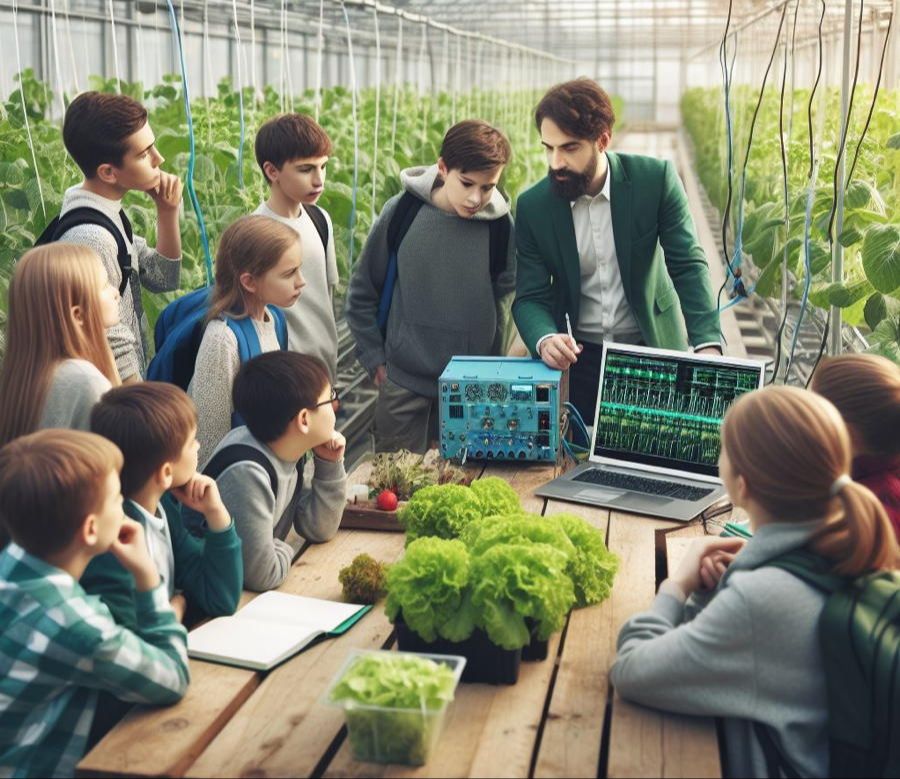
Illustration: Students watch a teacher talk to a technician about the computer code for the vegetable greenhouse - Bing Creastor