Living in the university or the ordeal of students on African campuses
This is not about living on university campuses but about spending nights in the lecture halls ...
Publish at February 19 2024 Updated February 19 2024


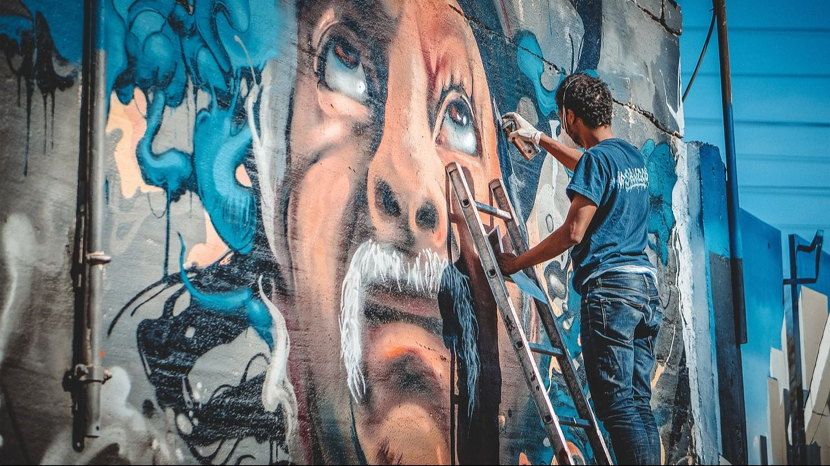
Artists have always fascinated us with their creative abilities, which differ from those of ordinary humans. This is undoubtedly the concept summed up in these lines.
"From ancient to modern art, the myth of the artist has oscillated between that of the self-taught half-mad and that of the demi-god with innate talent. Here's one possible definition of an artist: to be on the bangs of society because he or she is outside ordinary humanity. The idea is romantic. And the artist is by no means innocent in the construction of such a myth" ( Urfalino, 2016).
This phrase expresses two main characteristics of the artist: self-taught and innate talent. With the advent of robotization or artificial intelligence, these qualities are likely to lose notoriety.
A self-taught person is one who is able to learn something new without the help of a mentor or formal education methods. In other words, he or she acquires knowledge using only his or her own efforts and abilities, partly through trial-and-error experiments, reading and so on. Self-teachers teach themselves, exploring subjects that interest them and developing skills without relying on a traditional educational structure.
Their curiosity and intrinsic motivation drive them to learn and develop independently. A number of artists have developed in this way: Van Gogh, Maurizio Cattelan, Reggie Khumalo, to name but a few, are said to be excellent self-taught artists. Speaking of the former, he's undoubtedly one of mankind's most famous painters. After several failed attempts at education, this "half-mad" finally achieved self-fulfilment in painting. And with AI, we could now reproduce the Starry Night, at least in a digital version...
While robots can't match the dexterity of a painter's expert hand in painting, in music, the field of creative possibilities is growing ever wider.
Even if Céline Dion's voice is unique, it could very well be interpreted by Shimon, a robot that creates and plays its own compositions.
The artist, a being who navigates between worlds and weaves dreams with invisible threads, defies the laws of gravity by soaring on the wings of creativity. Her eyes, riveted on the infinite, capture glimpses of beauty in every corner of the world. Her words, like oracles, reveal hidden riches and awaken dormant emotions, a sensation that leads us to respect Joe Dassin, Michael Jackson, Picasso, Shakespeare and more.
But today, artificial intelligence is capable of creating "Romeo and Juliet" and "We are the world". What's more, it would not be easy for the public to tell the difference between a work produced by a robot and one produced by a human. In the face of this transformation, one wonders whether the artist will remain, for much longer, the demi-God. His art may be immortal, but it can now be reproduced by robots.
Robots, and above all artificial intelligence, only "create" from what exists. In fact, it's tempting to say that AI doesn't create, it finds. In other words, they function like sophisticated copiers. However, their ability to process large quantities of data in a short space of time leads to productions that are as interesting as they are strange.
"Heart on my Sleeve", which lasts around 2 minutes, attracted over 15 million listens on Tik Tok before being removed under pressure from Universal Music Group. Here's a robotically-crafted gem based on the voices of American rappers Drake and The Weeknd that hasn't left many music lovers indifferent. This example is just the tip of the iceberg in the ocean of robotic creations in the arts.
Artists have always had to deal with changes in their environment. Coupé Décalé, a lively musical style from Côte d'Ivoire, was partly successful in the early 2000s thanks to DJs' ability to use computers to make mixes.
Nevertheless, the distance between an original creation, the fruit of the artist's genius, and the production capacity of AI tools is becoming ever shorter. In future, it will be difficult to distinguish between purely human productions and those of robots. Robots may be human creations, but their artistic production capabilities will bring drastic changes to the way we think about art and artists.
Over and above the divine image that accompanies them, in many fields we'll have to reconsider the status of authors and artists' remuneration. Should we create prizes or distinctions for robotic artistic creations, what we might call RoboARt?
Already, with the emergence of social networks, copyright issues have become almost uncontrollable; with the prowess of AI, the problem becomes even more complex. Perhaps we'll have to resort to AI to solve it.
References
Kohlhagen, Dominik, 2005, "Frime, escroquerie et cosmopolitisme, Le succès du "coupé-décalé" en Afrique et ailleurs", Politique africaine 2005/4 (N° 100), pages 92 à 105.
Mazzetti, Benoît, 2022, "Can robots demonstrate artistic creativity?"
https://www.actuia.com/contribution/mazzettibenoit/les-robots-peuvent-ils-faire-preuve-de-creativite-artistique
Urfalino, Mathilde, 2016, "How the myth of the artist was born, and built."
https://www.lesinrocks.com/arts-et-scenes/lartiste-un-mythe-66343-03-07-2016/
You might also like:
Living in the university or the ordeal of students on African campuses
This is not about living on university campuses but about spending nights in the lecture halls ...
Exaggerated use of figures to evaluate the quality of a training course makes us miss "what cannot be measured". We question the qualitative dimensions of the Wow! Effect by presenting the advantages and limits of this marketing invention.
The importance of welcoming students
Greeting students in class has far greater effects than we might have thought. Studies tend to show that a teacher's attitude towards students can literally have repercussions right down to the results of assessments. There's nothing insignificant about this gesture of greeting, and that's why some people are working to improve the first contact with learners.
Play and foreign language learning
Play in foreign language learning motivates the learner, creates a climate of security in the face of an unfamiliar and threatening language and, above all, enables considerable progress to be made.
Understanding quantum intelligence and its challenges
Has artificial intelligence reached its limits? Problem of managing complexity, of ethics, of discernment, of understanding common sense. Maybe, but let's look at it differently. If in fact artificial intelligence was what parchments were to books 500 years ago, at the time of the last great Western mutation called the Renaissance?