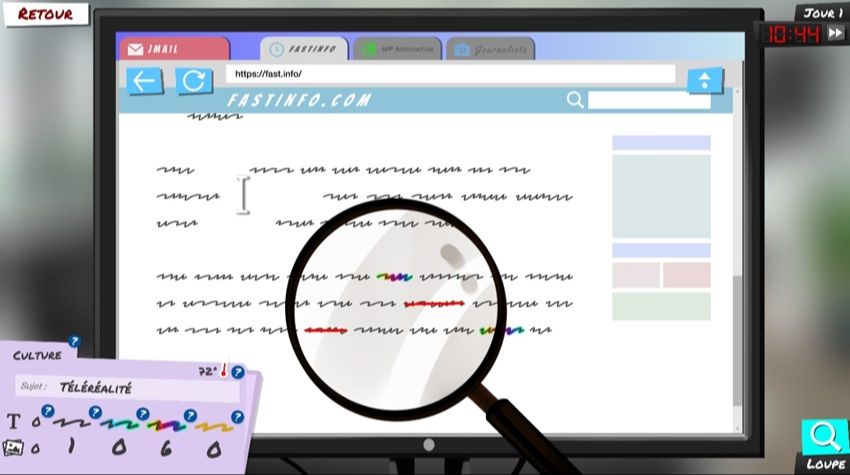
Newscraft: the game that puts you in the shoes of a reporter
A serious game that explains and brings to life the notion of news selection and the editorial line of different types of media.
Publish at May 22 2024 Updated May 22 2024


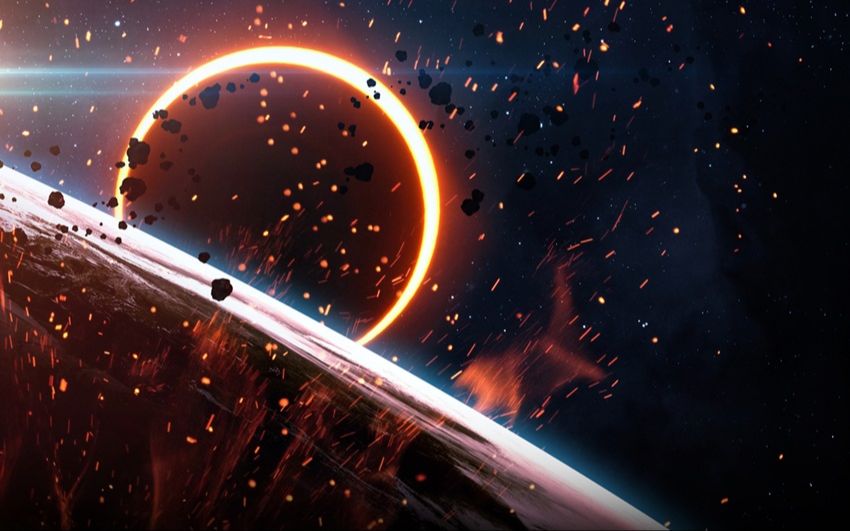
Everything has an end. It's one of the first things we learn in life. Whether it's a fun evening or the life of a loved one, everything will reach a point where it will be no more. Therefore, our universe too, theoretically, should one day experience its demise. Astrophysicists are trying to calculate this finality. They're mostly at the hypothesis stage, because there are still many elements of physics yet to be discovered.
For the moment, two scenarios are likely on the scale of our solar system and our galaxy: our Sun will eventually run out of fuel in 5 billion years' time, and around the same time, the Andromeda galaxy will hit the Milky Way with unknown effects. As for the universe itself, astrophysicists are considering three hypotheses. It all depends on how far the universe expands. If it accelerates ("Big Rip"), it will end up tearing apart, since it will surpass all the forces that keep it stable, including gravitation, electromagnetism and so on. In short, atoms would be shredded. If it continues to expand at the same speed without stopping, there will come a time when it will no longer be "fast enough", leading to the thermal death ("Big Freeze") of galaxies and planets. In the event of the gravitational force becoming stronger than the expansion of the universe, it would force the universe to fold in on itself and crash ("Big Crunch"). The point of contraction would change to a state so hot that it would probably recreate another "Big Bang". In short, the cosmos would reset itself.
Nevertheless, all these theories take place in a timeline impossible to conceive of humanly. We're talking trillions of years here. Predictions that could change with increased knowledge of dark energy and other little-known astrophysical phenomena. Will human civilizations then be able to find ways of surviving these scenarios? We should already be in a position to ensure our survival for the next few centuries on our good old planet.
Running time: 28min22
You might also like:
Newscraft: the game that puts you in the shoes of a reporter
A serious game that explains and brings to life the notion of news selection and the editorial line of different types of media.
The Englishes MOOC course was developed by an artist and is designed for anyone interested in the (English) language. It explores the history of English, its pronunciation, and its relationship to the art world.
The sharing economy has led to small changes in various economic sectors such as transportation, housing, etc. This approach has changed the relationship of citizens for different services, now cheaper and offered by their fellow citizens. However, who actually benefits from this new economy? The people or the companies in question? A U.S. newsgame shows how the life of Uber drivers isn't as lucrative as one might think.
Tests of vigilance and attention
Measuring attention remains a concern in many settings. Some work tasks are not very error tolerant. Here are a series of sample tests to measure attention in children and adults.