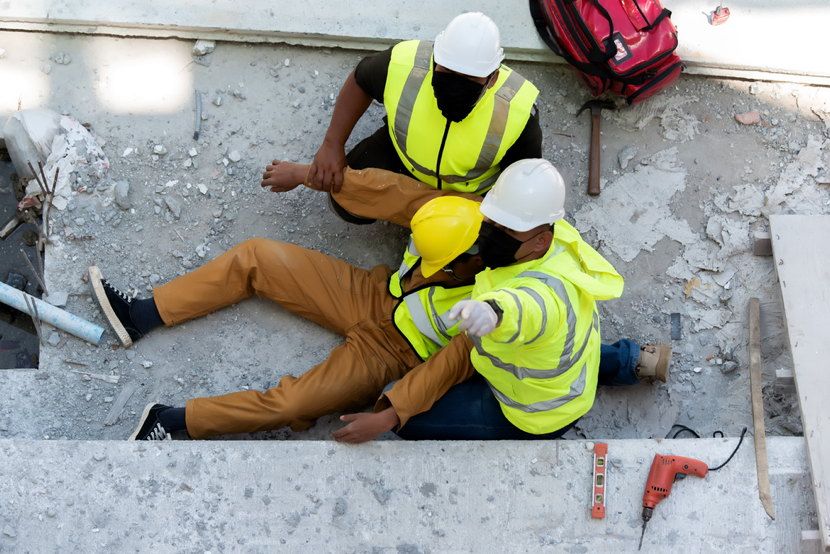
In the professional world, depending on the activity, a work-related accident generally leads to a post-traumatic period that is not always well negotiated. Don't we need to assess and understand what we're going through before considering the possibility of retraining?
Numbers that challenge
No professional sector is spared from accidents. It's certainly true that the transport sector takes the lion's share, as accidents end the lives of over a million people worldwide every year, according to a study conducted by Emmanuel Lagarde for the Institut de Recherche en Santé Publique.
In the same vein, a WHO press release dated September 17, 2021 in Geneva, reveals that work-related illness and trauma were responsible for the deaths of 1.9 million people in 2016. In Senegal, a study conducted on the characteristics linked to work-related accidents reveals that they lead to fractures in 51% of cases, and affect the hand in 30% of cases. The above data shows that this is a worrying situation that needs to be given greater attention.
Consequences not to be underestimated
First of all, it's clear that traumatic situations in the workplace leave their mark on the individuals directly involved. Psychologically speaking, the injured person often finds it difficult to return to work, for fear of reliving the situation.
In social terms, they may be abandoned by society, leading to loneliness, which is unlikely to improve their situation. For example, it would be very difficult for a bus driver to return to work after an accident. Sometimes he's no longer medically fit to work. Faced with this post-traumatic period, he needs moral support.
Secondly, on an economic level, victims of work-related accidents often find themselves in a very difficult situation, especially when they have no direct support from family or friends, or from their professional environment. In fact, whatever the sector, it is quite possible to find oneself without resources, or with a drop in income, which could be even more traumatic when the victims have significant dependents.
Finally, mental isolation can lead the person concerned to consider leaving this world prematurely, depending on the seriousness of their condition. Here again, great mental strength is required to overcome this void. The person concerned must regain a taste for life, start afresh and rebuild a life that was previously running smoothly.
In the light of the above, we need to put in place strategies that will really help people in a post-traumatic state to regain their confidence and, so to speak, heal from the traumatic event.
Ways out
We won't go through the whole range of proposals for supporting people in distressing situations. Instead, we'll structure them according to the model of the renowned French neuropsychiatrist Boris Cyrulnik. He developed the concept of resilience. In his development, he proposes three progressive stages for coping with post-traumatic periods. We will present each of them in turn, adapting them to the worker's situation.
- Attachment
After a work-related trauma caused by an accident, the most important thing is to avoid being alone, because, as he states in an interview, "solitude is a serious neurological, psychological and organic aggression". It is imperative to attach oneself to people who can help one feel better. These people must be reassuring. For the worker, this could be his spouse and children.
- Reflection
Not to be confused with rumination, which keeps the worker focused on the traumatic event. At this stage, he or she should reflect on the situation. Of course, a dialogue should be held with the reassuring person who will help him or her to better understand the situation.
- Taking action
After the first two phases, the worker is invited to take action. This is a decisive stage that will help him to gradually take the initiative. They are called upon to deploy what Boris Cyrulnik calls protective factors. These include sport (walking, for example, is an excellent tranquilizer). If he's more fond of literature, he might take up reading or even DIY. It all depends on his sensitivity and preferences.
In any case, it's important to remember that we shouldn't be looking for perfection, but rather for progress through these stages. In reality, good healing takes time. Once the child is born again, he or she will be psychologically better prepared and able to decide whether or not to change direction.
One thing's for sure: this period of self-work will help him to feel better in his flesh, which is the most important thing.
Illustration: Kokllang - DepositPhotos
Sources
Boris Cyrulnik: la résilience ou l'art de rebondir à tout âge | La Ligue de l'Enseignement et de l'Éducation permanente (ligue-enseignement.be) - Nathalie Masure, 2020
https://ligue-enseignement.be/boris-cyrulnik-la-resilience-ou-lart-de-rebondir-a-tout-age
Frédéric Le Teurnier, 2022 "How to rebuild after a serious accident? - France
https://www.francebleu.fr/emissions/c-est-deja-demain/comment-se-reconstruire-apres-un-accident
Emmanuel Lagarde, 2013 "Traumatismes: les enjeux de santé publique" - IRESP
https://iresp.net/wp-content/uploads/2022/11/IRSP_23_2013023.pdf
2021, "WHO/ILO: The number of work-related deaths rises to nearly two million each year"
https://www.ilo.org/fr/resource/news/omsoit-le-nombre-des-deces-lies-au-travail-seleve-pres-de-deux-millions
https://www.ilo.org/publications/whoilo-joint-estimates-work-related-burden-disease-and-injury-2000-2016-0
Desmarez, Pierre. I Godin and Renneson, Bernard, 2007, "l'impact des accidents de travail sur le statut socio-économique des victimes" in le travail humain 2007/2 ( Vol 70.), pages 127 à 152
https://www.cairn.info/revue-le-travail-humain-2007-2-page-127.htm
Books by Boris Cyrulnik - https://www.decitre.fr/auteur/438270/Boris+Cyrulnik
Boris Cyrulnik reveals the secrets to overcoming trauma
https://www.youtube.com/watch?v=5RdCARyfZEI
See more articles by this author