
We would naturally be attracted to individuals who seem the most prestigious. This phenomenon has already been studied in psychology as prestige bias. How can this be explained?
Publish at June 12 2024 Updated June 12 2024


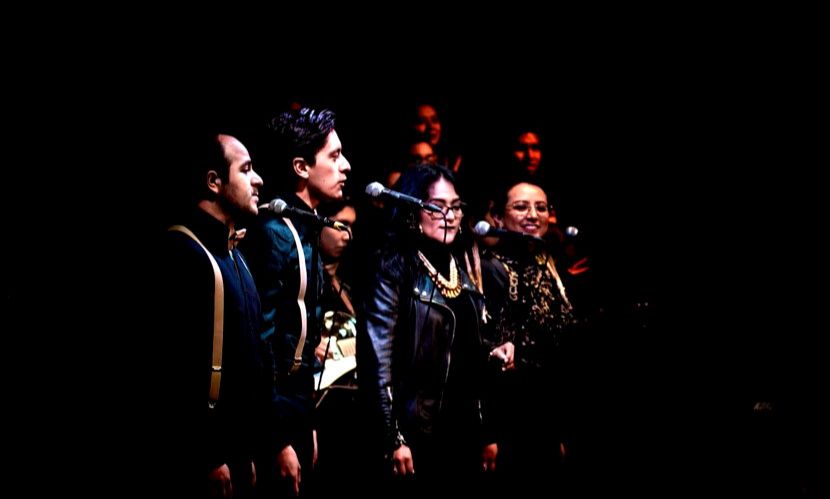
"It's not so much the singing that's sacred, it's the bond it creates between beings."
Philippe Barraqué / At the Source of Sacred Song
Chanting has a variety of effects on collective learning, influencing physiological aspects such as heartbeat, breathing and muscle tension. Singing and vibrating together is one of the most powerful ways of building community.
Singing has significant effects on the body. Depending on their nature, songs can slow down or speed up the heart rate. For example, soothing songs such as Gregorian chants reduce heart rate, while war songs increase it. Singing regulates breathing, encouraging deep, rhythmic breathing, which can reduce stress and increase lung capacity. Synchronized chants, such as those used during work or ceremonies, can reduce muscular tension by regulating movement and promoting relaxation.
All these songs form part of humanity's heritage as an unrivalled means of expression. The various types of song influence collective learning by reinforcing identity, transmitting knowledge and values, and offering emotional and social support.
Their physiological effects reinforce these benefits, promoting physical and mental health. They are central to community development. Today, choirs are taking up the baton, offering new spaces for bonding. That's something generative AI won't take away from us!
Illustration: Unsplash: Choir
Sources
Griaule, M. (1965). Conversations with Ogotemmêli: An Introduction to Dogon Religious Ideas. Oxford University Press. https://archive.org/details/conversationswit0000gria
Hiley, D. (1993). Western Plainchant: A Handbook. Oxford University Press. https://archive.org/details/westernplainchan0000unse
Ka'ai, T. M. (2004). Te mana o te reo me ngā tikanga: Power and politics of the language. Auckland: Pearson Education New Zealand. https://www.researchgate.net/publication/328490517_A_Maori_perspective_of_being_and_belonging
Levine, V. L. (2009). Medicine Bundle: Indian Sacred Performance and American Literature, 1824-1932. University of Pennsylvania Press.
Lloyd, A. L. (1967). Folk Song in England. Paladin. https://archive.org/details/folksonginenglan0000lloy
McDonald, M. (1989). We are all Celts Now: The Construction of a Breton Identity in Brittany. In Ethnic and Racial Studies, 12(2), 195-215. https://archive. org/details/celtsconstructio0000chap/page/n5/mode/2up
Nettl, B. (2005). The Study of Ethnomusicology: Thirty-one Issues and Concepts. University of Illinois Press. https://archive.org/details/studyofethnomusi0000nett_k8g4
Smith, D. (2000). Zulu Shaman: Dreams, Prophecies, and Mysteries. Destiny Books. https://www.goodreads.com/book/show/481397.Zulu_Shaman
Winkelman, M. (2010). Shamanism: A Biopsychosocial Paradigm of Consciousness and Healing. Praeger. https://www.researchgate.net/publication/323755883_Shamanism_A_biopsychosocial_paradigm_of_consciousness_and_healing
You might also like:
We would naturally be attracted to individuals who seem the most prestigious. This phenomenon has already been studied in psychology as prestige bias. How can this be explained?
Access to educational resources: orientation and priorities
Overlooking the responsibility of education in reproducing an inequitable system will not make us any less responsible for the situation. Scarcity of education? Education for scarcity!
Facilitation as a medium of passage between transmission and self-transformation
There is a bias towards thinking of training as submission to the world, or as an attempt to emancipate oneself from it. A third way is to learn to live in peace with it.
Resistance to change": a criticized concept
It is conventional to condemn "resistance to change". Project managers spend a lot of effort trying to reduce, circumvent or erode it. And yet, some authors show us that this rather simplistic concept fails to capture the diversity of attitudes to change.
Synchrony and complexity in our world
Our time has gone from asynchronous to synchronous in just a few years. The brain engine that manages complexity does so by modulation. The more complex our world becomes, the simpler the input of information becomes, leaving asynchrony, the temporal dislocation of the letter carrier's letter for example, by the synchronous time of tweets, cell phones... of each other.