Regenerative approaches developing the link with the living
Pedagogical approaches to put us back in touch with life.
Publish at July 03 2024 Updated July 03 2024


"We asked a wise man: 'Why don't you retaliate against those who misbehave with you?' He replied with a smile: 'When a donkey pushes you, do you push him too? When you see a dog barking, do you bark too? When you're in the middle of the river, you don't insult the crocodile."
African proverb
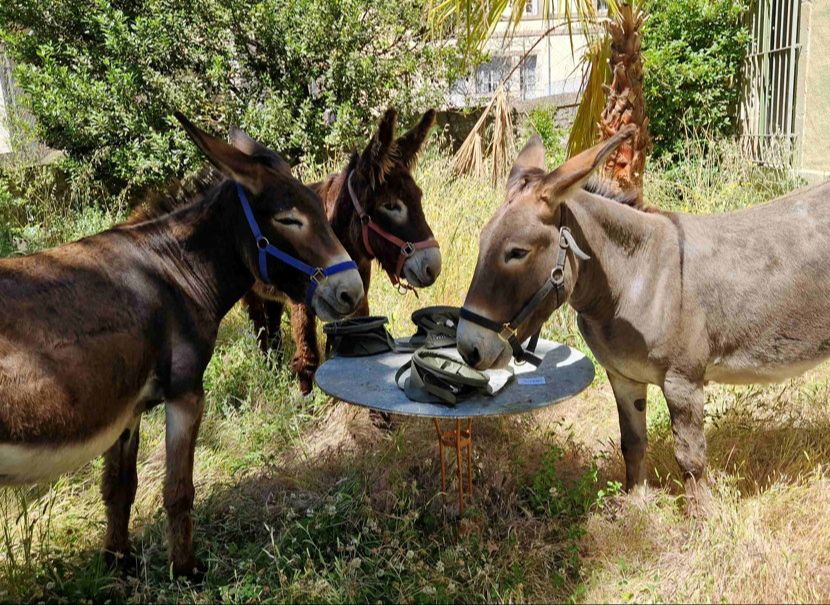
Here I am, owner of 3 donkeys Gygesse, Klarine and Kansas, and they're putting what I thought I knew about pedagogy to the test. In an increasingly connected world, effective communication is essential for both personal and professional development. Indeed, around 55% of human communication is non-verbal, highlighting the importance of understanding and interpreting non-verbal signals (Mehrabian, 1971). Furthermore, 85% of problems within organizations are attributed to communication deficiencies (Harvard Business Review, 2017). Finally, studies show that positive interactions with animals reduce stress in humans by an average of 31%, illustrating the therapeutic and educational potential of interspecies relationships (Beetz et al., 2012).
The presence of an animal in an institution is a genuine act of care. The warmth of its breath, listening to its breathing and its heart, is a reminder of life as it passes. The dimension of the animal in touch with its environment reinforces our anchorage. Animals are said to be gifted with sentience, i.e. sensitivity, emotional capacity and unique learning abilities.
The example of donkeys, animals often underestimated but endowed with a rich palette of behaviours and modes of communication, offers invaluable lessons. Their study helps us refine our understanding of non-verbal communication and develop key facilitation skills, while supporting a phenomenological pedagogical approach.
This text explores how interspecies communication enriches facilitator training through three main categories: interpersonal skills development, communication enhancement, and personal and professional enrichment.
With these 3 donkeys, my wife and I decided to start training trainers, facilitators, change agents, innovators, coaches and managers.(Dan'A's Dream project). Asine mediation (with donkeys) enables us to work on several key skills:
If you'd like to experience or learn more, come to the Haut Languedoc.
Illustration: donkeys Kansas, Gygesse and Klarine at the table - ©Denis Cristol
Sources
Broom, D. M., & Fraser, A. F. (2007). Domestic Animal Behaviour and Welfare. CABI. http s://www.cabidigitallibrary.org/doi/book/10.1079/9781789249835.0000
Burden, F. A. (2012). The welfare and veterinary care of donkeys. Veterinary Clinics: Equine Practice, 28(3), 481-499. https://bvajournals. onlinelibrary.wiley.com/doi/full/10.1136/vr.b4800
French, J. M. (1997). Donkey: The Story of the Ass from East to West. Boydell & Brewer. https://archive. org/details/donkeystoryofass0000dent
Grandin, T., & Johnson, C. (2009). Animals Make Us Human: Creating the Best Life for Animals. Houghton Mifflin Harcourt. https://books. google.fr/books/about/Animals_Make_Us_Human.html?id=yXazZCCj9QYC&redir_esc=y
Hall, E. T. (1984). The Dance of Life: The Other Dimension of Time. Anchor Books.
Harvard Business Review. (2017). The Cost of Poor Communications. https://www. proquest.com/docview/2429061659?pq-origsite=primo&sourcetype=Trade%20Journals
Kiley-Worthington, M. (1990). Animals in Schools: A Guide for the Education of Human-Animal Relationships. Learning Development Institute. https://books. google.fr/books/about/Animals_in_Schools.html?id=K4Wwdy1QgO8C&redir_esc=y
Kolb, D. A. (1984). Experiential Learning: Experience as the Source of Learning and Development. Prentice Hall.
Lazarus, R. S., & Folkman, S. (1984). Stress, Appraisal, and Coping. Springer Publishing Company. https://link. springer.com/referenceworkentry/10.1007/978-1-4419-1005-9_215
Levinson, B. M. (1969). Pet-oriented Child Psychotherapy. Charles C. Thomas. https://archive. org/details/petorientedchild0000levi
McDonnell, S. M. (2003). The Equid Ethogram: A Practical Field Guide to Horse Behavior. Eclipse Press. https://archive. org/details/equidethogrampra0000mcdo
Mehrabian, A. (1971). Silent Messages. Wadsworth. https://archive. org/details/silentmessages00mehr
Skinner, B. F. (1953). Science and Human Behavior. Free Press. https://www. bfskinner.org/newtestsite/wp-content/uploads/2014/02/ScienceHumanBehavior.pdf
Thorne, T. (1998). The Donkey Companion. Storey Publishing. https://archive. org/details/donkeycompanions0000weav
Varela, F. J., Thompson, E., & Rosch, E. (1991). The Embodied Mind https://direct.mit.edu/books/monograph/4061/The-Embodied-MindCognitive-Science-and-Human
Dan' A 's dream https://apprendre-autrement.org/reve-dana/
You might also like:
Regenerative approaches developing the link with the living
Pedagogical approaches to put us back in touch with life.
Practice in healthcare training
Training courses in the healthcare sector give a central place to practical work in order to build professional skills and attitudes. Beyond technical gestures, these professional situations foster socialization, the care relationship and ethics. This experiential learning involves specific pedagogical, legal and human issues. Simulation renews it, but also questions the balance between distance and presence in the transmission of a caring profession.
Presentation of the Syllabus to Students: Getting the Facts Right
Many teachers consider the syllabus as a static reference document. However, some teachers do not hesitate to modify it as needed, to better correspond to the reality of the field. There is nothing better than discussing it with the students.
Graphics and thought construction
Among the means used to expose a project, a reasoning, we note the existence of varied graphic tools, digital as much as analogical. To make a clear message circulate, it is then necessary to deconstruct the object to valorize it, in an overall dynamic. The graphic design is as much a means to build, to expose and to enrich a questioning.
The contribution of the deaf to education
Taking a cross-language look at sign language and French, at the power of gesture and the contribution of the deaf to a more sensitive and inclusive pedagogy.