Good ideas are rare. Disseminating them is not easy. You have to know how to convince people. Mathematician Cédric Villani takes the example of Semmelweiss, whom he describes as "tragic".
Ignace Philppe Semmelweiss was a Hungarian obstetrician who discovered the usefulness of washing hands before giving birth. In contrast to his colleagues, who insisted on dissecting the corpses of dead parturients in order to understand the causes.
Semmelweiss was the first to understand that hand hygiene played a major role in the success of childbirth. He failed to disseminate this new idea. The doctor ended his life institutionalized and rejected by his colleagues...
How are ideas born?
According to researcher and politician Cédric Villani, an idea is born like a "eureka".
"a little flash in the brain from who knows where".
Cédric Villani describes the birth of an idea as an illumination that initially involves a very small number of brains (often just one).
Then, an entire collective is built around this initial nucleus.
For him, an idea is "a brief flash of lightning followed by years of development". An idea emerges in a great disorder.
According to the mathematician, good ideas are unpredictable, but certain ingredients are very often present:
- documentation. In other words, what's been done before;
- motivation;
- a favorable environment (city, industrial research environment, etc.)
- exchanges
- constraints (stimulating creativity)
- a mixture of work and enlightenment (e.g. H Poincaré)
- perseverance and luck.
Ideas aren't born in the brain!
...but in the conscience... And according to physicist Philippe Guillemant, consciousness is not a product of the brain!
All the great thinkers have been interested in how ideas come to them. Ideas are not always - not even often - voluntarily generated. This is what neuroscientists call the"default network mode".
What does our brain do when we don't solicit? For example, in a waiting room or in transit, with no reading material or digital media to work with?
This line of questioning has led to the discovery of a brain area that is active in these situations of apparent inactivity, dubbed "default network mode" by the researchers.
The brain would be continuously active, even when the individual is not actively engaged in a task.
In this exchange, Fabrice Micheau and Philippe Guillemant discuss a new way of understanding brain function thanks to quantum physics. Default network mode is said to be a specific feature of neuro-atypicals, as well as being a normal brain function.
According to Philippe Guillemant, it is consciousness that is creative, not the brain.
The physicist distinguishes analytical intelligence (brain) from vibratory intelligence (intuition, feelings, emotions), which implies a "connection" outside the brain.
Are genius mathematicians more inclined to this vibratory intelligence?
Creativity and mathematics
Atlexandre Grothendieck was a mathematician. He is described by his peers as one of the greatest, a genius who "turned mathematics on its head".
Largely because his way of thinking was so distinctive. Jean-Pierre Goux, himself a mathematician, describes this way of approaching a problem through generalization. This consists in looking at a problem in the most general way possible, in order to treat it as a whole and thus approach things from a new angle.
Grothendieck demonstrated "an uncommon capacity for generalization and abstraction, an ability to go straight to the most general.
"This quest for maximum generality and the refusal to use examples are his strength." (Sources Ph. Pajot)
Grothendieck has lived part of his life as a hermit,"secluded in a village in the Pyrenees", far from any media coverage, unlike Cédric Villani, who has clearly communicated his creative approach to mathematics and built up his political persona.
In the end, math is useful for many things
For hypersensitive musician and singer Zaho de Sagasan, mathematics has inspired her to decipher her sensitivity. For her, putting her feelings into words on paper is a bit like solving a math equation: visualizing it.
«Problems are like equations: as long as you don't put them down, you can't solve them»
Do you generate ideas by solving problems? It's an idea...
Sources
Christine Bastin (2018). The default brain network: a rest that isn't. Revue de neuropsychologie, 10, 232-238. https://doi.org/10.1684/nrp.2018.0469
Philippe Pajot (2014) "In search of maximum generality" La recherche 485 https://www.larecherche.fr/3-%C3%A0-la-recherche-de-la-g%C3%A9n%C3%A9ralit%C3%A9-maximale
Fabrice Micheau (2024) "Carte Blanche N°19 F. Micheau welcomes P. Guillemant, physics engineer, Centrale. Dr physics . " https://www.youtube.com/watch?v=jxPabl_pQA4&t=1650s
Pierre Ropert (2014) "Les notes manuscrites de Grothendieck, un trésor des mathématiques maintenant en libre accès" France Culture https://www.radiofrance.fr/franceculture/les-notes-manuscrites-de-grothendieck-un-tresor-des-mathematiques-maintenant-en-libre-acces-9857480
Cédric Villani (2017) "La naissance d'une idée" Conference at USI https://www.youtube.com/watch?v=prpoogz36Sc
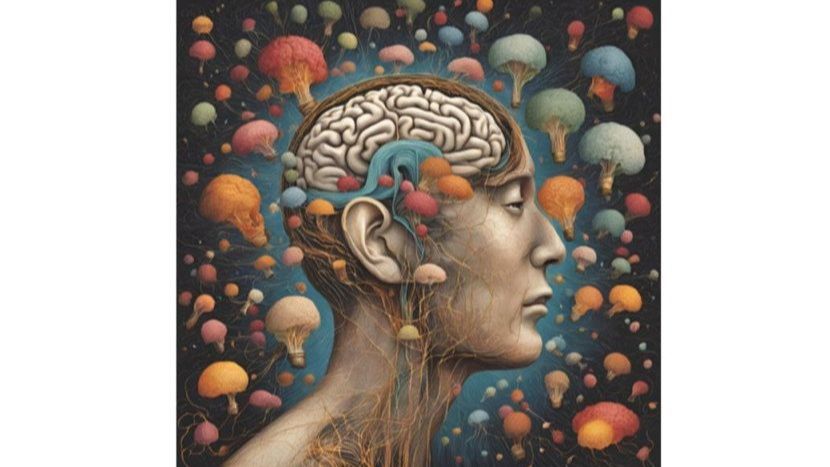
AI-generated image (canvas)
See more articles by this author