Artificial intelligence has grown and continues to grow. Education is no exception to its influence. Its omnipresence raises questions. Artificial Generative Intelligence (AGI) offers a wide range of opportunities, and should education players embrace them?
Artificial intelligence in the education sector
It is now possible to easily obtain rich and diversified content through tools such as CoPilot, Chat GPT, Perplexity AI, among others. They work with conversational chatbots. Whatever the field of learning (science, math, chemistry, etc.), the results generated are reliable to a high degree.
By way of illustration, a mathematical operation can be solved simply by putting it to CoPilot, Microsoft's AI assistant. The latest news is that Open AI, the creator of ChatGPT, has launched o1, a generative AI model capable, they claim, of "reasoning" and, in turn, answering more difficult mathematical questions.
These multi-faceted and revolutionary opportunities created by AI led to conferences and training courses to understand how teachers and learners could use these tools in learning situations.
In the case of the former, they can set up courses and exercises focusing on this technology. Aware of the impact of AI, MOOCs (Massive Open Online Courses) have been set up. For example, in the FLE (Français Langue Étrangère) sector, the course entitled: "Le potentiel de l'intelligence artificielle en FLE: par où commencer?" isavailable on the IF profs platform.
In the same vein, a webinar entitled L'intelligence artificielle dans l'enseignement (Artificial intelligence in teaching) was held on August 30, organized and supervised by the Académie de Paris. The milieu is questioning this rise of AI in the education sector.
Is education changing?
The mere thought that a technology can now think like humans doesn't leave one unmoved. In reality, to be able to generate content, an AI tool follows a process: learning (an AI reads thousands of sources); pattern recognition (it learns how texts are constructed); creation (it uses what it has learned to create). Conventional education is concerned with the cult of effort, not only on the part of the learner, but also on the part of the teacher. It's through hard work that a learner develops over the long term. With AI, the cards have been reshuffled in the training process.
To take things a step further, the learner can decide to focus exclusively on AI to generate answers to class exercises. In this configuration, his learning process is skewed. They become lazy, which has an effect on their level and mortgages their future. What's more, they are not controlled by their teachers outside the classroom. The teacher, for his part, can now focus solely on the AI to prepare his lessons, with less room for personal effort and adaptation to the learning context. What can be done about this reality?
Striking a balance
Whether we like it or not, it will no longer be easy to do without artificial intelligence. In reality, if a school chooses to remain conservative, it won't be able to prevent the learner from using it outside the classroom, unless we ban digital technology from the world. The school could readapt, become aware of AI and guide learners into this universe while insisting on responsible use and respect for ethical rules.
As Matt Miler states,
"When we don't share how AI can be used responsibly, we leave a vacuum".
The teacher can, for example, demonstrate in the classroom how it can be used in the learning process. To do so, they will need to update their skills in this sector, at least in terms of knowledge of AI and its potential.
In short, artificial intelligence is more present than ever in the education sector. Although it offers opportunities, the fact remains that its adaptation to education is far from complete.
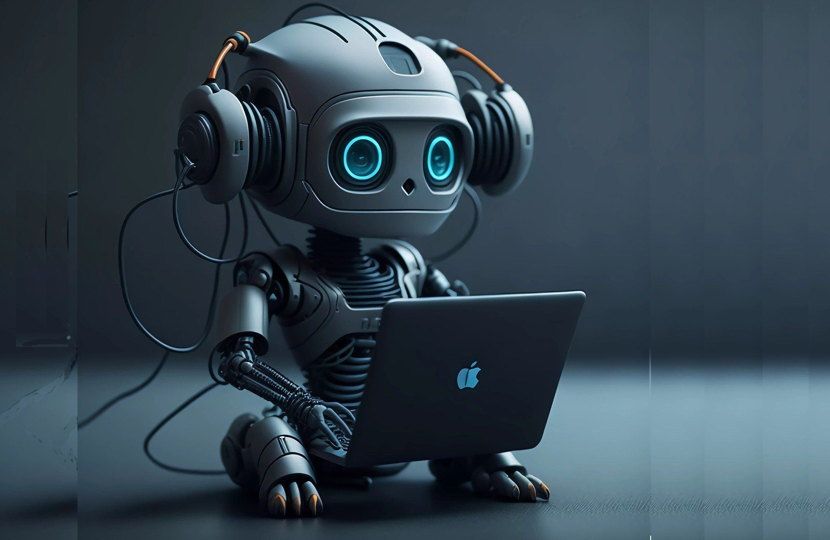
Illustration: Susan-Lu4esm on Pixabay
Sources
How AI will revolutionize education
https://www.lesechos.fr/tech-medias/intelligence-artificielle/comment-lia-va-revolutionner-leducation-2118705
"The age of AI has begun": for Bill Gates, artificial intelligence is one of the greatest technological revolutions in history.
https://www.jeuxvideo.com/news/1725714/l-ere-de-l-ia-a-commence-pour-bill-gates-l-intelligence-artificielle-est-l-une-des-plus-grandes-revolutions-technologiques-de-l-histoire.htm
OpenAI launches O1, an AI model capable of solving math problems.
https://www.lesechos.fr/tech-medias/intelligence-artificielle/openai-lance-o1-un-modele-dia-capable-de-resoudre-des-problemes-de-maths-2118685
10 AI questions every school should seriously ask - École branchée
https://ecolebranchee.com/10-questions-sur-lia-que-toute-ecole-devrait-serieusement-se-poser/
Artificial intelligence (AI) in education: impact and examples (questionpro.com)
https://www.questionpro.com/blog/fr/ai-en-education/
The potential of artificial intelligence (AI) in FLE: where to start? - IFProfs
https://ifprofs.org/formations/66670eaa2ca88?sfnsn=wa
Artificial intelligence in education: Académie de Paris (ac-paris.fr)
https://www.ac-paris.fr/l-intelligence-artificielle-dans-l-education-130992
See more articles by this author