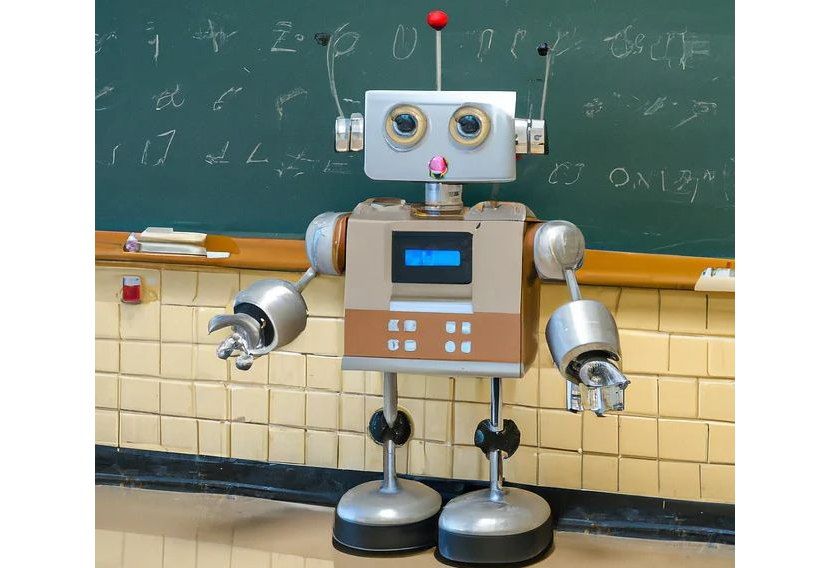
A number of films, such as Lucy, predicting the end of human reign over the world, have already made the rounds of cinemas and even bookshops, creating among viewers, carried away by the power of fiction, a belief in the eventual domination of machines over mankind. These machines, while contributing greatly to the improvement of our living conditions, are endowed with a disconcerting autonomy. Yet, generally speaking, the information provided by AI on a given subject is self-evident.
Even so, this tool offers enormous potential in education, despite the fact that many challenges remain in adapting to this new situation.
The origins of AI
According to Parnas (2017, p1), AI is a buzzword that we tend to use without really knowing its definition. It emerged in the early 1950s under the leadership of Alan Turing, who questioned the ability of machines to think for themselves. The result of his exploratory adventure was the Turing Test, whose aim was to determine the point at which it becomes impossible to distinguish between the responses of a machine and those of a human. It was not until five years later that John McCarthy defined it as the act of attributing human faculties to a machine.
Not all AI systems are equally sophisticated. Some are sufficiently sophisticated to merit special attention, as they carry a high risk of drift. This is why experts in the field recommend that trusted AI should be legitimate, ethical and robust.
The social and ethical challenges of AI
Far from serving the public interest, AI is the preserve of web giants who are investing colossal sums in it. Sometimes with complete disregard for ethics, they use this sophisticated tool to manipulate users via advertisements based on consumption habits, and to harvest user data for unknown purposes. Such harvesting violates one of the fundamental rights of human beings: the right to privacy.
The risks of AI are very real. It is therefore essential to establish AI ethics. The biggest task falls to politicians, who must collaborate with scientists, and indeed the entire algorithmic chain, including citizens, to ensure the responsible development and use of this tool. The latter must, however, be designed taking into account the principles of transparency, common good and respect for the diversity of individuals, hence the need to widen the circle of stakeholders in the search for solutions to limit the risks of AI.
Despite these risks, however, AI is de-automating human work, even though this advance is completely changing the job market by forcing workers to undergo continuous training or risk losing their jobs. Such a context will be unfavorable for people with less formal education. On top of this, training curricula need to adapt to the emergence of AI by educating learners digitally.
Opportunities and challenges for education
As far as the education sector is concerned, AI systems would make teaching less tedious for the teacher from a pedagogical point of view, since the machines, thanks to the data they contain on learners, enable the teacher to intervene more effectively by personalizing learning according to the student's achievements and shortcomings.
With the integration of AI in education, the main challenges lie in the search for relevant applications, the revision of course and activity designs, and pedagogical scenarios. It is also important to acquire new skills in the IT field, in order to "educate with AI as well as with AI". In other words, individuals need to be educated about AI from an ethical point of view, and about how AI systems are built, so that AI can best respond to today's educational challenges, particularly the achievement gap.
The challenges of AI for education
The speed with which AI can solve problems is impressive, but the accuracy of its solutions has yet to be verified. Indeed, the system of profiling and cataloguing of learner data by the machine raises fears of "over-determination of learning profiles and standardization of pathways". Not to mention the fact that machine-assisted student guidance, because that's what it's all about, will only accentuate social inequalities and fuel discrimination. Hence the need for constant human assistance.
In addition to this scenario, the manipulation of information management by AI requires the teacher to develop students' critical thinking skills, and to provide them with the tools they need to assess the reliability of the information to which they are exposed.
Beyond manipulation, attention management is a reality that is supported by the use of digital tools. To this end, we recommend that users inform themselves about the impact of digital use on their physical and psychological well-being.
The future for AI in education
While at the very beginning of AI's expansion, what mattered was the added value it would bring to education, the questions now being asked revolve around AI's abuses. Recommendations are being made on this subject, such as inviting respect for human rights when designing these digital tools. Also, the main players in the sector, teachers, realize that they need to adapt to the various upheavals affecting the education sector.
This involves :
- Identifying the skills that need to be taught, in particular collaboration, communication and critical thinking;
- The collaboration of teachers in the development of AI for the transmission of knowledge and certain pedagogical skills;
- The implementation of an inclusive, people-centered pedagogy;
- Setting up a learning ecology based on interoperability and open data.
Illustration: Alexandra_Koch on Pixabay
Reference
Gaudreau, Hélène and Marie-Michèle Lemieux (2020). L'intelligence artificielle en éducation: un aperçu des possibilités et des enjeux, Études et recherches, Québec, Conseil supérieur de l'éducation, online
https://www.cse.gouv.qc.ca/wp-content/uploads/2020/11/50-2113-ER-intelligence-artificielle-en-education.pdf
See more articles by this author