Bio-inspired training: approaches to educational eco-design
Three paths to understanding the world and finding other ways to approach our teaching practices based on the living world.
Publish at October 16 2024 Updated October 16 2024


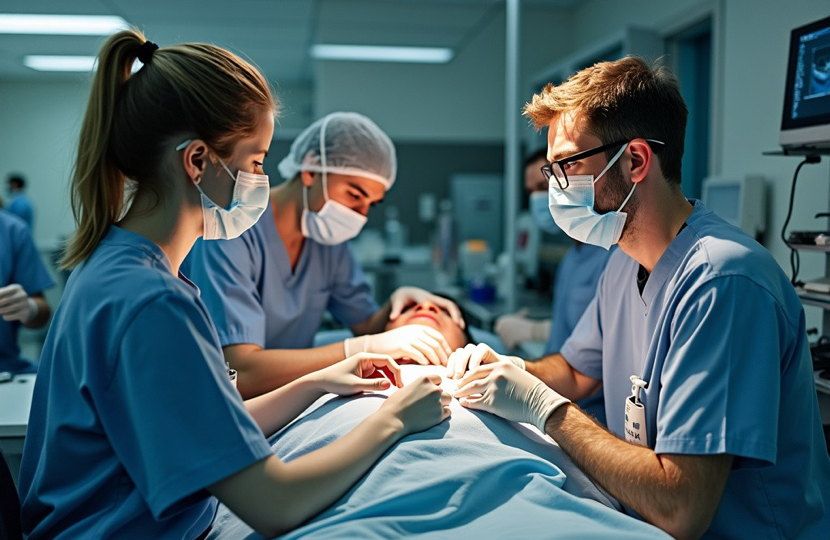
In the corridors of medical faculties and nursing training institutes, a pedagogical revolution is underway. Gone are the days when learning took place solely on static mannequins or standardized patients. Now it's time for high-fidelity simulation, an immersive method that immerses learners in ultra-realistic care situations.
Imagine: you're a student nurse and you're faced with a virtual patient showing all the signs of a heart attack. His or her heart rate is racing and breathing is becoming difficult. It's up to you to act quickly and precisely, just as you would in real life. Except here, there's no risk to the patient: a high-tech mannequin reacts in real time to your actions.
This is the scenario experienced by hundreds of healthcare students during simulation sessions. Thanks to state-of-the-art equipment (connected mannequins, virtual reality, monitoring, etc.), these simulations faithfully reproduce the complexity and stress of healthcare environments. An immersion as close as possible to the real thing, to learn by doing and by feeling.
The aim? To enable future caregivers to develop their technical and non-technical skills (communication, leadership, stress management, etc.) in a safe environment, without risk to patients. But also to experiment with rare or critical situations, which are difficult to encounter in an internship.
While simulation is akin to life-size role-playing, it is far from being mere entertainment. Each scenario is meticulously designed by experts to target precise pedagogical objectives. And each session is followed by an in-depth debriefing, to analyze performance and anchor learning.
So, is high-fidelity simulation set to revolutionize healthcare training? What concrete benefits does it bring compared to traditional methods? And how do learners and trainers experience it?
High-fidelity simulation relies on advanced technological tools to create learning environments as close to reality as possible.(1) At the heart of these devices are connected, reactive mannequins, capable of reproducing a patient's physiological reactions with great realism.(2) Thanks to sophisticated sensors and software, these "simulated patients" can breathe, speak, and even react to the gestures performed by the learners.
At the same time, virtual reality and digitized environments make it possible to recreate perfectly faithful care environments, such as an operating theatre, a hospital room or an ambulance. Students are thus visually and aurally immersed in familiar spaces, learning to find their way around and interact in conditions close to the real thing(3).
Finally, real-time monitoring and display of simulated vital parameters (heart rate, blood pressure, oxygen saturation, etc.) immerse learners in the urgency and technicality of a real healthcare situation. They must learn to quickly interpret these data to adjust their care, just as they would at the bedside of a real patient.
But technology alone is not enough to make a successful simulation. Each scenario is meticulously designed by experts in the field (doctors, nurses, teaching specialists), to target precise learning objectives.(4) Whether it's working on a technical gesture, team communication or leadership in a crisis situation, everything is designed to put learners in a position to mobilize the targeted skills.
The scenarios are designed to reproduce as faithfully as possible the complexity and variability of real-life care situations.(5) These can range from "everyday" situations (nursing care, medical consultation, etc.) to more urgent or critical situations (stroke, cardiac arrest, mass casualty disaster, etc.). The aim is to expose students to a wide range of cases that they may encounter in their future practice.
Finally, high-fidelity simulation enables students to experience the very real stress and pressure of a high-stakes care situation.(6) Faced with emergency situations or simulated ethical dilemmas, students learn to manage their emotions and make rapid decisions. This is essential preparation for real-life conditions, where self-control can be vital for the patient.
The combination of cutting-edge technology and finely-tuned scenarios makes high-fidelity simulation a powerful tool for immersing future caregivers in the realities of the field, in all their richness and complexity. An immersion as close as possible to the real thing, to learn by experiencing situations rather than conceptualizing them.
One of the major advantages of high-fidelity simulation is that it enables learners to develop their technical skills through repeated practice of care gestures and protocols.(7) Unlike lectures, where learning remains theoretical, simulation offers the opportunity to train in a concrete, realistic way. Perfusion, intubation, cardiac massage... These are all procedures that students can repeat over and over again on mannequins, until they have mastered them perfectly.
This learning-by-doing process takes place under virtually real-life conditions, with the same equipment and constraints as in a real-life care situation. Learners are thus confronted with the practical difficulties, unforeseen circumstances and particularities of each simulated patient. It's a far richer experience than simple procedural training.
But the decisive advantage of simulation lies in the possibility of learning in complete safety, without putting real patients at risk.(8) Here, the right to make mistakes is not only tolerated, but encouraged: it's by making mistakes that we learn best. Students can experiment, test hypotheses and confront the consequences of their decisions without fear of harm. This frees them up to take risks, helping them to anchor their learning.
But the practice of care is not just a succession of technical gestures. Relational and organizational skills are just as crucial to the quality and safety of care. Here again, simulation offers an ideal training ground for developing these "soft skills" in real-life situations.
Teamwork is at the heart of the scenarios on offer. Nurses, doctors, orderlies... Learners are put in situations where they have to work closely together to solve complex cases. Communication, coordination, task allocation... They experience in real time the demands of inter-professional cooperation, with its successes and obstacles.(9)
Simulation is also an opportunity to develop leadership skills and the ability to make informed decisions under pressure.(9) Faced with emergency situations or ethical dilemmas, students learn to analyze situations rapidly, prioritize and assert themselves assertively within a team. These are key skills for future caregivers, who are called upon to manage crisis situations where every second counts.
Last but not least, realistic role-playing exercises enable participants to come to terms with the stress and emotional charge inherent in the care professions. Faced with a patient who suddenly deteriorates or a family in distress, learners experience intense emotions: fear, doubt, empathy, frustration... These are all feelings they will learn to recognize and manage over the course of the simulations, to maintain their professional effectiveness without becoming exhausted.
By immersing learners in realistic care situations, simulation enables them to jointly develop their technical, relational and emotional skills. An integrative approach, as close as possible to the multi-dimensional requirements of the profession, to train caregivers who are both experts and human beings.
With its immersive, interactive aspect, high-fidelity simulation can sometimes be likened to a life-size role-playing game. Learners take on the role of caregivers, interacting with simulated patients and handling equipment as they would in the real world. This playful dimension is an asset in terms of engaging and motivating participants(10).
But be careful not to fall into the trap of a simple game with no stakes. To be fully effective, simulation requires a serious and sincere investment on the part of learners. Everyone must behave as they would in a real-life situation, with the same professionalism and sense of responsibility. Only then will the experience be authentic and instructive(11).
Similarly, the realism of the scenarios is crucial to the immersion and credibility of the simulation.(11) Everything must be designed to faithfully reproduce the environment and conditions of a real healthcare situation: realistic dialogues with simulated patients, real medical data, equipment identical to that used in the departments... Any approximate or incoherent element would break the contract of trust and hinder learning.
Finally, it is essential that each simulation session is framed by clear and explicit pedagogical objectives. Learners need to know precisely what is expected of them, what skills they will be working on, and on what points they will be assessed. This prior framing gives meaning to the experience and guides subsequent observations and reflections. Without this pedagogical compass, the simulation runs the risk of being nothing more than an amusing but sterile interlude.
Learning doesn't stop once the scenario is over. On the contrary, it's during the post-simulation debriefing that the real action takes place(12). This time of exchange and analysis, guided by a trainer, is crucial to making sense of the experience and learning from it.
The debriefing is first and foremost an opportunity for each participant to review his or her experience of the simulation, its successes and difficulties. What went well? What were the moments of doubt or discomfort? By comparing points of view, highlighting strengths and areas for improvement, the group learns from itself and refines its reflective practice(9).
Beyond actions, the debriefing also seeks to elucidate each person's thought processes. How was the information gathered and analyzed? On what elements was the decision based? What options were considered? By clarifying these cognitive processes, sometimes implicit in the heat of the action, learners develop their clinical reasoning skills.
Finally, debriefing is designed to facilitate the transfer of learning to real-life practice.(13) How can the experience be transposed to future care situations? What lessons can be learned for one's own practice, or that of the team or organization? This work of decontextualization and projection is essential to ensure that what is learned through simulation is actually reinvested in the field.
So, seriousness in the game and reflexivity in the debriefing appear to be the two inseparable sides of an effective simulation. It is in this subtle in-between, between faithful immersion and analytical distancing, that the pedagogical potential of this innovative method is built.
High-fidelity simulation generally arouses great enthusiasm among healthcare students. For many, it's a breath of fresh air in an often dense and theoretical curriculum. At last, something practical and real! Immersion in realistic care situations is seen as stimulating and motivating, and a privileged means of projecting oneself into one's future professional identity. Learners also appreciate the playful, interactive nature of the method, which breaks with the passivity of lecture-based teaching.
However, this majority support should not mask certain possible misgivings. For some students, taking part in a simulation can be a source of anxiety, or even blockage. Fear of doing badly in front of their peers, stage fright about "performing" in front of an audience, stress in the face of unexpected situations? These are all apprehensions that can inhibit the most reserved or least confident learners. The gaze of others, although benevolent, can be experienced as a paralyzing judgment, especially at the start of training(14).
It is therefore important to be attentive to these different experiences, and to create a climate of trust and pedagogical security conducive to everyone's commitment. Reassure people that they have the right to make mistakes, play down the issues at stake, value progress rather than performance... It is only under these conditions that everyone will be able to take full advantage of the benefits of simulation, at their own pace and according to their own personality.
For trainers too, high-fidelity simulation implies a change of pedagogical paradigm. Far from the classic posture of a teacher dispensing knowledge to passive pupils, the teacher becomes a learning facilitator. His role is no longer to transmit knowledge, but to create the conditions for learners to build their own skills through simulated experience.
This presupposes a great deal of upstream work to design scenarios adapted to the pedagogical objectives and level of the learners. Like a stage director, the trainer has to think through the sequence of events, anticipate difficulties, prepare events and plot twists. A task made all the more delicate by the unpredictability of learners' reactions.
Once the simulation has begun, the trainer must be able to adjust the scenarios in real time to maintain the realism and fluidity of the experience. Getting the simulated patients to react consistently, injecting new data or complications, orchestrating the interventions of the various participants... All this requires a high level of responsiveness and the ability to improvise within a predefined framework.
Finally, during the debriefing, the trainer takes on the role of reflective facilitator. Through targeted questioning and benevolent guidance, he or she helps learners to put their experience into words, analyze their thought processes and draw out transferable lessons. A subtle balance between non-directiveness and framing, to enable each learner to develop his or her own knowledge and reflections.
As you can see, the role of simulation trainer is one that challenges habits and demands real pedagogical, relational and even artistic skills. It's a stimulating challenge for teachers ready to reinvent themselves in order to help students learn differently. And a unique opportunity to forge a pedagogical relationship with learners based on trust and the co-construction of knowledge.
Illustration: AI-generated - Flavien Albarras
References
1-High-fidelity simulation: the future of training - Innovation - Corpore Sano - InVivo, [no date]. [online]. Available at: https://www.invivomagazine.com/fr/corpore_sano/innovation/article/323/la-simulation-haute-fidelite-l-avenir-de-la-formation [Accessed October 4, 2024
2-PRÉMAUD, Morgane, 2021. Un mannequin pour apprendre en situation simulée au CESU 86. CHU de Poitiers website [online]. December 15, 2021. Available at: https://www.chu-poitiers.fr/un-mannequin-pour-apprendre-en-situation-simulee-au-cesu-86/ [Accessed October 4, 2024].
3-Un bloc opératoire virtuel pour mieux former le personnel chirurgical, [no date]. [Online]. Available at: https://www.lepelerin.com/france/sante/un-bloc-operatoire-virtuel-pour-mieux-former-le-personnel-chirurgical-8191 [Accessed October 4, 2024].
4-Simulation in healthcare - HAS
https:// www.has-sante.fr/jcms/c_2806574/fr/simulation-en-sante
5-Healthcare simulation and risk management - HAS
https:// www.has-sante.fr/jcms/c_2906013/fr/outils-du-guide-methodologique-simulation-en-sante-et-gestion-des-risques
6-LEHOT, Jean-Jacques, SCHLATTER, Sophie, PARASCHIV, Andrei-Petru, AIGLE, Luc, RODE, Gilles, RIMMELÉ, Thomas and LILOT, Marc, 2023. Stress remediation in high-fidelity simulation of critical situations. Revue Défense Nationale. April 28, 2023. N° HS4, pp. 119-128. DOI 10.3917/rdna.hs10.0119.
https:// shs-cairn-info.iepnomade-2.grenet.fr/revue-defense-nationale-2023-HS4-page-119?lang=fr
7-CABLAT, C., COURTIN, V. and BOUCHOT, H., 2018. High-fidelity simulation: an asset in the professional development of maieutic students. La Revue Sage-Femme. June 1, 2018. Vol. 17, No. 3, pp. 107-113. DOI 10.1016/j.sagf.2018.03.003.
https://www.sciencedirect.com/science/article/abs/pii/S1637408818300245#:~:text=La%20simulation%20haute%2Dfid%C3%A9lit%C3%A9%20permet,'exercise%20professional%20%5B3%5D.
8-Simulation is an essential tool for improving patient safety, available to all, regardless of environment and means, [undated]. Anesthesia Patient Safety Foundation [online]. Available at: https://www.apsf.org/fr/article/la-simulation-est-un-outil-essentiel-damelioration-de-la-securite-des-patients-disponible-pour-tous-independamment-de-lenvironnement-et-des-moyens/ [Accessed October 4, 2024].
9-Apprendre ensemble à travailler ensemble : l'interprofessionnalité en formation par la simulation au service du développement des compétences collaboratives | Cairn.info, [no date]. [online]. Available at: https: //shs-cairn-info.iepnomade-1.grenet.fr/revue-recherche-en-soins-infirmiers-2014-2-page-33?lang=fr
10-What is the purpose of gamification? Objectives, benefits and practices. - Drimify, [no date]. [online]. Available at: https://drimify.com/fr/ressources/but-gamification-objectifs-avantages-pratiques/ [Accessed October 4, 2024].
11-Major crisis simulation for training decision-makers and future decision-makers: games, serious?
https:// imt-mines-ales.hal.science/hal-03315472/document
12-Simulation debriefing - HAS
https:// www.has-sante.fr/jcms/c_2906185/fr/outil-11-debriefing-en-simulation
13-Nitiation au débriefing pour les internistes : état des connaissances et mise en pratique pour transformer des situations cliniques réelles ou simulées en moments d'apprentissage, [on line]. Available at: https://www.researchgate.net/publication/341029173_Initiation_au_debriefing_pour_les_internistes_etat_des_connaissances_et_mise_en_pratique_pour_transformer_des_situations_cliniques_reelles_ou_simulees_en_moments_d'apprentissage [Accessed October 4, 2024].
14-How to promote the psychological safety of nursing students when teaching emergency care by simulation? | Cairn.info, [undated]. [online]. Available at: https://shs-cairn-info.iepnomade-1.grenet.fr/revue-recherche-en-soins-infirmiers-2019-2-page-62?lang=fr [Accessed October 4, 2024].
You might also like:
Bio-inspired training: approaches to educational eco-design
Three paths to understanding the world and finding other ways to approach our teaching practices based on the living world.
Redesigning course design standards
How interactions between participants and content make conventional course programming impossible or at least unsatisfactory, and upset the balance on which the design of distance learning systems was based.
The stable models to which we used to refer are losing their primacy in the face of interaction possibilities.
In a society that values horizontality, the figure of the "teacher-buddy" is seductive. But this excessive complicity can weaken the pedagogical framework, blurring reference points and opening the door to favoritism or even harassment. To avoid such abuses, an ethic of "good distance" is essential, combining benevolence with high standards. A good teacher is not a buddy, but an adult who creates an asymmetrical, supportive relationship, conducive to learning.
Multilingual education as a factor of integration
The complex situation of multilingualism in some countries with migratory phonemes calls for better management of learners in the classroom.
The teacher's place in the personal learning environment
Closed-environment e-learning was intended to be socio-constructivist, but is being refuted as such by proponents of the open learning environment. If everything is zone of proximal development, where is the added value, in terms of learning, and what is the role of the teacher?