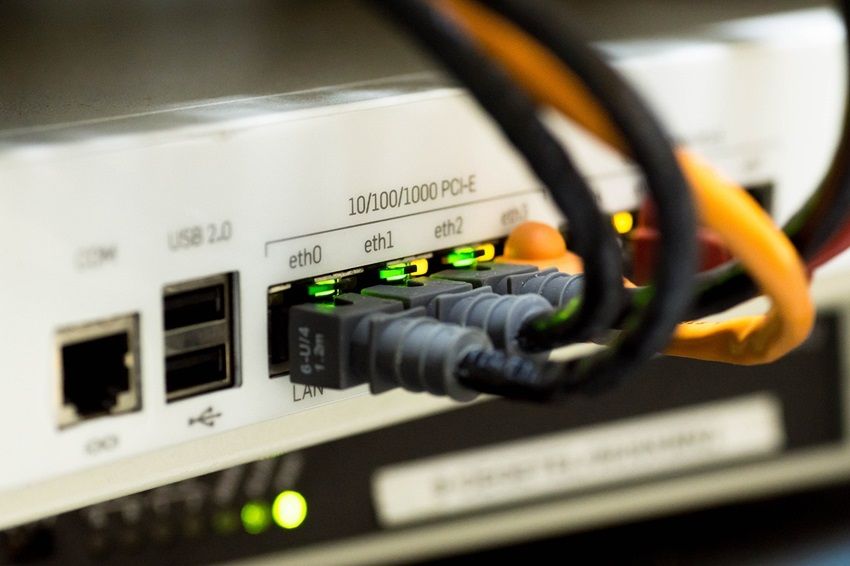
The whole world is a network. Of humans, yes, but also of computers. With the Internet established almost everywhere, we're all networked. At one time, we could be disconnected from it by leaving the telephone line. The advent of wireless connections put an end to those days. Now, unless the Internet service fails, we're always on it.
Yet this structure, part of our daily lives from the moment we get up until we go to bed, remains a mystery to most of us. How can we understand this immense network that has found its way onto our planet, or even explain it to neophytes?
Computer urbanism
When you first become interested in networking, the terms used can seem complicated, and rightly so. In fact, when you get down to explaining the various elements, you have to think of the network as different cities. Small independent hamlets are Local Area Networks (LANs), there are Metropolitan Area Networks (MANs) and huge metropolises like the Internet are part of Wide Area Networks (WANs). These places are criss-crossed by a variety of streets with passive devices (cables, sockets) and active devices (routers, switches and access points, among others).
As a result, each of these urban networks is designed differently according to a typical topology. Some will be star-shaped; all paths lead to Rome, or in this case to a central point. Some will take a form along the length, known as a bus, where information will pass from one end of the track to the other, and others will be ring-shaped, meaning that each device is connected to at least two others to form a closed loop. To circulate in this network, it is necessary to use a protocol. The most common is TCP/IP. The IP (Internet Protocol) is the vehicle registration number of the machine on the server. TCP (Transmission Control Protocol) would be the car's automated route through the network. The DNS (Domain Name System), meanwhile, acts as a road map, coupled with the Google Maps-type application for storing addresses and guiding vehicles.
As a result, this intense traffic requires humans to check that everything is running smoothly. First of all, the designers of this urban planning are the computer engineers who will design these roads, make sure they are safe, and so on. For their part, the network managers are a bit like the police and the emergency services. They monitor fluidity, analyze traffic, manage incidents and even optimize infrastructures, both physical and internal. All these jobs require them to take care of network security too.
Cybersecurity for all
Since we are all part of these immense networks, we find ourselves dependent on them, and at the mercy of those who would like to attack them. If there were highwaymen in the past, their modern counterparts are hackers. Individuals looking to make a buck and attack have many choices, from Denial of Service (DoS) attacks, which literally block access to targeted servers, to phishing and Trojan horse techniques. Hence the importance of network security through monitoring, yes, but above all by working upstream to close the various loopholes.
A large part of this protection relies on encryption methods using different encryption approaches, post-quantum algorithms and even artificial intelligence, which enters the dance of network protection. As this resource from Revue 3EI explains, cryptography gives hackers a hard time, since the sender encrypts his data and only the recipient has the key to decipher it. This makes it virtually impossible to pirate transmitted information.
But you need to know how to use these encryption tools. All sectors, including education, need to take an interest in what's happening in cybersecurity, so as to protect educational data, which is almost as attractive to criminals as banking data. Nowadays, all information has its price, and criminals have understood this.
October is the month of cybersecurity, and every year the French Ministry of Education offers resources for teachers. But cybersecurity isn't just an autumn topic; teachers can also use it throughout the year to cover topics such as phishing and password design. Younger students need to learn to use the same passwords for different services as little as possible, if at all, to vary the characters used, to avoid phrases or words that are too easy, and so on.
Image: Jean Martinelle from Pixabay
References
Adobati, Cécile. "How to create a strong password? Get our infographic for your students." Edifice. Last updated January 31, 2024. https://edifice.io/comment-creer-un-mot-de-passe-robuste-recuperez-notre-infographie-pour-vos-eleves/.
COlab - Social Innovation and Digital Culture. "Cybersecurity: an essential digital skill to be developed in the Quebec educational community." École branchée. Last updated: August 20, 2024. https://ecolebranchee.com/cybersecurite-competence-numerique-essentielle-developper-communaute-educative-quebecoise/.
"How to optimize your company's computer network." Amerix Computing. Last updated: September 25, 2024. https://www.informatiqueamerix.com/comment-optimiser-le-reseau-informatique-de-son-entreprise/.
"The computer network, the poor relation of infrastructure?" WANDesk. Last updated: February 27, 2024. https://www.wandesk.fr/le-reseau-informatique-parent-pauvre-de-linfrastructure/.
"The fundamentals of computer networks." DevSecOps. Last updated: September 19, 2024. https://blog.stephane-robert.info/docs/reseaux/introduction/.
"Computer networks and how they work." Les Bases Du Numérique D'intérêt Général. Last updated: March 22, 2024. https://lesbases.anct.gouv.fr/ressources/les-reseaux-informatiques-leur-fonctionnement.
"What are the latest advances in ensuring network security?" EDS.fr. Last updated: June 13, 2024.
https://eds.fr/2024/06/13/quelles-sont-les-dernieres-avancees-pour-assurer-la-securite-des-reseaux/.
"What is computer security?" IBM. Accessed October 26, 2024. https://www.ibm.com/fr-fr/topics/it-security.
"What is a computer network engineer?" Guru. Last updated October 22, 2024. https://www.getguru.com/fr/reference/it-network-engineer.
"What is network management?" HPE Glossary. Accessed October 26, 2024. https://www.hpe.com/ca/fr/what-is/network-management.html.
"Security: Protecting the computer network." CNIL. Last updated March 14, 2024. https://www.cnil.fr/fr/securite-proteger-le-reseau-informatique.
"Education and cybersecurity." éduscol. Last updated October 2024. https://eduscol.education.fr/3679/education-et-cybersecurite.
See more articles by this author