"Sir, I saw you on Instagram this weekend!"
This little phrase, which has become commonplace in the mouths of students, speaks volumes about the transformation at work in the teacher-learner relationship. In the age of social networking, teachers' private lives have never been so exposed to the public eye. One click is all it takes to access their vacation photos, their political rants or their light-hearted jokes with friends.
Gone are the days when the teacher could easily compartmentalize his or her life, donning the costume of master in the classroom and then reverting to a lambda individual once the threshold had been crossed. With the widespread use of digital tools, a whole symbolic boundary between the professional and private spheres is disappearing. Students have never been so close to their teachers, for better or for worse.
While this new closeness can humanize the teaching relationship, revealing a more authentic face of the teacher, it also brings its share of risks. The risk of over-familiarity undermining the teacher's authority. The risk of exposing aspects of one's private life that are not meant to be shared with students. The risk, too, of seeing one's professional image tarnished by personal publications deemed inappropriate.
Faced with this blurring of reference points, teachers are torn between the desire to preserve their privacy and the temptation to surf the 2.0 wave to better connect with their students. Some choose to keep their profiles as private as possible, even if it means depriving themselves of a digital presence. Others assume total transparency, at the risk of overexposure. Still others opt for a differentiated use of networks, strictly separating their business and personal accounts.
But beyond individual strategies, the entire profession is called upon to reposition itself in the face of this new ethical challenge. What posture should we adopt in the face of students' digital solicitations? How far should we go in revealing our secret garden, without losing credibility? How can we maintain the right relational distance, guaranteeing healthy authority?
An increasingly porous public/private boundary
Before the age of social networking, teachers enjoyed a fairly clear separation between their professional persona and their life as an individual outside the school walls. The classroom was the stage where they took on their role as educators, with the necessary codes and distance.(1) Once this role had been fulfilled, they could go back to being "Mr." or "Mrs. Everyman", without their students having access to this intimate part of their existence.
But since the advent of the social web, this once-tight boundary has become increasingly porous. With just a few clicks, any student can now access fragments of their teacher's extracurricular life. On Facebook, Instagram, Twitter or even LinkedIn, they can discover their vacation photos, their cultural favorites, their associative or political commitments, their friendships or family relationships... In short, a whole area of their intimacy that was previously carefully kept away from the pupils' gaze.
This increased visibility of teachers' private sphere radically changes the relationship between them and their students. Students now have an open window onto the person behind the teacher, with his or her passions, opinions and lifestyle. This unprecedented closeness is having an impact on the way they perceive and interact with their teachers.
Social networks, a window onto the teacher as a person
This new transparency in the lives of teachers can have positive effects on the teaching relationship.(2) By showing their face "outside the walls", more authentic and closer to them, social networks help build a different bond with students.
Gone is the image of the distant, all-powerful teacher, cut off from the realities of his flock. By sharing their tastes, hobbies and commitments on the networks, teachers show that they are not just dispensers of knowledge, but individuals in their own right, with their own idiosyncrasies and points in common with their pupils.
This "humanization" of the teacher figure can be an interesting lever for arousing the interest, and even the support, of students. By communicating on subjects that affect them, in formats that they are familiar with, the teacher can succeed in hooking them in a different way, by playing on more personal springs.
For example, a teacher who shares his or her passion for rap, manga or video games will undoubtedly appear more accessible and credible in the eyes of his or her students, who are passionate about youth culture. By dropping the mask of the exclusive holder of knowledge, and revealing his doubts, his crushes, even his second degree, he can hope to weave a richer and more complicit relationship.(3)
The dangers of teacher-student hyperconnection
But this new form of proximity also entails its share of risks and difficulties for teachers.
My teacher friend
The first pitfall is that of over-familiarity, which can blur roles and undermine the respect owed to the teacher(4).
When students have access to their teacher's private life, they may be tempted to treat him or her as a "buddy", to feel authorized to indulge in unwelcome familiarities. "Hey Mister, nice pictures at the playa!", "Madam, I love your last post, I'm dead"... So many little phrases which, by dint of repetition, insidiously nibble away at the pedagogical distance.
Because it's the question of the teacher's authority that's at stake(5). It's hard to fully assert your authority in the face of students who come to pry into your private life, comment on your every move and scrutinize your company. Teachers find themselves potentially weakened by what they show on the networks, exposed to judgment and mockery about aspects of their lives that are normally none of their students' business.
What do I care?
Another major risk is that of seeing one's professional image tarnished by personal publications deemed inappropriate. A drunken party immortalized on Instagram, a gravelly joke liked on Twitter, a divisive political stance posted on Facebook... These are all "digital pots and pans" that can tarnish a teacher's reputation and be detrimental to his or her job.(6)
In this hyper-connected environment, boundaries become blurred, and teachers are sometimes caught off guard. When a student asks to become a "friend" on Facebook, should they accept in the name of their claimed closeness, or decline to preserve their secret garden? How do you firmly reframe a student who shows himself to be too familiar, when you yourself have opened wide the doors to his intimacy? These are just some of the dilemmas facing the educational community.
The challenge of an authentic yet controlled digital presence
Faced with this new relational situation brought about by social networks, teachers are groping for the right posture to adopt. Should they play the no-holds-barred transparency card to capitalize on the codes of the 2.0 generation? Or should they keep their private lives as private as possible, so as not to let anything show that could interfere with their teaching relationship?
Between total openness, with the risk of overexposure, and absolute compartmentalization, with the risk of digital exclusion, the challenge is to find the right balance. The aim is to forge a more authentic bond with students, without falling into the trap of invasive intimacy.
To meet this challenge, teachers must first and foremost learn to control their image on the networks. Rather than being subjected to the unveiling of their private lives, they need to be proactive in building their digital identities.(7) This means thinking about what they want to show and what they don't, and what message they want to get across through their publications.
One of the keys is undoubtedly to intelligently segment your profiles according to your audience. Some teachers choose to have a strictly personal Facebook account, reserved for close friends and family, and a more "professional" profile on Twitter or Instagram, where they share content related to their profession or areas of interest.
Others rely on content filtering strategies, fine-tuning access to their publications. Still others opt for a certain degree of exposure, while setting clear limits in their exchanges with students: yes to kind comments on a public post, no to outbursts and intrusive "pokes" in private messaging.
Social networks, revealing a changing pedagogical relationship
Beyond individual adjustments, social networks act as a powerful revealer of the transformations at work in the teacher-student relationship. By overturning the dividing lines between public and private, they are forcing us to completely rethink the modalities of the teaching relationship(8).
With the end of the lecture as the sole format, and the rise of active pedagogies favoring interaction, the horizontality of the web seems a logical extension. The teacher-learner relationship is no longer a vertical face-to-face affair, with the master perched on his pedestal, but increasingly a collaborative side-by-side, where each learns from the other.
In this new configuration, the challenge is no longer to maintain an overhanging position of authority, but to find the right relational position to make the exchange bear fruit. Neither too close, so as not to lose all credibility, nor too distant, so as not to break the participative dynamic. It's a subtle balance that calls for a new kind of professorial legitimacy(9).
Digital technology is indeed bringing about a profound change in the teaching profession.(10) In a world of knowledge accessible at the click of a button, the teacher is no longer primarily the one who holds the knowledge, but the one who helps students to understand and apply it. His role is more one of accompaniment, coaching and inspiration than pure transmission.
This raises the question of whether social networks might not be inducing a form of pedagogy of transparency, in which the teacher gains legitimacy by revealing more about himself or herself.(2) Unless, on the contrary, they call for a renewed ethic of prudence and distance, to preserve a sanctuarized pedagogical space.
One thing is certain: social networks are profoundly changing the way teachers position themselves in relation to their students. By blurring the boundaries between professional and personal, they are forcing us to reinvent the pedagogical relationship, striking a delicate balance between proximity and authority.(11) They are also acting as a formidable stimulus for thinking up new learning modalities, geared more towards collaboration and participation.
But this major upheaval is not without its tensions and uneasiness within the educational community. Many teachers feel powerless in the face of this injunction to transparency, and even deprived of their legitimacy as experts. This is all the more true given the temptation to retreat into a position of rigid authority in the face of relational difficulties.
To meet the challenge posed by social networks, the entire profession is called upon to reflect collectively on its identity and missions. How can we successfully integrate the codes of digital technology into teaching practice, without relinquishing our role of supervision and transmission? What professional ethics should be forged for this new environment? What skills should be developed to inspire trust and respect, despite increased personal exposure?
These are just some of the questions that invite teachers to collectively reinvent themselves, to make the most of the relational potential of social networks without falling into their shortcomings. A fascinating project, at the heart of the educational challenges of our time.
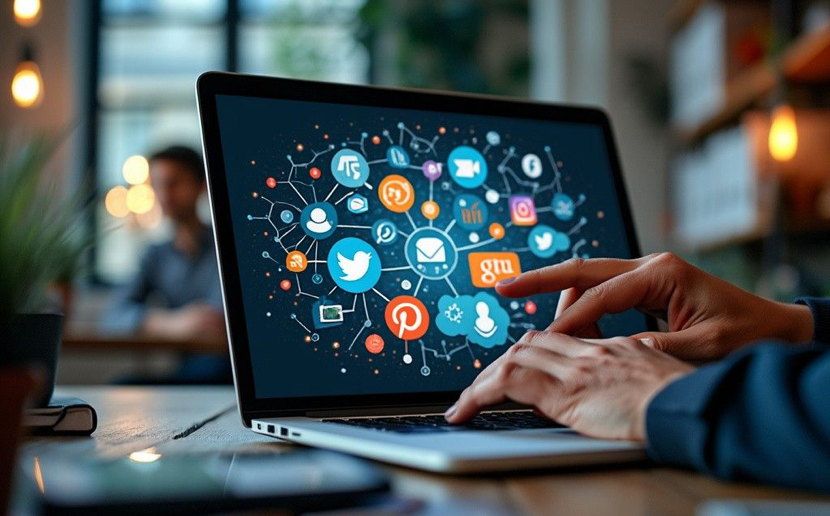
Illustration: AI-generated - Flavien Albarras
References
1-BLANDIN, Bernard, 2004. La relation pédagogique à distance: que nous apprend Goffman? Distances et savoirs. 2004. Vol. 2, n° 2, pp. 357-381. DOI 10.3166/ds.2.357-381.
https:// shs-cairn-info.iepnomade-1.grenet.fr/revue-distances-et-savoirs-2004-2-page-357?lang=fr
2-DANINO, Philippe and LAVAL, Christian, 2009. Construire l'école transparente?:Les conséquences de l'Espace Numérique de Travail sur le métier des enseignants, les conditions d'apprentissage et les rapports pédagogiques. L'Enseignement philosophique. 2009. Vol. 59, no. 5, pp. 36-54. DOI 10.3917/eph.595.0036.
https:// shs-cairn-info.iepnomade-2.grenet.fr/revue-l-enseignement-philosophique-2009-5-page-36?lang=fr
3-RÉZEAU, Joseph, 2002. Médiation, médiatisation et instruments d'enseignement: du triangle au " carré pédagogique ". ASp. la revue du GERAS. December 1, 2002. N° 35-36, pp. 183-200. DOI 10.4000/asp.1656.
https:// journals-openedition-org.iepnomade-1.grenet.fr/asp/1656
4-GOUDESEUNE, Didier, 2024. Proximity, rigor and severity in teacher authenticity. Par temps clair [online]. January 3, 2024. Available at: https: //partempsclair.substack.com/p/proximite-rigueur-et-severite-dans [Accessed October 29, 2024].
5-L'usage des réseaux sociaux à l'école : enjeux et risques, 2022. L'Autonome de Solidarité Laïque [online]. Available at: https: //www.autonome-solidarite.fr/articles/lusage-des-reseaux-sociaux-a-lecole-interets-risques-et-obligations/ [Accessed October 29, 2024].
6-Déontologie et utilisation des réseaux sociaux numériques dans l'éducation nationale - French Ministry of Education
https:// www.education.gouv.fr/media/160173/download
7-BLANC, Charlotte, 2015. Digital identity and social networks. In: MUTELET, Valérie and VASSEUR-LAMBRY, Fanny (eds.), Qui suis-je? Dis-moi qui tu es : L'identification des différents aspects juridiques de l'identité [online]. Arras : Artois Presses Université. pp. 121-130. Law and economics. ISBN 978-2-84832-490-6. [Accessed October 29, 2024].
https:// books-openedition-org.iepnomade-2.grenet.fr/apu/23598?lang=fr
8-PLATEAU, Jean-François, 2022. Pédagogie et réseaux sociaux à l'épreuve du confinement. Revue internationale des technologies en pédagogie universitaire / International Journal of Technologies in Higher Education. 2022. Vol. 19, no. 2, pp. 107-130. DOI 10.18162/ritpu-2022-v19n2-08.
https:// www-erudit-org.iepnomade-2.grenet.fr/fr/revues/ritpu/2022-v19-n2-ritpu06981/1088861ar/
9-The question of the right distance in the pedagogical relationship: a permanent adjustment between desire and prohibition. - Gérard Netter
http://w ww.gerardnetter.com/wa_files/la-question-de-la-bonne-distance.pdf
10-HAMON, Dany and GENEVOIS, Sylvain, 2017. Évolution du métier d'enseignant à l'ère numérique : des sources d'incertitude et des moyens de les réduire:Le cas des collèges " tout numérique " de Seine-Saint-Denis. Spirale - Revue de recherches en éducation. 2017. Vol. 60, no. 2, pp. 37-48. DOI 10.3917/spir.060.0037.
https:// shs-cairn-info.iepnomade-2.grenet.fr/revue-spirale-revue-de-recherches-en-education-2017-2-page-37?lang=fr
11-REYNAUD, Christian, 2007. Three types of authority for three modes of pedagogical relationship. Tréma. March 1, 2007. N° 27, pp. 69-80. DOI 10.4000/trema.516.
https://journals-openedition-org.iepnomade-2.grenet.fr/trema/516?lang=en
See more articles by this author