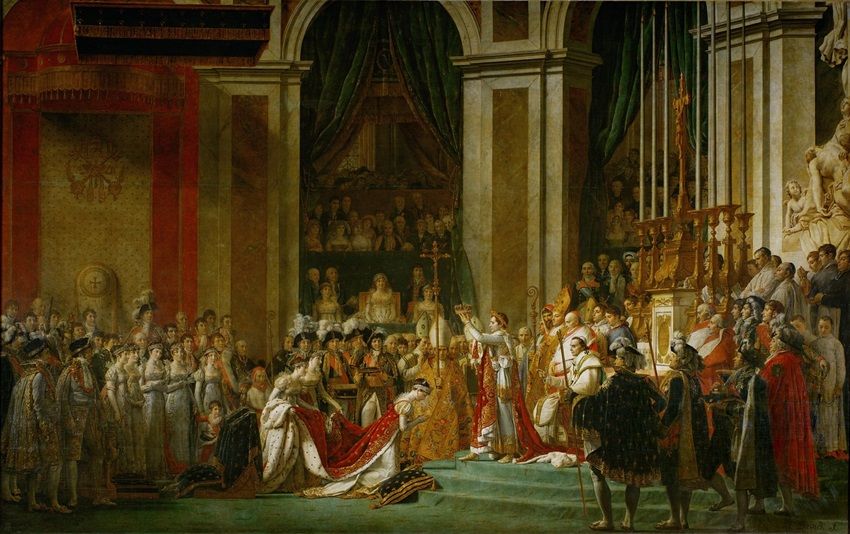
What is history? If we had to define it succinctly, it would be the succession of events that led us to the present day. But that would be to ignore the subtleties of history. Because history isn't just made up of great moments. It's also made up of agitated or sometimes very calm eras when everyone adapted to life according to their social status, existing technologies and so on.
The definition of history is also complicated by its purpose. What's the point of knowing it? Even here, specialists disagree. This can be seen in the notion of the "national narrative" or "roman national", which is hotly debated in civil society, since it would be a question of how (or not) to teach it in schools.
The need (or not) for a common history
This debate has only thickened over the past decade. In France (and elsewhere), the question of History with a capital "H" is a hotly debated topic, and often serves as an indicator of the political vision of those who defend it.
On the right, the idea is clear: history must unite the people under a glorious narrative to foster a sense of belonging. The Rassemblement National, for example, wants a single educational program focused on nostalgia, on France's incredible past and its achievements under kings and Napoleon Bonaparte alike. Work of this kind had already been done by Ernest Lavisse, father of the national novel under the Third Republic. It was Lavisse who came up with many of the clichés that are still around today, such as the Gallic ancestors, the greatness of Clovis, etc.
On the left, we denounce this romanticized approach to history, which omits important parts of the story to keep only the most positive aspects. For them, it seems that all this is an instrumentalization of the past to promote chauvinism and a conservative worldview. The idea would be to constantly present students with events and moments without ever putting them into a more global and plural context.
Even today, the issue of French colonization of African countries is viewed in textbooks in a largely positive light. This is without explaining the realities, for example, in Algeria of some who accommodated the French presence but others who didn't, of what the nation was like before colonization, and so on. So, for these people, history must be plural, as the human past has been throughout the world.
Canada also experienced this kind of debate with the concept of a single history textbook, which did not meet with unanimous approval among historians.
As a result, everything surrounding history is controversial between these two. The former remind us that it is essential to build a collective narrative, that it can be a major binding force today. It's not necessarily a matter of erasing other realities, but of highlighting them, as Quebec would like to do with its Musée national de l'histoire du Québec. The latter fear that this would serve to prioritize histories and declare one more important and dominant than the others. Quite the opposite, in fact.
The importance of historical science
It's hard to make sense of this debate, especially for a school system that wants to train citizens but must also submit to political will and diktats. All the more so since, even on the left, there is talk of popular history, a narrative that would be plural, comprehensible and fun for everyone to learn. Let's return to a fundamental idea: history is a science. We seem to forget this, but it is populated by researchers who, as in the life sciences or physics, regularly make discoveries that partly improve our knowledge of the past. As Maxime Laprise, a doctoral student in history, points out, the problem with the preachers of the "national narrative" is that they transform a science into a discourse.
David Gaussen would even like us to de-demonize the idea of the national story, because here again, it has changed over time. For a time, it was monarchical in France, then republican, before taking on a more global dimension. For him, there's nothing wrong with the very principle of a narrative - on the contrary. On the other hand, the novel must be built with all the players in contemporary society, with a vision of our times. It would make no sense, as some would have it, to go back to the Napoleonic regime or the Trente Glorieuses, as we approach the quarter of the 21st century.
This is perhaps the position that schools should take: teach a narrative, certainly, but remind us that it is anything but static. That new knowledge adds subtleties. That not everyone experienced certain eras in the same way, and that few historical figures were unanimous.
This plurality does not prevent us from developing a foundation on which to tell the story of the evolution of a territory such as France, Quebec, Belgium, Cameroon or the Ivory Coast, but it does respect history as a science that evolves through the nuances provided by research.
Image: user1469083764 from Pixabay
References:
De Cock, Laurence. "History as a tool for popular education." Agone. Last updated: November 15, 2024. https://agone.org/5342-2/.
De Cock, Laurence. "L'instrumentalisation politique du roman national." Carnets Rouges. last updated November 23, 2024. https://carnetsrouges.fr/linstrumentalisation-politique-du-roman-national/.
De Cock, Laurence. "L'éternel retour (en arrière) du roman national." Agone. last updated August 25, 2023. https://agone.org/leternel-retour-en-arriere-du-roman-national/.
Durand, Anne-Aël. ""National novel", "national narrative": what are we talking about?" Le Monde.fr. Last updated: September 28, 2016. https://www.lemonde.fr/les-decodeurs/article/2016/09/28/roman-national-recit-national-de-quoi-parle-t-on_5004994_4355770.html.
Gaussen, David. "2000 ans que ça dure | Le roman national: plus que jamais nécessaire." Herodote.net. Last updated September 18, 2023. https://www.herodote.net/Le_roman_national_plus_que_jamais_necessaire-synthese-2796-5.php.
Lagarde, Yann. "Ernest Lavisse, le père du roman national à la gloire de la IIIe République." France Culture. Last updated: August 22, 2022. https://www.radiofrance.fr/franceculture/ernest-lavisse-le-pere-du-roman-national-a-la-gloire-de-la-iiie-republique-8573184.
Laprise, Maxime. "Mathieu Bock-Côté hates History." Pivot. last updated July 22, 2022. https://pivot.quebec/2022/07/22/mathieu-bock-cote-deteste-lhistoire/.
Larochelle, Catherine, and Camille Robert. "Les risques d'un retour au " récit national "." La Presse. La Presse. last updated May 2, 2024. https://www.lapresse.ca/dialogue/opinions/2024-05-02/musee-national-de-l-histoire-du-quebec/les-risques-d-un-retour-au-recit-national.php.
"Le manuel d'histoire unique, l'ouvrage qui a déchiré les historiens." Radio-Canada.ca. Last updated: October 17, 2024. https://ici.radio-canada.ca/ohdio/premiere/emissions/aujourd-hui-l-histoire/episodes/947103/le-manuel-dhistoire-unique-louvrage-qui-a-dechire-les-historiens/transcription.
Lokmane, Samia. "France: in school history textbooks, there is still talk of the positive role of colonization." Middle East Eye French Edition. last updated March 22, 2024. https://www.middleeasteye.net/fr/actu-et-enquetes/france-dans-les-manuels-scolaires-dhistoire-il-est-encore-question-du-role-positif.
Pedneaud-Jobin, Maxime. "Le nécessaire récit national." La Presse. last updated May 9, 2024. https://www.lapresse.ca/dialogue/chroniques/2024-05-09/le-necessaire-recit-national.php.
"Pour une histoire plurielle." Histoire Engagée. Histoire Engagée. Last updated: September 26, 2024. https://histoireengagee.ca/pour-une-histoire-plurielle/.
Rousset, Marion. "Programmes scolaires : "Le RN voudrait une histoire de France congelée qu'il n'y a plus qu'apprendre par cœur." Télérama. Télérama. last updated July 5, 2024. https://www.telerama.fr/debats-reportages/programmes-scolaires-le-rn-voudrait-une-histoire-de-france-congelee-qu-il-n-y-a-plus-qu-a-apprendre-par-c-ur-7021198.php.
See more articles by this author