Reasons why we cannot unlearn and reasons why we cannot learn
Publish at February 05 2025 Updated February 05 2025


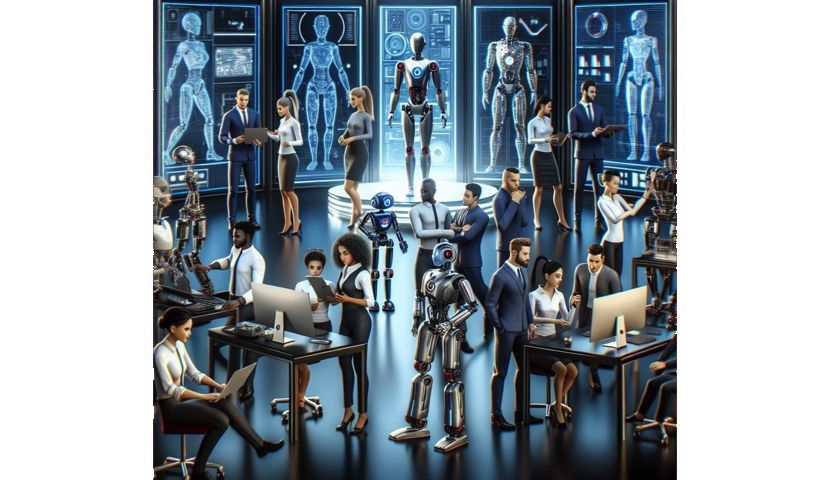
By 2025, in the field of AI, more collaboration between robots and humans is expected, which could modify or influence human characters in interpersonal relationships. Already, we can legitimately ask ourselves at what level do we end up with human sensitivity?
Following the logic of 2025 forecasts, the trend is towards systematic collaboration between humanoid robots and human beings. Leading players in AI-enhanced robotics are pushing for robots and humans to work in tandem. The question arises as to what will happen to human specificities. In other words, won't robots ultimately influence human beings to such an extent that their specific traits, such as attentiveness, empathy and altruism, to name but a few, are affected?
The materialization of this collaboration has already been highlighted in a previous article. We spoke, for example, of Optimus, Elon Musk's humanoid robot capable of serving coffee, playing tennis and conversing with human beings.
More recently, in another publication about the Middle Kingdom, it emerged that Chinese humanoid robots would be taking part in a marathon in the company of humans - a major first. The same publication highlights the aging of this population in view of the extremely low birth rate (according to forecasts, 1/3 of the Chinese population will be 60 or over by 2035). The Chinese are counting heavily on robots to boost their economic growth.
In reality, robots are known to automatically solve human problems. They function as modern neo-slaves. Even if certain theories, accentuated by the cinema, think that we'll arrive at a world where robots become autonomous, for the moment, through programming, man gives orders and robots carry them out.
Will human beings, by dint of their involvement in this process, end up immersed in a form of insensitivity linked to extensive collaboration with robots? At this rate, what will human relationships look like in the next fifty years?
Many are extolling the virtues of e-mail marketing in the age of AI. Already, it's one of the most recommended marketing strategies for communicating with potential customers about a product. With the arrival of generative AIs such as Copilot and Monica, it is now possible to automatically manage parameters such as message frequency, content idea generation and email automation, to name but a few.
However, by immersing ourselves in this automation, aren't we gradually losing authenticity and human sensitivity? Is creativity, which is intrinsically human, not affected? It seems as if this new approach, which is being used more and more, is constantly leading humans down the path of robotization and standardization. And yet, when it comes to putting together an e-mail, the human element is primordial. If several people are given the task of producing a message to translate the same reality, it's precisely the singularity of each that will be perceived. On the other hand, if several people use the same application to automatically generate a message, this will be less perceptible.
This may not yet be the time to cry "robot invasion", as increasingly depicted in science-fiction films, but we must recognize that the dizzying evolution of artificial intelligence is constantly transforming practices.
By way of illustration, investment in the sector, and more specifically in improving the capabilities of robots, is on the increase. In this vein, the existing cold war between platform owners means that everyone wants to improve the performance of their applications by creating new models, which requires considerable investment.
Notwithstanding this general observation, humans have specific characteristics that the world of robots has difficulty copying. When it comes to strategy, autonomy, reflection, decision-making and message personalization, the human being takes precedence over the robot. Of course, dissonant voices will wonder how long this argument will endure. Even if we're talking more about the use of synthetic data, because human data is no longer sufficient, we should still remember that AIs draw inspiration from data introduced by humans into web pages to generate an image, text or even a video.
Illustration: AI-generated image - Hermann Labou
Sources
AI: What can we expect in 2025? - https://www.presse-citron.net/ia-a-quoi-sattendre-en-2025/
Humanoid robots to take part in a half-marathon in China
https://www.lequipe.fr/Athletisme/Actualites/Des-robots-humanoides-vont-participer-a-un-semi-marathon-en-chine/1534835
AI and emailing: benefits and recommendations | Mailjet
https://www.mailjet.com/fr/blog/bonnes-pratiques-emailing/email-marketing-ia/
AI in the driver's seat - Thot Cursus
https://cursus.edu/fr/32383/lia-aux-commandes
Using AI in e-mail marketing | Mailchimp
https://mailchimp.com/fr/resources/ai-email-marketing/
Synthetic AI: a launch pad for traditional and generative AI
https://www.journaldunet.com/intelligence-artificielle/1538027-l-ia-synthetique-une-rampe-de-lancement-pour-l-ia-traditionnelle-et-generative/
Usbek & Rica - AI: Will there be a data war?
https://usbeketrica.com/fr/article/ia-la-guerre-des-donnees-aura-t-elle-lieu-data-synthetiques
What is Microsoft 365 Copilot? | Microsoft Learn
https://learn.microsoft.com/fr-fr/copilot/microsoft-365/microsoft-365-copilot-overview
Alibaba introduces a new AI: more powerful than DeepSeek, ChatGPT and Llama! | LesNews
https://lesnews.ca/intelligence-artificielle/chatgpt/alibaba-presente-un-nouvel-ai-plus-puissant-que-deepseek-chatgpt-et-llama/
You might also like:
Initiating and integrating interdisciplinary projects into the curriculum
Integrating interdisciplinary projects into higher education prepares students for the complex challenges of the real world. Despite the challenges of implementation, these projects offer many advantages: development of cross-disciplinary skills, complex problem-solving, creativity and innovation. Strategies are proposed for successful integration.
Designing 21st Century Classrooms
It is amazing how school design has remained largely unchanged in several centuries, while society is in constant upheaval. Nevertheless, we may finally be in an era of change. As workplaces transform, teachers and educational thinkers are proposing that the classroom become an open environment that engages more than just the retention of knowledge. What if the classroom offered multiple experiences within its walls?
.Don't leave the story unattended
As artificial intelligence facilitates the creation of videos on the networks, many are using history to generate engagement... without anyone checking the facts about what's being posted online. Interpretation and transmission of historical context become key issues to avoid sharing false information.
Philosophy, humanities and pop culture: the unexpected alliance
There are countless magazines and publications that take a tour through pop culture to deal with themes usually considered serious. If we can't explain this success, we can happily discover what pedagogical use to make of these stories, films, comics, serials or songs shared by the greatest number.