
Receive our File of the week by email
Stay informed about digital learning in all its forms. Great ideas and resources. Take advantage, it's free!
Publish at February 12 2025 Updated February 18 2025



The LearningTech France trade show brought together hundreds of exhibitors on January 29 and 30, 2025. A true barometer of the sector's activity, it reveals the digital and training trends for the coming years.
After a few sad years, when few visitors wandered among stands sometimes deserted by the exhibitors themselves, the show offered a very lively and enthusiastic vision of the sector. The aisles were hard to navigate, and the stands were well frequented, even when they weren't holding pancake distributions.
Artificial intelligence was one of the major themes of the show. The word has been around for years, but concrete applications have been lacking. This time, we're there. The vast majority of visitors have already tested or even incorporated artificial intelligence into their teaching practices.
This trade show is therefore an opportunity to reflect on what has changed in the world of training, and more specifically for trainers and learners. Let's take a look at some of the new roles.
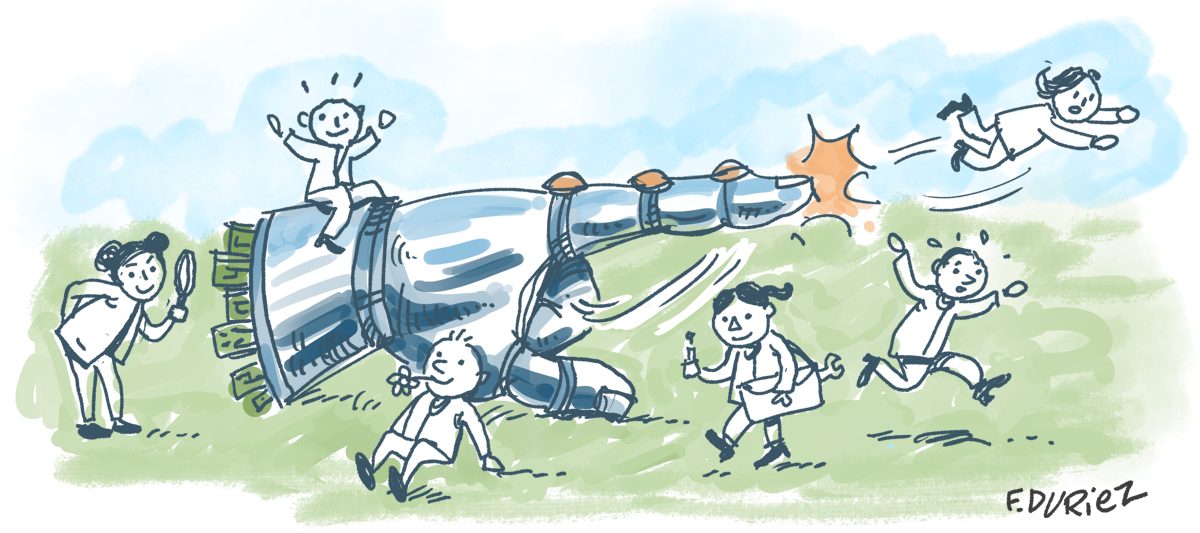
What kind of trainer are you when it comes to AI? Curious, enthusiastic, unconcerned, worried... ?
As with the arrival of the Internet and then of cell phones, it's hard for teaching teams to ignore these new technologies. When should they integrate AI into their teaching practices? When to leave it aside to develop or assess skills? How can we help teaching teams and students to make the most of these tools, when we often have the feeling that students are one step ahead...
To tackle this topic and get some pointers, we're off to the presentation by Yannig Raffenel, President of EdTech France.
Yannig Raffenel introduces us to the Gartner cycle, which describes the phases of technology adoption. There's something reassuring in thinking that our anxieties and emotions are nothing new.
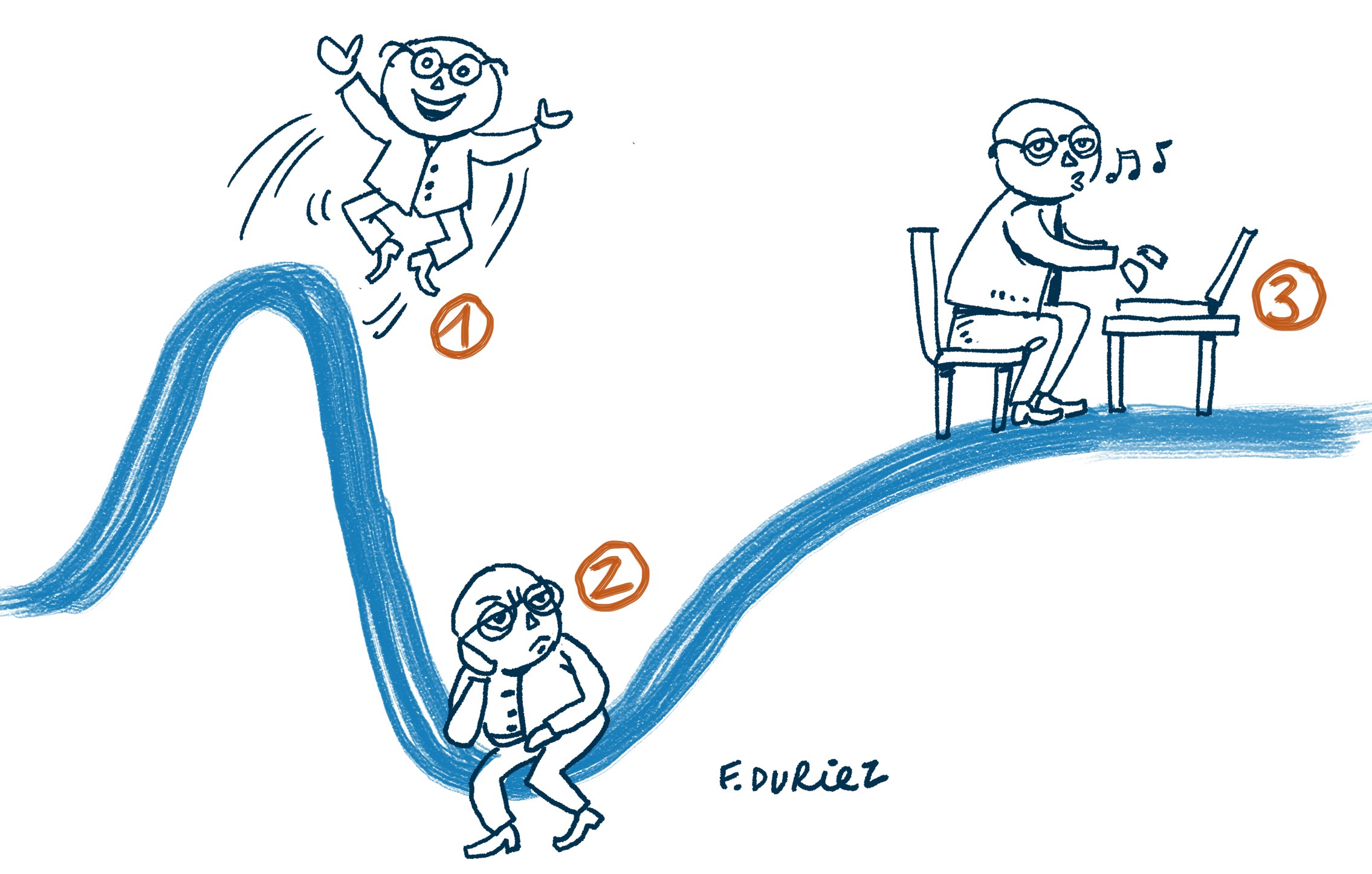
First, we have unbridled expectations and enthusiasm for the new trend (1) , followed by disillusionment that makes us regret what came before (2). Then we readjust our expectations, familiarize ourselves with the tool and make it part of our routine (3).
And yet, at this trade show, as we wander from booth to booth, we hear reassuring voices telling us that artificial intelligence is just a tool to save us time and help us go further. Speakers sneer at the word "intelligence" used for machines that do nothing more than calculate probabilities. A few meters away, on another stand, an animator with an almost religious accent tells us, on the contrary, that this is a revolution like no other, that nothing anywhere will soon be like it was before.
So how do we stay in control? For Yannig, you need to know AI, and in particular its limits. It's essential for those involved in training to have a clear understanding of how AI works, and of the probability models that underpin its responses.
To use AI intelligently and ethically, educational teams need to guard against the biases and stereotypes it can propagate, reproduce and amplify. Finally, and even if it's invisible and remote for the user, trainers can inform themselves about the environmental impact of artificial intelligence. Yannig Raffenel tells us, for example, that interrogating GPT chat once a day accumulates a ton of carbon per year, and that producing images or videos via AI is even more greedy. The Belgian financial newspaper l'Echo attempts to take stock of the situation in February 2025.
Distance learning platforms are also using it. But what can artificial intelligence do for them? After all, generalist AIs are already doing important work alongside trainers. I can specify the audience I'm addressing, ask them to help me define the objectives, then the content, and then identify reference resources. By searching on an engine like aifinder, I'll be able to bring specialized AIs into dialogue, many of which operate on a freemium model, free for initial use or for basic functions.
But the platform provides and structures a methodology. It integrates AI into several stages of the pedagogical chain, from the definition of objectives to the production of materials! There's something magical and liberating about it: just a few input elements and the training is built almost automatically. On its stand, 360 Learning gave us a demonstration of how to create an e-learning course in less than five minutes, less time than it takes to make a pancake...
The Didask website details these steps, and emphasizes the time saved. The platform also relies on a conversational agent to encourage interaction. And what about the trainer's role? Oh, but it's still very important. He controls what the machine has produced...
|
| "What a waste! If Verrocchio, Da Vinci's master, had had artificial intelligence, little Leonardo would have drawn much more elaborate pictures! |
In 2018, David Graeber developed the very useful concept of "bullshit jobs", and drew up a typology of them. Among these jobs, not all poorly paid, but all unhelpful, were the "box tickers". These are the controllers, auditors and quality inspectors who produce nothing but spend their time filling in forms and inventing procedures that have no real effect on the life of organizations.
And artificial intelligence could well help to develop these jobs. The production of automatic content must be accompanied by validation or supervision by a credible, qualified, trained and experienced human, who can secure content, avoid inconsistencies and reassure trainees and training clients. When talking about artificial intelligence, there's always a moment when it's appropriate to raise one's eyes to the sky, to put on an air of inspiration and say "there's no substitute for the human being! So we have to leave room for it, and at the very least ask it to tick boxes. Since checking takes less time than designing, validating will cost less...
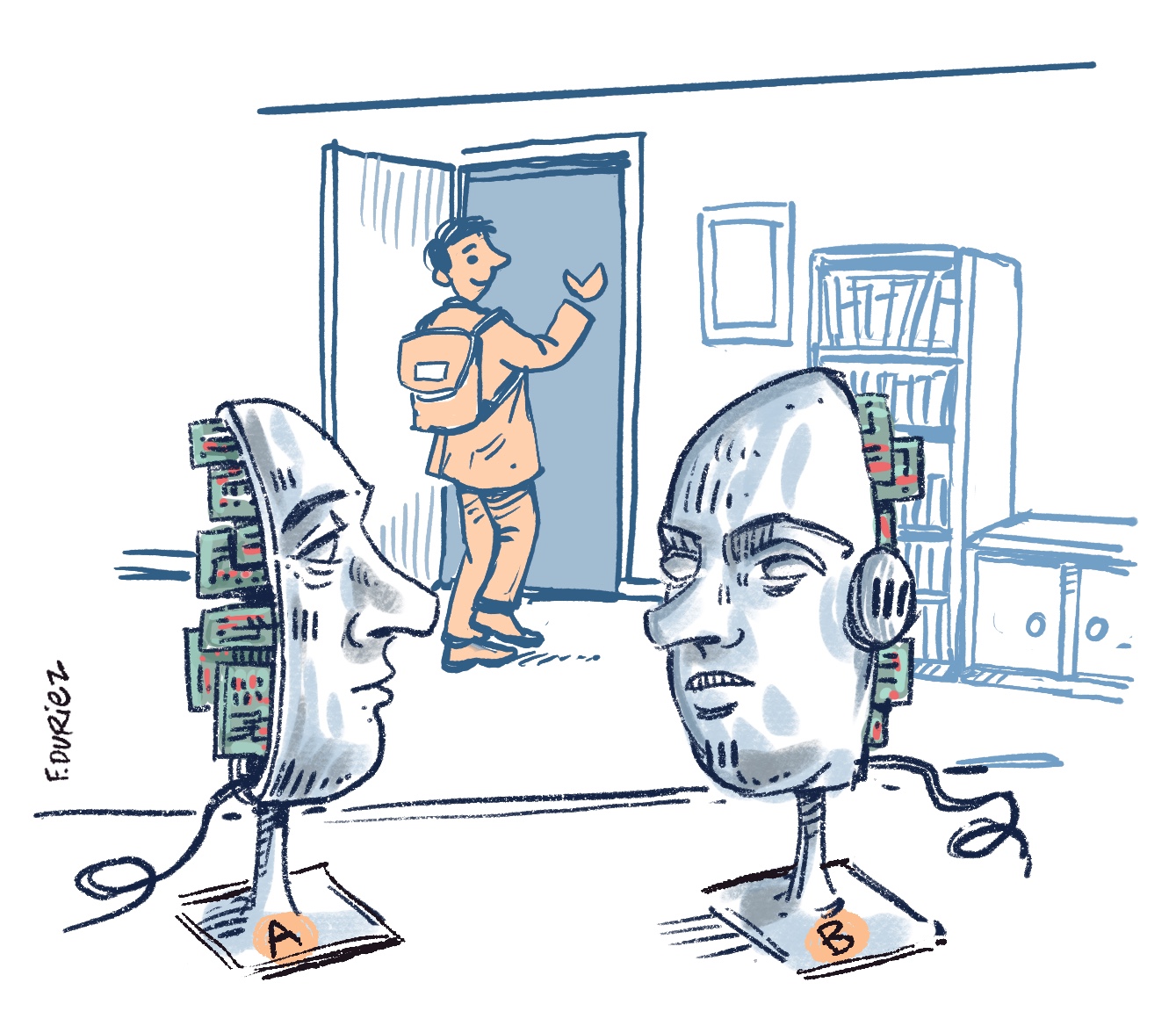
The trainer in charge of validation can further increase productivity by asking a second AI to check the first. And if the learner realizes that it's machines that are talking to him, sending him e-mails and evaluating him, he can in turn be replaced. Let the AIs talk to each other, and let's take a walk!
|
| If the trainer took five minutes to design the course and ten minutes to validate it, why should the learner spend any time at all? Nothing prevents artificial intelligence B from responding to artificial intelligence A... |
Numerous stands show that, on the contrary, artificial intelligence can turn trainers' imaginations into reality. They know their audience, have a sense of rhythm and can imagine learning situations, but they don't have the time, and they're not graphic designers, musicians or video editors.
Nolej presents itself as a tool capable of transforming content into training aids. Quizzes, crosswords, podcasts, videos, summaries. The list of possibilities is impressive. The promise is strong. All you have to do is bring in content that you've probably produced on Mistral, Perplexity, Claude or ChatGPT.
Trainers can extend the process. Content entrusted to Napkin can produce a few diagrams. Monica, for its part, can be used to transform structured content into a dialogue-based, sequenced podcast. Different voices and languages can be selected. Other AIs use realistic avatars to enter into dialogue with learners. The eighth edition of ILDI 's Digital Learning Book gives precise and useful examples of usage and prompts.
We conclude as we began, with Yannig Raffenel showing us how, in parallel with the Gartner curve, training organizations are adapting their posture, from the temptation to forbid, to exploration, then fascination and finally empowerment.
In an earlier article, he reminded us of the fundamentals of learning: assimilation time, the role of social interaction and the danger of delegating too many tasks and retaining only "the illusion of understanding".
Sources
L'Echo, Arnaud Martin, Martin Samain- Le gouffre énergétique de l'intelligence artificielle est-il sans fin ? - article published February 1, 2025, accessed February 10, 2025
h ttps://www.lecho.be/entreprises/tech-science/le-gouffre-energetique-de-l-intelligence-artificielle-est-il-sans-fin/10585477.htmlA
Les cahiers de l'Innovation - Jean-Pierre Léac : Avez vous un "job de merde"? consulted February 10, 2025
https://www.lescahiersdelinnovation.com/avez-vous-un-job-de-merde/
Didask - website consulted on February 10, 2025
https://www.didask.com/lms/outil-auteur
