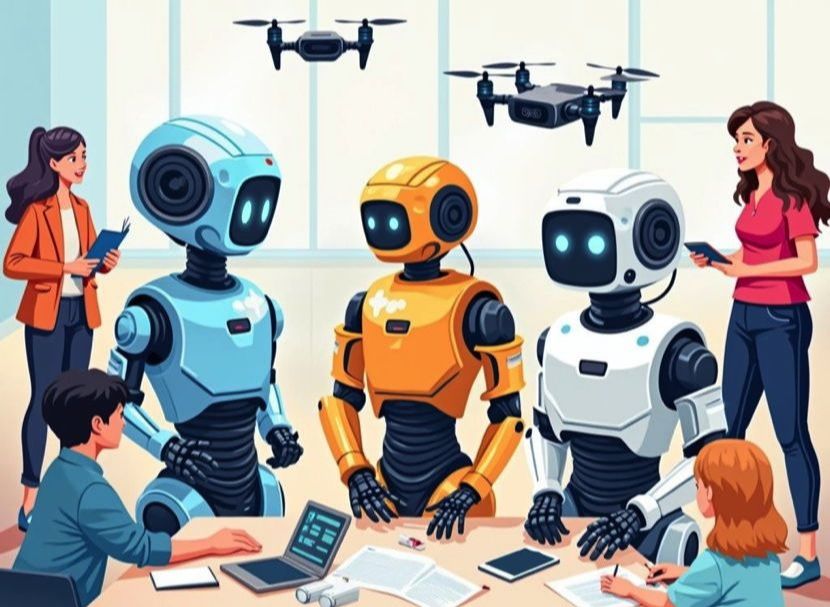
"Will we soon all be replaced by robots?"; "Are robots threatening our jobs... and our humanity?"
These questions, once the preserve of science fiction, are now invading media headlines and everyday conversations. Robotics, long confined to factories and laboratories, is now making its way into every corner of our lives. From vacuum cleaners to delivery drones and voice assistants, our lives are increasingly governed and facilitated by these autonomous machines with their ever-improving capabilities.
While this accelerated domestication of robotics promises considerable benefits, it also raises a host of societal, ethical and even anthropological questions. What will long-term cohabitation with these now "intelligent" robots, endowed with decision-making capabilities and a form of autonomy, change? How will it reshuffle the cards in our relationship to work, education and health? How far can the social and legal acceptability of these new "mechanical partners" go? Ultimately, won't this ongoing "robolution" fundamentally reexamine the nature of our human specificity?
Faced with the "robotization" of our societies, and the many challenges it brings with it, a collective acculturation to the challenges of robotics seems an urgent necessity. Far from being confined to expert circles, these technologies need to be genuinely embraced by the general public. Everyone needs to be able to understand the workings and implications of these intelligent machines that are shaping our common destiny, so that they can better grasp them rather than be subjected to them. In short, we urgently need to develop a societal robotics culture, in addition to professional training courses.
This article outlines this new field of robotics education. The aim is to explore the aims, methods and issues involved, using a resolutely transdisciplinary approach. The aim is to show how education in robotics, conceived as a new component of general culture for the 21st century, could contribute to the emergence of enlightened, critical citizens in the face of the rise of robots. Before we venture to sketch out a curriculum for this "roboticity", from school to continuing education.
Robotics, a total social fact that reinterprets our relationship with the world
From fiction to reality: robotics in our daily lives
Long fantasized in the guise of anthropomorphic creatures in science-fiction stories, from Frankenstein to Asimov's androids, robots have now left the realm of imagination to become very real in our everyday lives. Autonomous vacuum cleaners, delivery drones, telepresence robots, voice assistants, autonomous vehicles, rehabilitative exoskeletons, surgical robots, emotional companions... The list of autonomous and intelligent machines that are swarming into our lives continues to grow. Once confined to industrial assembly lines, robots are now taking over our homes, offices, hospitals and streets(1).
Not content with taking up residence in our familiar landscape, robots are becoming ever more "user-friendly", humanizing themselves in form and behavior. They sport friendly faces, adopt warm voices, react tactfully and appropriately, and learn from their mistakes. In short, they excel at making us forget ourselves as machines, weaving an almost intuitive relationship with us. This growing "user-friendliness" of robots, supported by dazzling advances in artificial intelligence, is accelerating their adoption by the general public. We have now entered the age of "cobotics": the era of close, everyday collaboration between humans and autonomous machines(2).
An upheaval in our human-machine relationship: towards a societal "robolution"?
The proliferation of robots in our living and working environments is not only upending our practices and habits. More profoundly, it is reexamining the way we in the West think about the relationship between man and machine.(3) Until now, a Cartesian "Great Divide" has separated man, endowed with interiority, intentionality and emotions, from machines, the inert, purely functional objects we use and control. Intelligent" robots, capable of autonomy, adaptation and even empathy, are blurring this reassuring boundary.
The rise of social and emotional robots, which promise to become our assistants, therapists or caring companions, is fuelling ever richer, more complex and personalized human-machine interactions.(4)(5) We're coming to attribute quasi-human characteristics to these machines, as illustrated by the very real attachment phenomena aroused by the Nao or Pepper robots.
From simple tools, robots are becoming partners in their own right, defying our usual reading grids. This growing confusion between human and machine, coupled with the spectre of total robot autonomy, fuels existential fears, brilliantly crystallized in the catastrophist scenario of the "Technological Singularity".(6) These imaginary worlds in turn shape collective representations of robotics.
Beyond these anthropological questions, the arrival of robots in our daily lives raises a host of societal issues. Robotic automation is set to profoundly transform the labor market, including in skilled trades, threatening many jobs(7).
The spread of assistance robots raises the question of how our healthcare and medico-social systems should evolve, and how they should be financed. The decision-making algorithms that govern robots call into question our concept of responsibility and our legal frameworks. The growing role of autonomous machines in our lives is also leading us to rethink notions of ethics, privacy and free will. Robotics thus constitutes a truly total social fact, powerfully reconfiguring the way we live together.
The need for collective acculturation to the challenges of robotics
Faced with this ongoing "robolution", and the many questions it raises, educating citizens about the challenges of robotics is a democratic imperative. All too often, robotics is still seen as a matter for specialists, arousing fantasies and irrational fears. It's time to bring these technologies back within the scope of citizen deliberation and action. Everyone must have access to a minimum understanding of how robots work, their uses and their limits. We need to be able to grasp them as an object of debate and collective choice, beyond the mere prism of acceptability.
Here, education has a major role to play in developing a genuine "robotic literacy", a common base of knowledge and skills for all 21st-century citizens. Much more than a mere technical veneer, it's a question of deconstructing myths, sharpening critical thinking and the imagination, and nurturing ethical and political reflection. In short, it's about forging a genuine robotics culture for society, one that's different from the instrumental and commercial logic of the past. It's a mission of general interest that calls for the coordinated mobilization of educational players, in a resolutely open and transdisciplinary approach.(8)
Objectives of robotics education: towards enlightened citizenship
Understanding how robots work: robotic literacy
To grasp the societal challenges of robotics, the first step must be to understand how robots themselves work. What are these machines used for? What are they technically capable of, and what can we expect from them? What are the main principles governing their behavior? A set of basic skills that form the foundation of a "robotic literacy", essential to evolve wisely in a world populated by autonomous entities.
At the heart of this acculturation, the artificial intelligence that brings robots to life deserves particular attention.
- What's behind this catch-all term, and what are the different approaches?
- What distinguishes "weak" intelligence (specialized on one task) from "strong" intelligence (multitasking)?
- What are the main principles of machine learning and its derivatives?
Exploring these notions, even in an accessible way, is important to understand the nature of "intelligent" robots. And to guard against an abusive anthropomorphism that would attribute to them intentions, emotions or reasoning capacities equal to our own.(8)
Robotics education must also explain the other fundamental technological building blocks that govern robot behavior. Concepts such as sensors, decision-making algorithms, actuators and man-machine interfaces need to be unpacked and demystified.
The challenge is to provide everyone with the keys to understanding robotic "reasoning", its strengths and limitations. Equipped in this way, citizens will be able to grasp the mechanics behind interactions with these autonomous machines, in a spirit of transparency.
Understanding the societal challenges of robotics: ethics, law, employment...
In addition to basic technical knowledge, education in robotics must also address the societal issues raised by the mass deployment of robots. What changes do these technologies bring about in the major areas of collective life, such as work, health, transport and education? What philosophical and ethical questions do they raise? What changes do they call for in our legal and insurance frameworks?
The effects of robots on employment and the nature of work are the first unavoidable area of questioning. How is robotic automation reconfiguring professions, redistributing skills and transforming organizations? Should we fear the "creative destruction" predicted by certain forward-looking studies, or rather count on the emergence of new sources of employment? How can we manage and regulate the algorithms that now govern industrial processes, logistics and recruitment? These are just some of the issues we need to decipher to prepare citizen-workers to interact with their future robotic colleagues.
Another field shaken up by intelligent robots is healthcare and autonomy. How do we reconcile human care with robotic assistance at the bedside of patients or frail people? How should tasks be shared with machines that can monitor, stimulate, comfort and even converse? What ethical and legal safeguards should be applied to the massive collection of health data by robots? Faced with the rise of "affective" robots, how can we preserve an approach to support that focuses on the intersubjective relationship? Robotics education should enable us to take a step back from these highly sensitive issues.
In fact, ethical reflection runs like a thread through all fields of robotics application. Will automotive robots be able to make moral decisions in the event of an accident? How can we ensure that military and police robots respect international law? What limits should be set for supervisory and educational robots, to preserve free will and privacy? Can we delegate the care of our planet or the education of our children to machines? The rise of robots raises profound questions about our values and ethical principles, calling for a collective effort to bring them up to date.
This effort must also focus on the law, which has been largely overturned by the increasing autonomy of robots. How can we rethink notions of fault and reparation in the age of "learning" robots? How can we regulate data sharing and infringements of privacy? What is the legal status of quasi-autonomous robots: property, subject of law, "robotic" personality? Should we formalize "robot rights" or even a "universal declaration"? These are just some of the legal issues that robotics education can bring to the forefront of collective responses.
Developing a critical view of robots: deconstructing imaginary images
To contribute to an enlightened "robo-citizenship", robotics education must also focus on deciphering the imaginary images that surround these technologies. Far from being neutral, robots crystallize a host of social representations, fueled by literature and cinema, which are largely anxiety-provoking.(9) From Frankenstein to Terminator, the myth of the robot that rebels and crushes its creator dominates minds, redoubled by the prospect of the "Singularity". Conversely, the utopian vision of the robot as savior of mankind, freeing man from the drudgery of labor and elevating him spiritually, also colors the discourse.
Rather than sticking to these binary fantasies, it's important to learn to deconstruct the imaginary world of robotics using the tools of the social sciences. To understand how these are part of a long line of mythologies and narratives about artificial creatures, stretching back to antiquity. Or to grasp how these representations in turn influence the way we conceive and perceive real robots, in a process of "fabrication of the real". Critical knowledge of this kind is essential if we are to move away from caricatured discourses and acquire a distanced view of the place of robots.
The analysis must then be extended to the role of robots in contemporary socio-technical imaginaries. How do these technologies crystallize certain collective fears, linked to autonomous technology, loss of control and the dissolution of human/machine boundaries? In what way does the robot embody a certain technicist and rationalist project for society? How is it mobilized by transhumanism in its dreams of augmenting and even surpassing the human? A sociological approach to these questions is invaluable in resituating the rise of robots in its ideological and cultural roots.
Robotics education needs to develop a critical awareness of the prophecies, utopias and dystopias surrounding "robolution". It's a question of tracking down the editorial biases, framing effects and biases that shape our perceptions of robots, to restore rationality to the debate. To question the way in which public authorities, but also industrialists, mobilize these imaginations to guide the social acceptability of robotic innovations. This is a prerequisite for democratically reappropriating the destiny of technologies that are as powerful as they are ambivalent.
Preparing to interact with robots: towards a "robotiquality"?
Deconstructing myths about robots is one thing, but learning how to interact with them on a day-to-day basis is quite another. At a time when these machines are establishing themselves as partners in our professional and domestic spheres, an education in "robotics" seems to be a prerequisite for life in society. This means developing the practical skills needed to cooperate effectively and serenely with these autonomous entities.
First and foremost, this means learning to communicate in a way that is adapted to the specific characteristics of robots. Decoding their modes of interaction (vocal, tactile, gestural), taming latency times, formulating unambiguous requests, managing misunderstandings and misunderstandings... These are just some of the new "conveniences" that need to be acquired to ensure a smooth human-machine dialogue.(10) Mastery of control and programming interfaces, enabling robots' behavior to be supervised and fine-tuned, is also part of the perfect cobot's baggage.
Beyond these technical aspects, robotics education must also prepare students to manage the affective and social dimensions of interactions with robots. This means understanding their influence on human emotions and behavior, so as to better regulate them. Learning to gauge the positive (comfort, stimulation) or negative (stress, dependence) "emotional valence" of each co-presence situation. Or knowing how to set relational limits, to guard against excessive attachment to machines, especially among fragile populations. It's a delicate task, necessary to build a "reasoned familiarity" with our robotic assistants(11).
Finally, this well-understood intimacy with robots means clarifying our moral stance on their desirable place in our lives. How far should we go in delegating to machines the relational, educational and creative tasks that define us as humans? What boundary should we draw with augmentation to preserve our autonomy as subjects? What are the ethical limits to sharing our personal data?
Such choices are crucial if we are to regulate our degree of collaboration with robots, in line with our own values. In this way, we can fully experience ourselves as subjects, rather than objects, of our future as "robo-citizens".
Pedagogical approaches to robotics education
More than just technical training: a humanistic approach to robotics
Robotics education cannot be reduced to the transmission of technical skills alone. Of course, mastery of computer science (programming, artificial intelligence) or mechanical engineering (mechatronics, embedded systems) is a prerequisite for designing and interacting with robots. But beyond these practical aspects, it is important to develop a humanist and civic-minded approach to these technologies.
Such a perspective implies placing robotics knowledge in the context of a reflection on the meaning and purpose of life.
- the meaning and aims of technical progress;(12)
- questioning the compatibility of automation with our values of emancipation and social justice;
- open the debate on the consequences of the increasing delegation of work, care and decision-making to artificial intelligences;
- to anchor robotics in a vision of technology as "pharmakon", poison and remedy, calling for a permanent effort at democratic regulation.
In short, to reintegrate these artifacts into the project for a more humane society.
This approach also calls for a broad mobilization of the human and social sciences to shed light on the challenges posed by robotics.
- Philosophy and ethics are invaluable resources for assessing the moral status of robots or discussing a "roboethics".
- Psychology is required to consider the effect of intelligent machines on cognitive and affective development.
- Education and communication sciences shed light on the didactic challenges of "robo-training".
- Economics and sociology help us to grasp the effects of robots on work, social protection and consumption patterns.
All these perspectives are essential if we are to forge technicians and citizens with sharp, complementary views of robots.
Anchoring learning in real-life experience: manipulating, experimenting, co-creating
To generate interest and commitment among learners, robotics education needs to be rooted in practical, hands-on experience. Rather than disembodied, abstract learning, the starting point should be the concrete uses of robots, as observed in living and working environments. It's about putting robots into situations, experimenting with them, to understand from the inside the issues raised by their design and interaction with humans.
Handling real or simulated robots is therefore a powerful educational tool. Whether building and programming a line-following robot, configuring a reception robot or analyzing the behavior of an autonomous vacuum cleaner, direct confrontation with robotics is irreplaceable. It enables us to test the possibilities and limits of these machines, to grapple with questions of reliability and acceptability, and to gain a better understanding of the ethical issues involved. Experiential learning can take the form of practical work, challenges and hackathons, encouraging iterative and collective development.
In the same spirit, "co-design" approaches, bringing together laymen and experts, are a stimulating way of teaching. Working together to imagine the robots of the future, sketching out new scenarios for human-robot interaction, prototyping robotic solutions to concrete problems... These "living lab" approaches involve learners in forward-looking, creative thinking about robotics. They encourage them to compare points of view, express their expectations and fears, and collectively draft safeguards for the responsible and inclusive development of these technologies. All of these scenarios contribute to a better understanding of the challenges posed by robotics.
Crossing disciplinary perspectives: the contributions of Information and Communication Sciences (ICS), psychology, philosophy...
Another prerequisite for a fruitful education in robotics is to cross disciplinary approaches in order to grasp the complexity of these "frontier" objects. It's essential to go beyond technological knowledge (derived from computer science or mechanics) and draw on the complementary insights of the human and social sciences. This transdisciplinary perspective is the key to grasping robotics in all its dimensions, and to thinking about its harmonious integration into society(13).
The Information and Communication Sciences (ICS) provide invaluable analytical grids for deciphering the social and symbolic mediations effected by robots. By considering them as "communicating objects", endowed with relational skills and a social "presence", they shed light on new forms of human-machine interaction and cooperation.(14) Their critical tools also reveal how these technologies perforate models (economic, political) and imaginaries, which in turn shape their modes of appropriation. A valuable communicative perspective for grasping robotics as a social fact and artifact.
Psychology and cognitive science are not to be outdone when it comes to thinking about the impact of robots on mental development. They show how repeated interaction with these "intelligent" machines modifies our learning mechanisms, our reasoning biases, our perception of technical objects.(15) They point to the risks of weakening attention, memorization, abstraction and emotional regulation capacities through omnipresent robotic stimulation. These effects call for vigilance when it comes to children's exposure to robotic toys. Their work also sheds light on the potential of robots to develop certain skills (spatial, creative, collaborative), opening up educational avenues to be explored.(16)
On a more philosophical and ethical level, robotics is re-interrogating our conceptions of identity, consciousness and free will in unprecedented ways.(17)(18) By imitating human capacities in ever finer detail, robots are blurring the traditional boundaries between living and inanimate, natural and artificial, autonomous and automated. They reactivate old questions about the nature of the mind, the singularity of the human, and the agentivity of objects.
Can we give robots a form of responsibility, or even legal personality? Should we confer rights on them, mirroring a declaration of "human rights in a world of intelligent robots"? Philosophical reflection, nourished by the ethics of technology, is fundamental here if we are to weigh up the anthropological upheavals that robots bring with them.
Finally, sociology and economics provide the keys to understanding the societal changes associated with the spread of robots. Their analyses decipher the redistribution of tasks, skills and status generated by the automation of work. They highlight the social justice issues raised by the replacement of certain jobs, and the growing polarization between low-skilled and high-skilled positions. They uncover the risks of accentuating inequalities in access to health, mobility and training as a result of "robodivision" between populations. Essential insights for political regulation of robotic technologies in the public interest.
Debating the challenges of robotics: the virtues of controversy
Ultimately, the most promising approach to educating people about robots is undoubtedly that of debate and controversy. Faced with technologies that are as powerful as they are fraught with risks, only the organization of broad-based collective deliberation can bring about enlightened, democratic responses. The aim is to bring the political and ethical issues raised by the "robolution" into the public arena, both in schools and in the community at large. It's about confronting points of view on this "robotized world" under construction, to sketch out a collective destiny for these machines.
This commitment to controversy as a lever for citizen appropriation can take many forms. Public debates, consensus conferences, deliberative polls, scenario workshops, online consultations or citizens' juries: there's no shortage of tools for creating the conditions for genuine deliberation. Schools and universities, as well as museums, centers for scientific culture, fab labs, living labs and third-party associations, are ideal places to deploy these initiatives. By bringing together the expertise of roboticists, social scientists and lay audiences, they open up a space for collective problematization of robotics issues.
The challenge is to translate the technical language of the experts to reach non-specialist audiences, and free up their voices on subjects still perceived as the preserve of those in the know. Discussions are best supported by immersive role-playing scenarios, enabling concrete experience of the impact of technological choices on everyday life. Innovative formats such as participatory theater, role-playing, interactive fiction or co-design workshops stimulate participants' involvement. They enable them to explore areas of uncertainty and friction for themselves, and to confront their values and imaginations with the logic of robotization.
Controversy has a major virtue: it allows questions to take precedence over ready-made answers, inviting doubt and nuance in the face of unambiguous technological promises. By clarifying the diversity of points of view and the complexity of the issues at stake, it guards against the temptation of univocal, miraculous or liberticidal "solutions". It rehabilitates debate, trial and error and compromise as the only legitimate compasses in the face of the unknown. These are all qualities of thought that education in robotics must tirelessly cultivate, to shape a citizenry equal to the challenges posed by these "disruptive" technologies.
Draft curriculum for lifelong robotics education
At school: include robotics in interdisciplinary lessons and projects
The first obvious place to introduce robotics education is at school, from the earliest age. Faced with pupils born into a world populated by intelligent objects, it's crucial to lay the foundations for a robotics culture at a very early age. Not through specific teaching, but by infusing these issues into existing subjects and projects, with a resolutely cross-disciplinary approach.
Technology and science, of course, but also French, history-geography and philosophy have every right to take up the socio-technical challenges of robots. Deciphering the literary and cinematographic imaginations of artificial creatures, grasping their anthropological motivations, analyzing the geopolitical stakes of automation, reflecting on the ethics of machines... So many complementary disciplinary prisms equally necessary to building a systemic understanding of robotics.
Beyond the classroom, interdisciplinarity can also take the form of collaborative projects combining hands-on experience and critical reflection. Designing and programming a robot to solve a local problem, exploring a science-fiction scenario questioning human-robot cohabitation, mounting an exhibition on the history of automata... By calling on creative, experimental and reflective approaches, these initiatives give substance to robotic issues and stimulate student involvement. They would also benefit from the involvement of external partners (scientists, artists, associations), to open up the school to the "real life" of robots.
Here are a few suggestions for "robocontrolled" teaching sequences:
- Primary: discover the basic principles of coding and computer thinking, using playful programmable robots (Thymio, Beebot). Learn about the diversity of robots through outings (science museums, companies) and meetings with professionals.
- Middle school: understand the concepts of algorithms and artificial intelligence through hands-on experience (Python or Scratch programming workshops). Think about tomorrow's jobs and the impact of automation. Decipher gender stereotypes associated with robots.
- High school: analyze the philosophical (nature of mind and consciousness), social (digital divides, relationship to work) and geopolitical (global race to AI) implications of robotization. Take part in debates and controversies.
The challenge is to disseminate a pedagogy that combines technical culture and societal questions about robotics, right from school. The aim is to train future citizens capable of both understanding and problematizing these technologies, which are set to increase our capabilities and our daily lives.
In higher education: specialized courses that are open to societal issues
In higher education, education in robotics has a natural place in the specialized curricula that train future professionals in the sector. Engineering schools, masters in computer science and robotics, bachelor's degrees in mechatronics... These specialized courses must provide all the scientific and technical building blocks needed to design and program intelligent machines. But beyond these essential fundamentals, they would benefit from integrating solid training in the "societal" challenges of these technologies.
This already involves teaching the legal, ethical, economic and social aspects that accompany the development of robotics. What is the legal and insurance framework for autonomous vehicles? How can we prevent biases in learning algorithms? How can personal data captured by robots be protected? What business models and innovation ecosystems are needed for inclusive robotics? By exposing students to the exact sciences, we prepare them to develop a reflective and responsible approach to their future activities.
Hybrid curricula combining engineering and social sciences are a promising way of forging these "compredisciplinary" profiles. Double bachelor's degrees (in computer science and sociology, for example), master's degrees combining mechatronics and law, collaborative SHS/sciences projects... These "Y-shaped" career paths enable genuine interdisciplinary dialogue, where technology feeds into reflection on the human condition, and vice versa. They train "citizen-engineers", capable of thinking of robots not as an end in themselves, but as a means to a shared social project.
Beyond these specialized courses, all students, whatever their field, should benefit from an introduction to the challenges of robotics. In the form of introductory courses, seminars or MOOCs, these cross-disciplinary modules would give them a basic understanding of key concepts (machine learning, human-robot interaction), and an awareness of the socio-technical issues they raise. This basic acculturation is essential for conscientious navigation in a world of intelligent machines... and for potentially encountering them in the workplace.
It would also be valuable to increase the number of interdisciplinary student projects involving robotics. Hackathons involving engineers, designers, legal experts and sociologists around robotic challenges, coworking in Fab labs to prototype solutions, impact studies carried out with associations... By combining experimental approaches and cross-fertilization, these "hands-on" initiatives are building the collaborative and creative skills required in the professions of the future. Above all, they help to anchor robotics in a genuine dialogue between science and society.
In adult life: reinventing popular education in robotics
In addition to initial training, education in robotics must also permeate adult life, through continuing education and popular education. At a time when digital transformation is reshuffling the deck in terms of professions and skills, robotics "upgrading" is becoming an employability issue for many working people. Targeted training modules should enable professionals to understand the effect of automation on their sector, grasp technological developments and develop their ability to collaborate with cobots. This challenge is all the more acute given that the development of robotic skills will largely determine the resilience of jobs in the medium term.
The vocational training sector has a key role to play here, offering courses tailored to the diversity of needs and target groups. Working in close partnership with professional branches and companies, they can build "tailor-made" courses, combining technical knowledge (programming, maintenance) and cross-disciplinary skills (problem-solving, human-robot cooperation). The use of immersive technologies (virtual/augmented reality) opens up unprecedented possibilities for role-playing and experiential learning, as close as possible to robotized work environments. The challenge is to democratize access to such training, via modular, distance learning and certifying formats (badges, blocks of skills), decisive levers for "robotic flexicurity".
Outside the professional sphere, it is also important to reinvent popular education in robotics, to support every citizen in the ongoing societal "robolution". Associations, digital public spaces, fab labs and even micro-folies provide a valuable local network for deploying mediation initiatives tailored to all ages. Workshops on deconstructing representations, robot cafés, citizen living labs, online debates... A wide range of formats needs to be invented to enable everyone to explore these technologies and their challenges.
The key is to create the conditions for active, collaborative and participatory learning, based on the questions and experiences of each individual. For example, by inviting citizens to test a robot and gathering their feedback, before collectively discussing its benefits and limitations. Or by involving them right from the design stage of robotic projects responding to identified social needs (tutoring, assistance for isolated people...). In this way, we lay the foundations for a more inclusive and ethical human-robot interaction.
In terms of content, this popular education must be both critical and emancipating. It's about deconstructing preconceived ideas, uncovering the biases and power relations behind robotic devices. Understanding who designs algorithms, for what purpose and with what societal consequences. To explore grey areas and controversies, rather than asserting unambiguous truths. In short, to provide citizens with the practical tools they need to influence the technological choices that shape their daily lives and their future. This is a vital democratic challenge, which calls for the mobilization of all knowledge mediators.
For senior citizens: taming robots with a view to ageing well
Finally, robotics education is particularly important for senior citizens, who are directly affected by the massive deployment of assistive technologies. Mobility assistance robots, emotional companions, remote medical monitoring assistants... These "age-well" devices are destined to multiply to support the advancing years and compensate for loss of autonomy. While they can be invaluable "care" aids, these robots raise specific questions that need to be addressed in advance with the elderly.
The first is the acceptability of these intelligent machines in the intimate sphere of the home and the body. How can we tame this technological "foreign body", without experiencing it as an intrusion or a dehumanizing prosthesis? Support is needed to help seniors gradually familiarize themselves with their robotic assistant, understanding both its functionalities and its limitations. Practical workshops can help them handle the robot, personalize it (give it a name, choose a voice), and learn the right control and safety "reflexes". The challenge is to build a relationship of trust and a feeling of control, the levers of free, informed consent.
Beyond that, it's important that senior citizens can fully exercise their reflexivity about the impact of the robotic companion on their lives. Do I feel safe, supported or, on the contrary, watched and dependent? What effect does it have on my relationships with my caregivers? How does it change my relationship with my body, my self-image? Peer discussion groups can be a useful way of stimulating this feedback, and helping you to adjust the way you live with the machine.
On a more forward-looking note, we also need to think about the right place to give these robots in the care of the elderly. We must be wary of giving in to a technological solutionism that sees machines as a miracle cure for isolation and dependency. Robots will never replace the human presence, carnal contact and psychosocial stimulation provided by care professionals and relatives.
Educating seniors about robotics therefore also means inviting them to remain masters and critics of the assistance choices they make. And to see the robot as just one of the many ways to achieve active, creative and supportive ageing, with the world of the living at our fingertips.
At our service
At a time when robotics are intruding into the smallest interstices of our lives, we urgently need to take collective ownership of the issues they raise. An education in robotics, conceived as a new component of general culture for the 21st century, could contribute to this. What's at stake? Enabling all citizens to become enlightened and critical players in this ongoing "robolution", so as to retain control over the tools shaping our common future. This societal challenge calls for a coordinated mobilization of the education system, the world of research and civil society.
Far from technophile or technophobic visions, education in robotics must develop a "roboticity" in everyone, combining technical understanding with ethical questioning. It's about acquiring the knowledge and reflexes needed to interact wisely with the intelligent machines that populate our environments. But also the ability to problematize their uses and to debate them collectively, so as to make them part of a genuine social project. A demanding acculturation, to be deployed throughout life, linking academic knowledge with everyday practices.
At school, this means infusing a robotics culture into all disciplines and projects, by cultivating interdisciplinarity between the sciences and the humanities. In higher education, we need to train citizen-engineers through "Y" curricula that combine technology and social issues. In adult life, to reinvent emancipating popular education, from fab labs to third places. And for seniors, taming the robots of "ageing well" with a view to empowerment. It's a vast, collaborative undertaking that calls for proactive public policies to support grassroots initiatives.
We hope that education in robotics will help us to become players, rather than mere spectators, in an uncertain technological future. Faced with the rise of machines that mimic our capabilities ever more closely, we urgently need to reaffirm what makes us uniquely human: the reflexive awareness that drives us to constantly question our own future. This gives new meaning to the old saying: "Science without conscience is but the ruin of the soul".
In conclusion, we would like to invite readers to pursue their own reflections, beyond any one-size-fits-all recipe. For it is by collectively learning to question technologies, to debate their aims, to prototype creative uses for them, that we will bring to life the critical spirit that our robotized societies so desperately need. Down with the "robolution" we've been subjected to, let's make way for robotics that are ardently debated, proudly amended and joyfully tweaked. Nothing will be a greater guarantee of progress than an education that puts technology to the test of our humanity.
Illustration: AI-generated - Flavien Albarras
References
1-Health: surgical robots take over Paris hospitals - YouTube, [no date]. [online]. Available at: https: //www.youtube.com/watch?v=cdcgYeOnB-I&ab_channel=LeParisien [Accessed February 2, 2025].
2-KLEINPETER, Édouard, 2015. The Cobot, cooperation between user and machine. Multitudes. May 7, 2015. Vol. 58, No. 1, pp. 70 75. DOI 10.3917/mult.058.0070.
3-Human/machine relationship: towards inter-humanism?", [no date]. [online]. Available at: https: //usbeketrica.com/fr/article/relation-humains-machines-vers-l-inter-humanisme [Accessed February 2, 2025].
4- SPATOLA, Nicolas, 2019. Human-Robot interaction, from anthropomorphism to humanization. L'Année psychologique. December 16, 2019. Vol. 119, No. 4, pp. 515 563. DOI 10.3917/anpsy1.194.0515.
5- Why do our robots become empathetic, [undated]. [online]. Available at: https://usbeketrica.com/fr/article/pourquoi-nos-robots-deviennent-ils-empathiques [Accessed February 2, 2025].
6- What is the technological singularity? | IBM, 2024. [on line]. Available at: https: //www.ibm.com/fr-fr/think/topics/technological-singularity [Accessed February 2, 2025].
7- Robotisation du travail : demain tous chômeurs ? | Les questions qui fâchent | ARTE - YouTube, [no date]. [Online]. Available at: https: //www.youtube.com/watch?v=fZkQzLDTDuM&ab_channel=ARTE [Accessed February 2, 2025].
8- Éduquer aux robots : les enjeux de la métaphore du vivant - Collard Anne-Sophie & Jacques Jerry
https:// www.marsouin.org/IMG/pdf/2018m_rsouin-collard_jacques.pdf
9- (14) La peur des robots dans le cinéma et les contes | LinkedIn, [no date]. [online]. Available at: https: //www.linkedin.com/pulse/la-peur-des-robots-dans-le-cin%C3%A9ma-et-les-contes-pascal-de-lima/ [Accessed February 2, 2025].
10- DEVILLERS, Laurence, 2019. The human-machine dialogue:Artificial intelligence/human intelligence: manipulation and evaluation. Futuribles. October 31, 2019. Vol. 433, n° 6, pp. 51 61. DOI 10.3917/futur.433.0051.
https:// shs-cairn-info.iepnomade-2.grenet.fr/revue-futuribles-2019-6-page-51?lang=fr
11- DEVILLERS, Laurence, 2018. Affective and social dimensions in human-robot interactions. Interfaces numériques.
January 12, 2018. Vol. 2, n° 1, pp. 105 118. DOI 10.25965/interfaces-numeriques.1760.
https://www.unilim.fr/interfaces-numeriques/1760#:~:text=Le%20lien%20avec%20le%20robot,sont%20en%20g%C3%A9n%C3%A9ral%20mieux%20accept%C3%A9s.
12- DUBEY, Gérard, 2013. The anthropological challenges of personal robotics. Annales des Mines - Réalités industrielles. September 7, 2013. Vol. 2013, n° 1, pp. 96 101. DOI 10.3917/rindu.131.0096.
https:// shs-cairn-info.iepnomade-1.grenet.fr/revue-realites-industrielles1-2013-1-page-96?lang=fr
13- WEISSBRODT, Rafaël, NANCHEN, Benjamin, BOVIGNY-SANDOZ, Sarah, BUSSY, Gaëtan, FRAGNIÈRE, Emmanuel, MIZERET, Jérôme and RULLAC, Stéphane, 2024. 2.1 Pour une approche transdisciplinaire de co-innovation dans le domaine des technologies d'assistance. In: Innovation Booster Technologie et Handicap [online]. Association Sociographe. pp. 65 78 [Accessed February 2, 2025].
https:// shs-cairn-info.iepnomade-1.grenet.fr/innovation-booster-9782494241169-page-65?lang=fr&tab=texte-integral
14- BLONS, Emmanuelle, 2019. Chapitre 4. Human-machine collaboration. Hors collection. 2019. pp. 81 99.
https:// shs-cairn-info.iepnomade-1.grenet.fr/l-entreprise-disruptee--9782100781461-page-81?lang=fr
15- SDGTA, 2024. Pédagogie et Intelligence Artificielle : Quand les Robots S'invitent à l'École ! grapholearn.fr [online]. December 31, 2024. Available at: https: //www.grapholearn.fr/pedagogie/pedagogie-et-intelligence-artificielle-quand-les-robots-sinvitent-a-lecole/ [Accessed February 2, 2025].
16- La robotique au service du développement des compétences transversales - École branchée, 2024. [online]. Available at: https: //ecolebranchee.com/robotique-service-developpement-competences-transversales/ [Accessed February 2, 2025].
17- What would the great philosophers have said about AI... according to AI? | by Jeremy Lamri | Medium, [undated]. [online]. Available at: https: //jeremy-lamri.medium.com/qu-auraient-dit-les-grands-philosophes-%C3%A0-propos-de-lia-selon-l-ia-cf62005d64f6 [Accessed February 2, 2025].
18- Robots, ethics and free will - - UNIGE, 2017. [online]. Available at: https: //www.unige.ch/lejournal/numeros/134/article-point-fort-2/ [Accessed February 2, 2025].
See more articles by this author