Are some fields of study more theoretical than others? Indeed, it seems that some require only documentation to instill knowledge. On the other hand, it's difficult for future specialists in medicine, piloting, metallurgy, social work, woodworking, sports or even sales to rely solely on theories. Professions that involve contact with materials and, above all, with people, oblige those who will be practicing them to do so beforehand. This explains the notion of internships, important phases where learners can experience reality in real workplaces. It's important, however, that trainees are not seen simply as staff to be given the thankless tasks that no-one else wants to do...
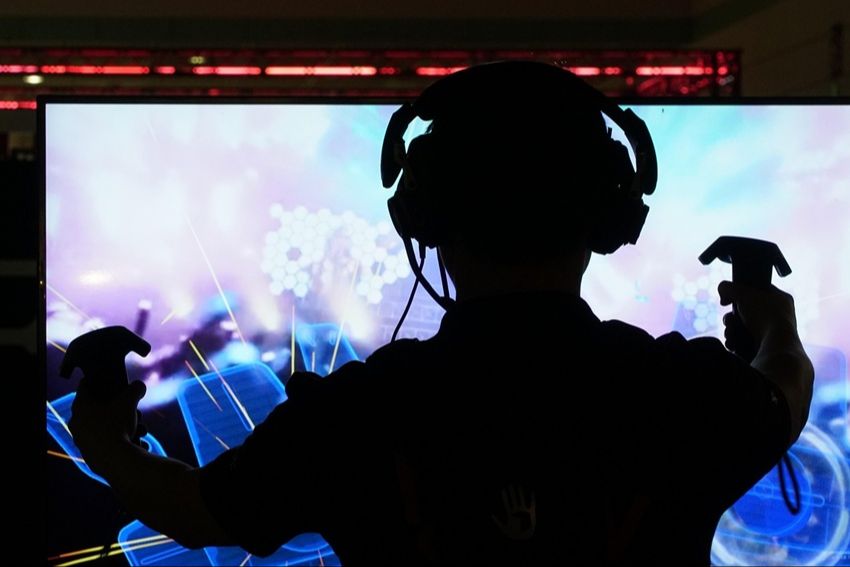
Simulation-based learning also provides some of this practical element. Whether staged with actors, or digitally with the advent of virtual reality, teachers can use these tools to force students to solve complex situations.
How do you deal with a patient who appears to be lying, a person in the throes of a suicidal crisis or a major loss of fuel in an airplane? Situational simulation allows us to experiment with more perilous conditions in a safe environment. This is becoming easier with the democratization of virtual reality, for example.
In recent years, another technology has become increasingly pervasive: artificial intelligence. Could it transform educational simulations?
More responsive simulations
Artificial intelligence is still the subject of debate in academic circles. On the one hand, it facilitates cheating and even intellectual laziness, since students can complete tests in just a few minutes with a conversational robot. On the other, it's a tool that's clearly here to stay, and will change many tasks in the future.
Institutions are therefore juggling AI literacy with surveillance against potential cheating. Interestingly, some academic circles are using simulations in which students have to play the role of AI thinkers, to ensure that AI is ethical.
AI can also be used to improve numerical simulations. A major problem with simulation-based learning is that it takes a long time to set up. The simulation has to be scripted, digitally recreated and ensured to cover all the desired aspects. This design time often makes updates a rarity, because they also require time for creation, programming and so on. AI simplifies things by making it possible , for example, to take all the teaching material in a course and create points and ideas for relevant scenarios. It can also analyze the scenario of a simulation and suggest concepts overlooked in its design. It can even provide a recipe from A to Z for the creation of a scenario.
In fact, there are few areas in which it could not drastically reduce the time required to produce a simulation, whether human or digital. A simulation based on artificial intelligence would be able to create adaptive situations based on students' reactions. It could then simulate the attitude of a patient, customer or any other person to what is said or done.
The world of video games is already seeing some experiments developed almost entirely with AI reacting to a player's words. This almost immediate feedback has an important effect on learning; the student understands the significance of gestures and words addressed to another person. What's more, the few faculties in the world offering this type of simulation see great interest among learners, who can then reassure themselves or gain in confidence by seeing that they have the right attitudes.
What's interesting in this study, for example, is that the young adults preferred the screen-based approach to the VR headset. This shows that immediate, reality-based responses are more important than being completely immersed in a virtual environment.
The recipe for an AI simulation
How do you create an AI simulation? Harvard University's School of Business Administration has already given us a good idea with a recipe used on ChatGPT with students as part of an exercise on negotiation.
What's interesting is the length of the request. To get a complete and really stimulating simulation, you need to tell the robot what is and isn't expected by the exercise. For example, in the Harvard professor's request, it is noted what the AI must perform but also avoid in its responses, including not giving in too quickly to the negotiation by accepting, since failure is tolerated in the activity. The advantage of this approach is that the algorithm can adapt to the student's interests and propose scenarios that come close to what he or she is passionate about.
But if AI does everything, what's the role of the teacher, since he or she no longer has to write anything or almost anything (apart from the request to the conversational robot)? He's there to accompany the students through the exercise, to see how they're getting on, the answers they come up with, and so on. Above all, it's there to set the table for the exercise, and to check back with the learners afterwards to find out what they liked, what they found odd or difficult, and so on.
Because, even if AI now seems capable of doing everything on its own, it needs a human to guide it so that it doesn't stray from the required objectives. What's more, non-digital simulations with real people (actors or not) will still be necessary, since AI does not reproduce 100% of the subtleties of human behavior, and some gestures and attitudes are better practiced without computers.
Nevertheless, it seems that artificial intelligence has the capacity to offer faculties around the world situational scenarios more quickly, so that they can be shared with students.
Image: dpung from Pixabay
References
Anthamatten, Angelina, and Jo Ellen Holt. "Integrating artificial intelligence into virtual simulations to develop entrustable professional activities." ScienceDirect. Last updated October 2024. https://www.sciencedirect.com/science/article/pii/S155541552400268X.
"How AI is innovating e-learning scenarios." Didask. Last updated March 2, 2025. https://www.didask.com/post/mises-en-situation-ce-que-lia-a-change.
Hoppough, Emma, and Patrick Moyle. "Using simulation technology to teach complex problem-solving." Institute of Education Sciences (IES). Last updated October 18, 2024. https://ies.ed.gov/learn/blog/using-simulation-technology-teach-complex-problem-solving.
"How AI is shaping the future of simulation-based learning." SchoolSims. last updated August 12, 2024. https://schoolsims.com/blog/how-ai-is-shaping-the-future-of-simulation-based-learning/.
Kelts, Steven A., and Chinmayi Sharma. "Leveling up to responsible AI through simulations." Tech Policy Press. Last updated September 4, 2024. https://www.techpolicy.press/leveling-up-to-responsible-ai-through-simulations/.
Mollick, Ethan, and Lilach Mollick. "How to use AI to create role-play scenarios for your students." Harvard Business Publishing Education. Last updated June 13, 2024. https://hbsp.harvard.edu/inspiring-minds/using-generative-ai-to-create-role-play-scenarios-for-students.
Munn, Yves. "The education community gets busy and cogitates on AI." Collimateur - Veille Pédagonumérique. last updated May 1, 2024. https://collimateur.uqam.ca/collimateur/le-milieu-de-leducation-sactive-et-cogite-a-lia/.
Woon, Andrew. "AI-driven simulations build decision-making skills." AACSB. Last updated February 18, 2025. https://www.aacsb.edu/insights/articles/2025/02/ai-driven-simulations-build-decision-making-skills.
See more articles by this author