By 2025, global debt will have reached a record $300 trillion, as shown in this chart from Bravos Research.
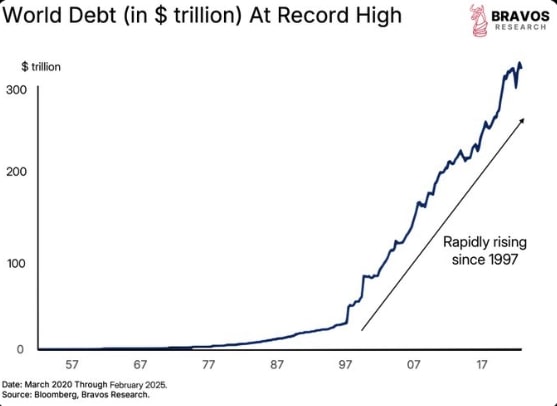
This exponential growth stems from the lax fiscal policies of governments and the monetary policies of central banks, which have encouraged massive indebtedness since September 11, 2001. We can see that the increase in debt is a process that began after 1971, when Nixon suspended the convertibility of the dollar into gold, which forced governments to adopt a certain rigor. This was followed by the Jamaica Agreements in 1973, which formalized floating rates.
Constantly growing public budgets to service the debt are putting pressure on the private sector, creating challenges for the younger generations. How can education prepare students to understand and influence this complex financial landscape?
State indebtedness: a cycle sustained by monetary policies
Public debt is growing all the time. States manage this burden by "rolling over" their debts: they issue new bonds on the financial markets to repay maturing debts, a mechanism facilitated by expansive monetary policies. Central banks, such as the US Federal Reserve (Fed) and the European Central Bank (ECB), maintained low or zero interest rates after the 2008 financial crisis, then extended these policies with interventions like Mario Draghi's "Whatever it takes" in 2012, often exceeding European budgetary limits, such as those in the Maastricht Treaty (debt limit of 60% of GDP).
This steady fall in rates until 2021 has stimulated a massive real estate bubble, with house prices rising disproportionately in countries such as the US, UK, and France - for example, median house prices in the US jumped 40% between 2012 and 2022, according to the Federal Reserve. This phenomenon has also inflated the value of financial assets such as stocks and bonds, benefiting above all the older segments of the population who already own these assets, such as retirees who own homes or stock market investments.
This monetary policy has encouraged massive public indebtedness, but the resurgence of inflation, linked to shocks such as the COVID-19 pandemic and the war in Ukraine, has forced rates to rise (e.g. Fed to 5.25% in 2023, ECB to 4%), making debt servicing (interest payments) more expensive. For example, countries such as France (113.8% of GDP) and Belgium (105.6%) have substantial debts and must now pay much higher interest rates, increasing budgetary pressure.
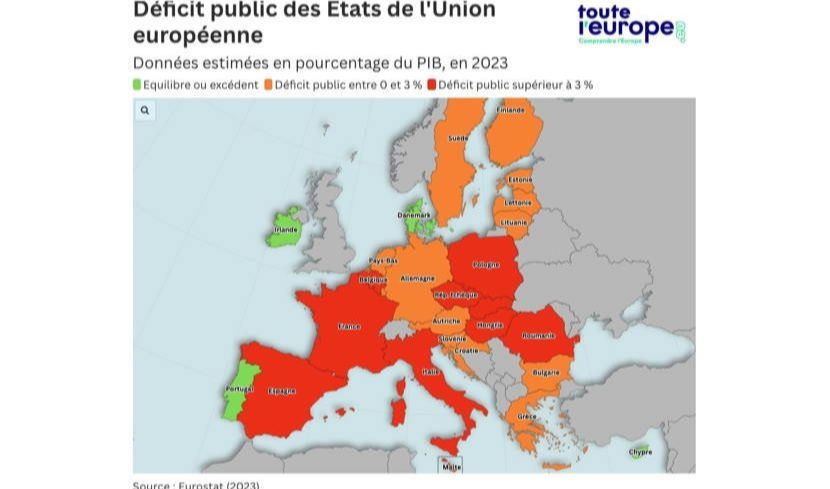
Public budgets, growing to absorb these costs, compete with the private sector by draining available capital, limiting investment in business and innovation. Deficits in France and Belgium peak at 5.5% and 4.2% respectively. Source
Added to this is the distrust of fiat currencies, illustrated by rising gold prices - from $1,800 an ounce in 2020 to over $3,100 in 2025 - reflecting concerns about the sustainability of this debt, adding a layer of complexity to the economic landscape.
Challenges for young people: a complex financial landscape
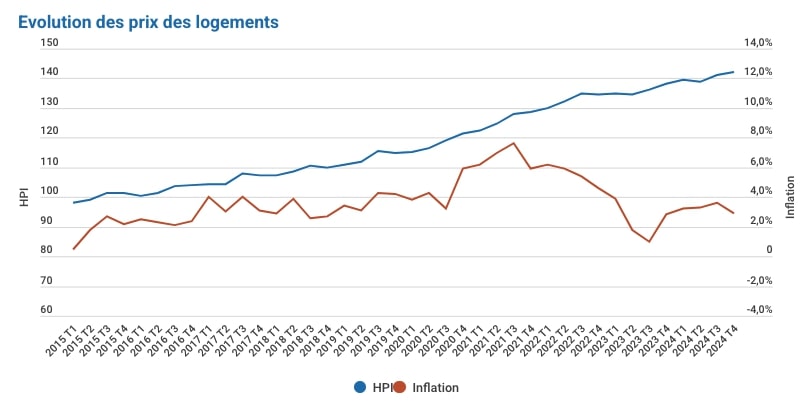
Younger generations face student debt, unaffordable mortgages and an economy where growing public budgets limit private sector opportunities. The property bubble, fuelled by low interest rates until 2021, has made home ownership increasingly difficult for young people, while older people who own homes or financial assets have seen their wealth appreciate considerably.
In Belgium,house prices have risen by 42% since 2015, making property purchases out of reach for many young people, who will now have to borrow at higher rates after 2021.
Against this backdrop, states are vying to attract foreign capital - sovereign wealth funds, institutions, investors - to refinance their growing debts. This competition may lead certain countries, perceived as risky (e.g. developing nations or fragile Europeans such as Greece in 2010), to issue bonds that will not find takers, risking exclusion from financial markets and a solvency crisis.
Financial markets, creditors and speculators exploit this instability, while digitization (crypto-currencies, DeFi) and rising gold prices further complicate the landscape. Distrust of fiat currencies, materialized by gold reaching historic highs, underlines economic uncertainties, making navigation even more arduous for young people without the right education.
The role of educational institutions: preparing for a world in debt
Schools and universities need to equip students for this complex financial landscape. This requires in-depth financial literacy: understanding debt rollover, the impact of low and then rising rates, real estate bubbles and asset valuations due to monetary policies, as well as the risks of debt with no takers(Lusardi & Mitchell, Financial Literacy).
Education must also explain how monetary policies since 1971, by maintaining low rates until 2021, have favored a real estate bubble and asset inflating, benefiting the older brackets, while analyzing the effects of growing public budgets on the private sector and the mistrust of fiat currencies, illustrated by rising gold prices (from $1,800 an ounce in 2020 to over $2,500 in 2025).
Practical simulations - such as workshops on budget management, case studies on the real estate bubble, competition for capital, or the effects of currency mistrust - and projects to promote economic reforms can prepare students. Education must offer them the tools to navigate and contribute to a sustainable financial system, balancing state interventionism and private dynamics, while taking into account the growing monetary mistrust signaled by gold.
4. Influencing the future: education as a driver of stability
Economic education can stabilize this system by training citizens to understand:
- fiscal policy,
- monetary policy,
- public debt management, debt rollover and the impact of monetary policies.
One major challenge remains: economic education. In Belgium, for example, students in transitional general education do not receive an economics course, unless they choose this option. This makes young people vulnerable, as they lack the tools to analyze complex economic realities, making them easy targets for extremist parties. These parties, by promising unrealistic measures such as early retirement, generous benefits or fully state-funded services, ignore budgetary and monetary constraints, such as growing public debts and rising interest rates.
To ensure the stability of the economic system, enhanced economic education is essential, but it must go hand in hand with state action: the state must reduce its spending, particularly its operating costs - such as administrative expenditure, increasing the scope of the public sector, or non-productive investments that are actually expenditure, in order to limit deficits and therefore the growth of public debts.
A thorough economic education, including courses on budgets, monetary policies, real estate bubbles and money, can prepare young people to evaluate policies and political party platforms, and vote as responsible citizens.
Conclusion
State and individual debts are on the rise, fuelled by state interventionism and low-interest-rate policies since 1971, then complicated by their recent rise, real-estate bubbles and asset valuations favoring older age brackets.
Growing public budgets weigh on the private sector, while distrust of fiat currencies, illustrated by rising gold prices (from $1,800 to $3,1500 per ounce between 2020 and 2025), adds a layer of complexity.
Education can equip students to understand, navigate and influence this system, by instructing in balanced monetary and fiscal policies. How can schools become levers for a sustainable economy, in the face of the risks of unpayable debt, a persistent real estate bubble, and monetary instability?
See more articles by this author