Young people denounce curricula that lead them to contribute to social and environmental disruption.
Publish at September 30 2025 Updated October 01 2025


In the collective imagination, libraries still often have the image of silent, dusty places, where books are kept en masse and access is reserved for scholars and students. This image has a tendency to persist, particularly in France, a country with a strong attachment to the notion of knowledge in the noblest sense, despite increasingly widespread, modern communication and high levels of library use.
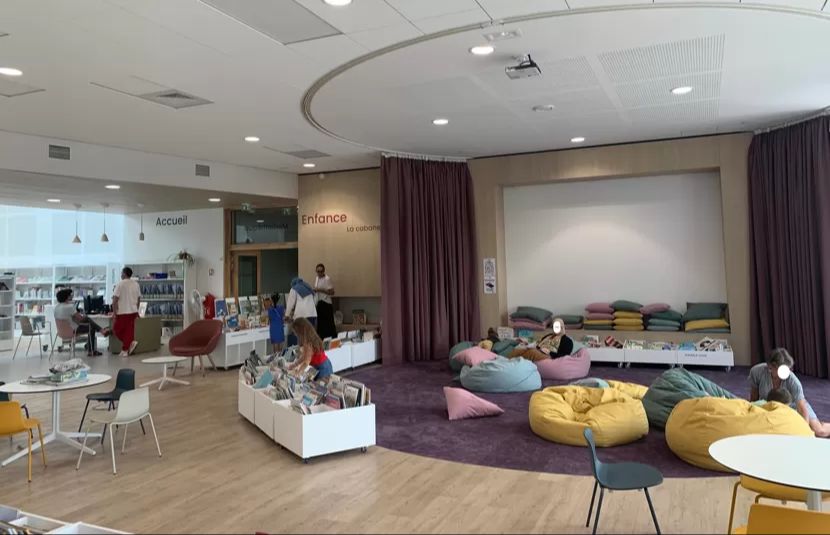
Nowadays, however, the library is first and foremost a place to live, a social space for discovery and encounters, open to all regardless of age or level of study, and free of charge.
At a time when theories about inward-looking attitudes abound, the library remains a formidable counter-example, a place of openness to others, a place of openness to the world. The open-air library is a cosmopolitan gathering place within the city, which observes, describes and dialogues with the world".
Sylvie ROBERT, Senator,
Report on library opening hours, November 2015
"The library, to tell the truth, is not on the scale of individual reading. To reach its critical threshold, the library needs to have many readers and many uses other than just reading. The library only exists through the community".
Michel MELOT, former Chairman of the Conseil supérieur des bibliothèques, 2004
French libraries today represent
The latter two report directly to the Ministry of Culture.
Local authority libraries had 6 million subscribers in 2024, and are used by almost 40% of the population of all ages.
University libraries recorded 66.5 million visits in 2023.
In terms of surface area, they range from less than 20 m2 in very small towns to tens of thousands of square meters for the largest establishments (almost 30,000 for the central library of the Lyon municipal network (BML), 54,000 for the Bibliothèque nationale de France (BNF)).
The grey literature is abundant on the subject of the library as a place. This question of place, however, has become more central in the last fifteen years or so, with the advent of the notion of the social role of libraries.
Up until the 1980s, the imagination saw any library of any size as a potential Library of Babel, providing access by definition to all human knowledge in printed form.
Buildings therefore divided their square meters between collection storage areas and spaces dedicated to borrowing and on-site reading, with the former occupying up to 80% of the total surface area, and lending often taking place without direct access to books (on request to librarians, after consulting the catalog). The library is a serious, silent place, dedicated to individual, intimate reading practices.
Over the next twenty years, with the democratization of access to music and cinema thanks to digital media such as CDs and DVDs, and the advent of the Internet, libraries saw the arrival of a host of new audiences, moving from an essentially individual, specific and restricted clientele to mass demand from a much more diverse public, with equally varied cultural backgrounds.
The number of group visits has grown (especially for schools), as has the range of services for young people, which had previously been very limited. We had to move to "open access", as indirect loan management was no longer possible in view of the volume of requests. Cultural programming has expanded, with librarians moving from the role of prescribing experts to that of mediators, the interface between the public and the knowledge resources available.
Political demand has also exploded, with libraries becoming a major public service in many communities, and their contribution to the attractiveness of the region increasingly recognized. Buildings had to be adapted, made larger and more visible, and offered more space for reception, reading and on-site work, as well as for cultural activities.
In 2010, French libraries adopted the concept of the "3rd place" (or, more generically, "tiers-lieu"), drawn from Ray Oldenburg's theories on the different spaces of socialization. According to this American urban sociologist, third places "welcome the regular, voluntary, informal and joyfully anticipated gatherings of individuals beyond the realms of home and work".
The question of the social role played by libraries thus became central for professionals. This conception of the role of the library developed in parallel in Quebec, in England with the Idea Stores in London, and in Scandinavian countries, starting with the Netherlands with the famous DOK in Amsterdam, with France following their example with a slight delay.
In France, this concept has mainly been deployed in local public libraries, but has also penetrated the academic world with the opening of Learning Centers, which emphasize peer-to-peer knowledge sharing and mediation.
Even if by no means all libraries have translated this vision into concrete reality, the library limited to the "place of books" or even to the "universal place of access to knowledge and culture" is now a dinosaur in the minds of all contemporary professionals.
Today's library is seen as a space for social integration and the strengthening of social ties, in addition to its role as a gateway to knowledge and culture, regardless of whether its users are individuals or groups, and regardless of the area in which it is located. Many library users no longer come to borrow documents, or even to read on the premises, but for a wide variety of other activities: seeing an exhibition, taking part in a debate, attending a concert, taking part in a creative workshop, practicing an artistic activity, learning about digital tools, surfing the Internet, dealing with administrative formalities online, learning how to write a CV, etc., but also meeting up, drinking a coffee, relaxing, playing games on their own or with others, sharing their reading and knowledge, contributing to solidarity projects, etc.
Nowadays, the number of "frequenters" (visitors) to libraries is considered to be more significant of their impact than the number of registered borrowers (or, as was the case before the 80s, the size of their collections).
The Ministry of Culture's latest in-depth study of library audiences (2016) indicates that only 39% on average of library users take out a registration card in order to borrow. Buildings have therefore grown even larger to facilitate discovery and encounters, but also individual and collective creation, sharing of all kinds and an ever-increasing diversity of uses.
"The evolution of the library is not only due to the evolution of reading media, but above all to the evolution of its role as a public space, and to the way in which new relationships to knowledge are inscribed within it".
Luigi Failla
Recent changes in the role of libraries have had consequences that professionals had not anticipated. For some staff, the job is no longer the one they had chosen. For some members of the public, fortunately few in number, this new library is no longer the one they want to visit. The shape of the library is no longer always easily identifiable by traditional criteria. Many missions are attributed to it, and there's a lot of fantasy about what it can/should provide.
"The library is the 'living-room of the city'".
Ray Oldenburg
"The library is not just a place in the world, but a place for understanding the world (which potentially contains it), a place where meanings are summoned".
Guy SAEZ, Observatoire des politiques culturelles.
"(The library) is a democratic place for debate and encounters with otherness".
Raphaëlle Gilbert
"(The library) is a space for strengthening social ties and warding off social disqualification".
Serge Paugam and Camila Giorgetti,
Des pauvres à la bibliothèque : enquête au Centre Pompidou,
Bibliothèque publique d'information, 2014
It is also said to be a warm and accessible place, open to more varied uses, that it is a "second home", that it is both a space for self-building and sociability, that it is a place for learning about citizenship and "living together".
We want it to be not only citizen-centric, but also eco-responsible, inclusive and participative, integrated into public policies and, above all, systematically multicultural, encyclopedic and universally accessible, and as free as possible. It's a challenge whose complexity you don't realize until you've faced it.
In an approach based above all on open-mindedness, inclusion and benevolence, the establishments inaugurated over the last fifteen years have sought to limit the rules governing use of the premises and simplify access to the various uses and services as much as possible. The idea was to bring together the most diverse publics, in terms of generations, social and ethnic origins, levels of education, etc., and to give them the freest possible access to multiple tools and resources.
Many then found themselves confronted, unprepared, with incivilities and tensions with members of the public who had not mastered this type of venue and practices, and were appropriating them in their own way. It should also be pointed out that, in the majority of cases, librarians were not familiar with these new places and their implications either, and needed to make them their own.
Staff therefore had to be trained in a new kind of welcome and in a mediation approach based on support rather than advice and prescription, a welcome and approach that above all required a great deal of pedagogy and new interpersonal skills (savoir-être). It was necessary to reflect, often with the public concerned themselves, on what these new multi-use public places should be, which had to be lived in harmony, respecting each other.
Library professionals, always adept at providing straightforward operational solutions and copying what is being done elsewhere, albeit without sufficient prior analysis, have gradually come to realize that there is no such thing as the obvious or the absolute truth, and that they need to constantly adapt to the political context, public expectations and behaviors, societal changes and technological upheavals.... Almost every establishment has had to find its own recipe.
As a place, the library now wants to offer a specific atmosphere and experience. It's no longer a question of offering standardized, timeless spaces, designed on the basis of statistical ratios. Each facility must define its own identity, with reference to the area in which it is located and the needs and expectations of the local population. Each facility knows that its service offering is likely to evolve fairly quickly to keep pace with cultural, social and educational needs, and that it now needs to be reactive and adaptable on a daily basis.
As a space shared by a variety of publics with fluctuating needs, the library must succeed in bringing together uses and publics, the search for intimacy and collective life, plurality and otherness, familiarity and strangeness.
The entirely silent library is no more, but there's no question of not offering this silence to those who seek it. We need to reconcile the possibility of meeting, talking or working with others, of playing noisily at times... with that of reading quietly, dreaming, concentrating, enjoying a moment of calm, relaxing alone among others.
To create the desire to use the space, we also need to offer both the familiar and the unfamiliar, which means defining what each of these notions means to each person.
"If anyone enters a library and finds nothing that is already familiar, then he or she is being told, I dare say violently, that this place is not for him or her".
Dominique LAHARY, from the Association des bibliothécaires de France and lecturer, 2003
The library is a place, but it's no longer, as it used to be, a bubble isolated from the world, unaware of the hustle and bustle of society. On the contrary, it's a place in dialogue with its urban, social and political environment. So, from now on, there's an interaction to be managed between the inside and outside of the library. From the 1980s onwards, librarians began to take so-called "out-of-home" initiatives, offering reading sessions in local neighborhoods, and events in retirement homes, day-care centers and institutions for the disabled. These were often one-off incursions, managed by a handful of specially-trained staff.
Today, the library is an integral part of its local community, with a growing number of partnerships of all kinds, setting up ephemeral venues not only in local neighborhoods, but also on beaches, in squares, at railway stations, in markets and at local events. It is organizing itself into collaborative networks in inter-municipal areas. It makes itself visible and part of people's daily lives. In some cases, residents have never been inside the library building, yet they regularly come into contact with the library in the places where they live.
It is said that one person's freedom ends where another's begins. Sharing a space without a sufficiently clear framework almost inevitably leads to disorder and conflict, since there is no such thing as self-evident in human communication.
Contrary to what some would have us believe, intuition and good will are not enough. So, to make it work, it's essential to draw up a project that precisely defines the missions and service offering in an intelligible way, and then to share this project widely with all the local players concerned, elected representatives and the public alike, staff and partners.
"The challenge is not to give concrete form to a service offering that meets perfectly objective needs based on average data calculated in proportion to the population. It's more a question of putting into space a political project anchored in a territory, as well as a certain conception of the missions and uses of the media library".
Raphaëlle Gilbert
We have to get rid of the implicit and establish a framework, both institutional and relational. In other words, we need to give everyone a set of instructions for using the facility, based on a sufficiently concrete and consensual foundation. Spaces and services must be made intelligible to all, which presupposes clarity about the community's objectives and a great deal of consistency in choices.
Republican elected representatives often wish to follow fashions or, if possible, precede them. Many of them, for example, have heard of the "3rd place" concept and wish to offer their fellow citizens, by building or modernizing their library, a place open to all, a modern social space, which meets all current and, as far as possible, future needs, and which at the same time contributes to the attractiveness of the region, and therefore to its economic development.
They can't be blamed for this, and in fact it's probably what our violent and unsympathetic society needs most today. They simply don't generally appreciate the implications in terms of reception management and staff skills, nor in terms of spatial organization and technical equipment, nor in terms of the dialogue that needs to be organized and supported between all the players in the area.
Sources
Antonutti, Isabelle. Les espaces d'une bibliothèque.
On line at: https: //bibliotheconomie.jimdofree.com/espaces-d-une-biblioth%C3%A8que/
Dujol, Lionel. The library, a home for the knowledge commons.
Online at : / : https://shs.cairn.info/communs-du-savoir-et-bibliotheques--9782765415305-page-35?lang=fr
Failla, Luigi. The library as public space. Espazium, 2017
Online at : https://www.espazium.ch/fr/actualites/la-bibliotheque-comme-espace-public
Gilbert, Raphaëlle. De quoi la bibliothèque est-elle le lieu? In: Penser la bibliothèque en situation de crise, ed. de la Bibliothèque publique d'information, 2022. Chap. 7.
Online at: https: //books.openedition.org/bibpompidou/2548
Inhabiting the library. Bulletin des bibliothèques de France, 2019.
Dossier thématique. https://bbf.enssib.fr/sommaire/2019/17
Oldenburg, Ray, Celebrating the Third Place: Inspiring Stories about the "Great Good Places" at the Heart of Our Communities, New York, Marlowe & Company, 2000
Pérès-Labourdette Lembé, Victoria. La bibliothèque quatrième lieu, espace physique et/ou en ligne d'apprentissage social : un nouveau modèle de circulation des savoirs. White paper. Agence Gutenberg 2.0, 2012.
Online at: https: //www.enssib.fr/bibliotheque-numerique/documents/56998-la-bibliotheque-quatrieme-lieu-espace-physique-etou-en-ligne-d-apprentissage-social.pdf
Schmidt, Aaron, Etches, Amanda. Useful, usable, desirable: redesigning libraries for their users. Presses de l'enssib, 2016. Downloadable from: https: //books.openedition.org/pressesenssib/1537?lang=fr
Servet, Mathilde. Les bibliothèques troisième lieu: une nouvelle génération d'établissements culturels. Bulletin des bibliothèques de France (BBF), 2010, t.55, n°4, p. 57-63. Online at: https: //bbf.enssib.fr/consulter/bbf-2010-04-0057-001
You might also like:
Young people denounce curricula that lead them to contribute to social and environmental disruption.
France is particularly keen on training seniors, with its new law to extend working life and raise the legal retirement age.
The urgent need for ecology at school
The climate issue is one of the most important in the population and is taught at school. Some consider that ecology is not a science but an opinion or an ideology. Ecological researchers are disturbed by this perception, when scientifically, the ecological crisis has been proven time and time again.
When doing is doing again: error analysis
It is not so much the error that is the problem, but the way in which we represent it... Ways to face the error well.
From Gaul to France, the evolution of the language of Molière
How did we go from Gaul to France? Why do we speak the language of Molière and not that of Victor Hugo? These are two questions that all French-speaking people who love their language and culture may ask themselves!