One of the most important things I've learned about translation is localization. It's an in-depth degree of translation that consists in taking into account a set of contextual data in order to make a suitable translation. These elements include
- cultural references,
- colors, images and illustrations used
- local jargon,
- adaptation of dates, times, currencies, units of measurement,
- local news,
to render the areas cited by Josh Gambin in his article entitled "What is localization in translation?
This data also needs to be taken into account when it comes to interpreting or public speaking. Speaking is universal, of course, but you can't express yourself in the same way in the West, Africa or Asia.
In this reflection, we're going to draw on a training course we've developed on "How to adapt public speaking when you're in Africa" to give our readers some tips.
When preparing to speak in public, it's always important to find the answers to the following questions: What? Who? How? Africa, like all other parts of the world, is attached to cultural values that are codes to be respected. So, to better localize your speech and better reach your objectives or target, you need to take a few facts into consideration.
1-Clothes don't make the man, but you can tell a man by his clothes
Let's start with physical appearance. At the 2019 graduation ceremony at Senghor University, OIF Secretary Louise Mushikiwabo took to the stage wearing a veil. Yet she is not of the Islamic persuasion. But to further establish her legitimacy and make herself heard, she adapted her mode of dress to that most popular in Egypt. Most women are veiled. Of course, not all the university's students are of the Islamic persuasion. Moreover, Muslims did not make up the majority of students, so her attire was more geared towards the non-student public, mainly made up of the many Egyptian authorities in the room.
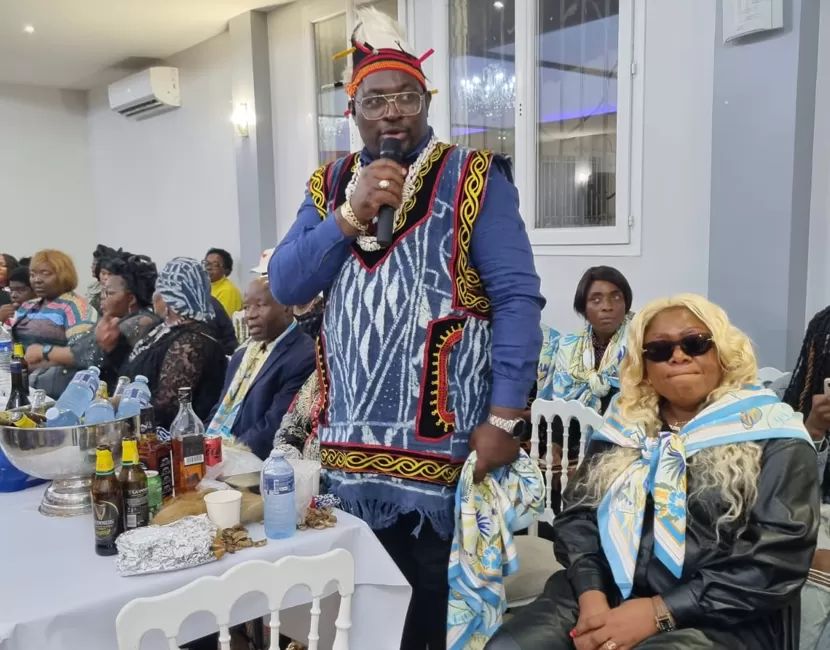
In Cameroon, especially in Bamiléké country, don't appear before an audience that includes a king, a notable or any other person with chieftaincy or kingdom functions dressed in Ndop without being authorized to do so. Ndop is a sacred cloth that is not worn by everyone. The habit doesn't make the monk, but in Africa, the monk is recognized by his habit. It's important to take your audience into account when dressing, and not just your clothes, but also your posture.
2- Take your hands out of your pockets
On the African continent, the birthright is very much alive. In fact, in many families, speech is controlled by the elders. In order to express themselves, younger siblings must have permission, or at least ask for it. Outside family circles, respect is the rule.
In a room where there are elders, or people older than you, don't express yourself with your hand in your pocket, as is possible in certain Western contexts. At certain eloquence competitions where I've been a judge, I've noticed that French, Swiss or American speakers sometimes express themselves with their hands in their pockets. My fellow jury members had no problem with this, and I had to get used to it. But in Africa, that's not possible. It's a sign of disrespect.
3-Avoid head coverings
A head covering is a fashion accessory worn on the head. By extension, it includes hats, caps, bonnets, etc. They are tolerated in many European contexts, but in Africa, if you're in front of people older than you, the first thing you'll be accused of is being disrespectful to your listeners. So don't wear a hat. Women, on the other hand, can. It's tolerated in their case, but unacceptable for a man.
4-Choosing the right vocabulary
Choosing the right vocabulary doesn't just mean choosing words specific to the subject of your performance. It's about words that once again reflect propriety. For example, many African languages do not use the formal form of address. On the other hand, it does exist in the Latin languages that arrived as a result of colonization, notably Spanish, French and Portuguese. As a result, in African countries where these languages are used, the use of the formal form of address towards elders, bosses or people who are socially above the speaker is very common, yet it is disappearing in the countries where these languages originated. In France, pupils and students are on a first-name basis with their teachers, which is not the case in Cameroon, Côte d'Ivoire, Togo, Equatorial Guinea and elsewhere.
5-Speak graphically to connect with the audience
Marc Bloch, in a book about formal and informal language in Africa, notes the strong imagery content of these languages. Africans use a lot of proverbs to express themselves. As an illustration, a debate eloquence match organized as part of the Pan-African Debating Cup, which can be found on YouTube, reveals the strong presence of proverbs among the Cameroonian and Chadian orators facing off. Chadian captain Mahamad consults a Cameroonian proverb to support his prose: "a field without a fence is trampled by an elephant"; as does Cameroonian Eden, who invokes a Gabonese proverb: "the river takes detours because nobody shows it the way".
6-Don't talk about everything!
Whether you're a businessman, politician or religious figure, once you're in Africa, be careful about what you talk about. It's not only in Africa that there are taboo subjects, however, it's important to be aware of the taboo subjects in Africa and avoid them as much as possible. One of the most sensitive is homosexuality. If you want to talk about it, make sure that the context or audience is able to understand your speech and your intention.
When we look at these few elements of public speaking in Africa, we can already deduce that it is based on so-called African values. Some are certainly the result of colonization, but as Phillipe Garique so aptly puts it, "The first trait common to all values is that there is a particular resistance in the mind to abandoning them once they have been accepted. The second is that the mind has always resisted novelty" (1958: 426).
So, as long as these prohibitions or elements have long been part of the African way of doing things, there's no point in trying to transgress them when you're thinking of expressing yourself on African soil.
Illustration: Mohamed Hassan - Pixabay
Bibliography
Garique, Philippe, (1958), Les changements sociaux et les valeurs culturelles, L'Actualité économique, Vol.34, N0 3, pp ; 426-435, https://doi.org/10.7202/1001332ar
Gambin , Josh (2020), "What is localization in translation?", https://altraductions.com/blog/quest-ce-que-la-localisation-en-traduction
See more articles by this author