The neutral mask, a tool for self-awareness and body appropriation
Disassociating yourself from your everyday persona
The history of the neutral mask, then known as the "noble mask", began at the Vieux-Colombier school, founded by Jacques Copeau in Paris in 1913. Actor, director and teacher Jacques Lecoq, founder of the famous international theater school of the same name, took up the idea in the 50s and turned it into a teaching tool.
While the neutral mask continues to be used in the training of actors and clowns, more recently it has also become a therapeutic tool for self-discovery and relationships with others, involving the body and emotions in movement.
Jacques Copeau, Lessons from the neutral mask
For Jacques Copeau, its creator, the noble mask is a fundamental learning tool in several areas essential to the actor's training.
The ability to step outside oneself
Detach yourself from your ego. Wearing a mask enables you to dissociate yourself from your everyday persona, the role you play more or less consciously all the time in order to relate to others, your so-called "personality". The mask is a form of identity protection that disinhibits.
QUOTE - "Putting on a mask is in itself a decisive psychological experience for the actor. The mask has an important effect on behavior. It is felt as an element of protection as well as expression". Guy Freixe
Listening to gesture
The mask requires physical integration. Movement must be concentrated and rigorous. Conscious emotions are highlighted by the simplicity and precision of gestures. Without an intense presence of emotion and gesture, the masked actor expresses nothing sincere, and cannot truly enter into a relationship with his partner and audience.
The musicality of the body on stage
The masked actor is a silent, infinitely graceful dancer. He is fully embodied in his body, and relies on his breathing to shape and tune his gestures. Every step, large or small, every tilt of the head, every twitch of a finger carries an intense meaning. The actor's gestures are as precise as the notes of a score being written as he goes along.
QUOTE - "The mask unites the actor with the organic rhythm of breath". Guy Freixe.
Chorality
Because they are fundamentally listeners, and exist only in relationships, masked actors naturally act as part of a collective. He's part of a whole, like one of those birds that dance together in the sky on certain evenings.
QUOTE - "(the mask) is the natural ally of the chorus, which seeks the homogeneity of a collective body". Guy Freixe.
Jacques Lecoq, Silence before Speech
Detachment from self-image allows inner feelings to emerge. Listening attentively to what's going on inside, combined with the embodiment of the body, enables authentic expression that creates a link. There's no need for words to understand each other in contact with others.
The mask protects and unifies. All actors have the same face, whatever their culture or skin color. All that remains beneath the mask is the unique vibration of each actor's presence in the world. Jacques Lecoq spoke of "essentialization", a simplification and densification of presence.
QUOTE - "Under a mask, the face disappears and we see the body. The body becomes a face". Jacques Lecoq.
Ariane Mnouchkine, "The mask is humanity in its quintessence".
The mask acts like a magnifying glass, and every movement, no matter how small, suddenly takes on unprecedented force. The actor must choose his gestures with great precision to make them legible and meaningful. Every ordinary gesture must become a "stage poem". The aim is to free oneself from everyday gestures and realistic attitudes.
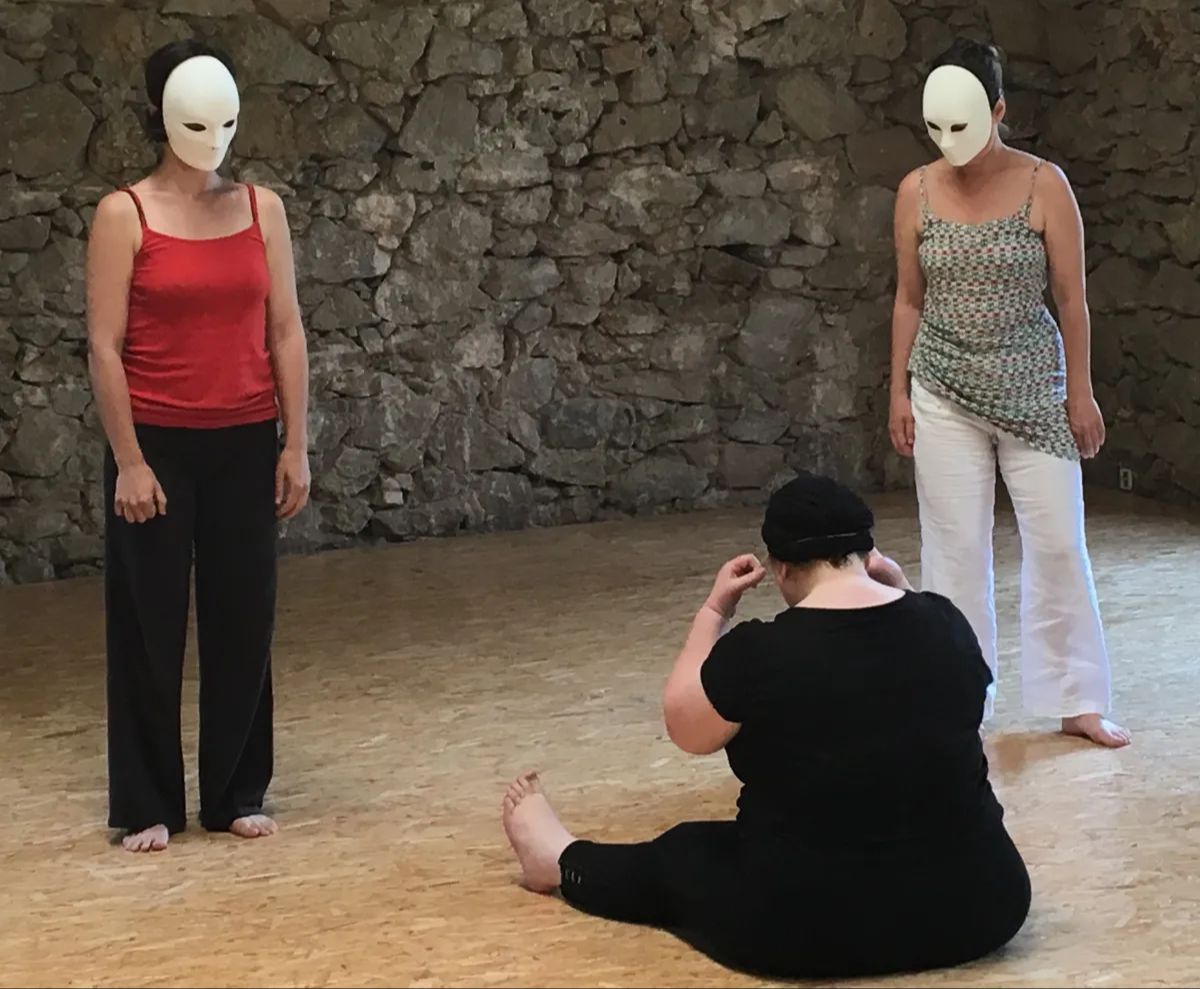
The narrow opening that frames the eyes prevents the gaze from operating at 180°. The head has to follow to be able to see. This emphasizes the direction of the gaze, making it more powerful. It also emphasizes intention. Walking cannot be hesitant. It cannot fluctuate from second to second, with no defined intention. Here again, the intention must be clear, the directions straight, the angles too. We make the space our own before taking it over. We are attentive to the moment when the gesture begins, takes shape, then ends. You punctuate it with your gaze and address your partner or the audience, to reinforce its meaning.
Through this rigor of gesture and intensity of presence, we manage to express without words what is most intimate, the very truth of our feelings. The fluidity of this passage between inside and outside, between feeling and its expression through the body, remains mysterious. It's a grace, a connection with the invisible.
For Ariane Mnouchkine, the actor can only serve his art by drawing on his own experience, his sufferings and his joys. The practice of the neutral mask obliges him to do this, while offering the protection that allows him to express his feelings.
What does it really mean to be neutral?
It's clearly a question that needs to be asked, in a society where positioning and self-assertion are permanent injunctions.
QUOTE - "Neutrality is not the absence of expression, emotion or feeling. It's a state of availability". Cathy Bouesse, L'Intranquille compagnie.
QUOTE - "Because no body is neutral, we all carry within us, visibly, for those who know how to look, our own emotional history, inscribed in our flesh, our bodily rhythm and our posture". Den, theatrical mask maker
Neutrality in dramatic art means "non-playing". We don't force anything, we don't create a character. You let the situation, the space, the interaction with your partners and the audience decide what's going to happen. We let ourselves react to proposals without planning anything in advance. The story is written in the moment, rich with unexpected twists and emotions. The key is availability. We "empty" ourselves to make room, sometimes apprehensively, for the encounter and the unimagined.
The practice of the neutral mask: (re)learning to be present in the world
For the average person, a neutral mask is "just" a mask with no defined expression, made of plastic or papier-mâché, usually white, with cut-out eyes and a fixed mouth, always closed. It's hard to imagine the amount of prior knowledge and body re-learning required to use it.
When the neutral mask is used in personal development, no rules or instructions are given beforehand. Indeed, to a certain extent, it's possible to discover its power through simple experimentation.
In a silent dialogue between two people, for example, if a dominant/dominated power relationship is to be established, it quickly becomes apparent. The gaze emphasized by the tilt of the head cannot be ignored, and neither can the intention behind it. Everything is said there, and is fully visible to those observing the play, sometimes even before the actors themselves are aware of it.
When practiced in depth, the neutral mask is governed by a very precise language, defined by a number of rules.
Improvisation: dialogue takes place in the moment, with what's there, inside the actors and in the presence of the audience.
Listening: attention to oneself and to others is the basis of the performance.
The gaze carries the intention and conditions the movement.
Movement is decomposed to be legible. It is supported by a clear rhythm.
We take turns expressing ourselves. When one moves, the other watches, then reacts.
Each movement (each "phrase") is addressed to the other, as a call or response.
Eye contact with the audience is never lost. When two people are performing, one looks at his or her partner, while the other looks at the audience. When there are more than two actors, at least one always looks at the audience.
It's all about taking over the space, finding your place in it, never alone, always in relation to the other(s). An invisible thread links all the actors together.
Freeze-frames are used to give strength to the message. The masked actor takes the time to underline his intentions with conspicuous pauses.
It's a sometimes laborious apprenticeship, requiring us to unlearn many things, to abandon our beliefs and certainties in order to welcome the unknown.
We then discover that any relationship lived in trust and in the presence of self and other is an adventure in itself, a leap into the void. Silence can be burdensome, the extreme precision of gestures can seem tedious, the impossibility of looking without being seen can be difficult to live with.
Little by little, supported by the constraint of this very firm framework, the inner truth emerges from its limbo and reveals itself for all to see. This, in particular, can make the experience at best disconcerting and sometimes painful, but just as much or no more so than any in-depth work on oneself.
The value of using spectacle to teach and facilitate learning lies in the connection between attention and reflection. An environment where play stimulates without manipulating, where AI supports without short-circuiting effort, where immersion opens up an experience without eliminating reflection, and where personalization does not erase the contribution of the collective.
Exaggerated use of figures to evaluate the quality of a training course makes us miss "what cannot be measured". We question the qualitative dimensions of the Wow! Effect by presenting the advantages and limits of this marketing invention.
Agriculture, characterized by the intensive use of chemical inputs, has long been presented as the guarantor of food security. Today, this model is proving incapable of guaranteeing stability. The multiple responses to today's challenges provide much more than just food.